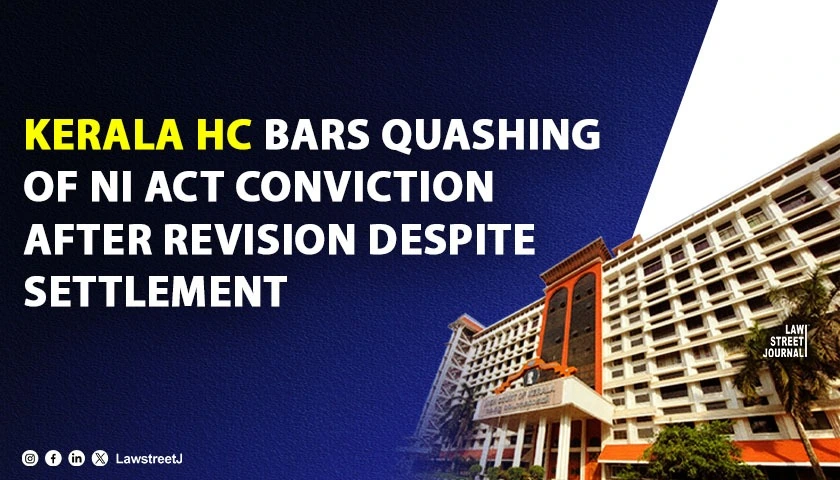
Kerala: The Kerala High Court has held that the inherent powers of the High Court under Section 528 of the Bharatiya Nagarik Suraksha Sanhita (BNSS) cannot be invoked to set aside a conviction and sentence under Section 138 of the Negotiable Instruments Act once the High Court has already finally decided the case in revision, even if the parties subsequently arrive at a settlement.
Justice C.S. Dias delivered the judgment while dismissing a criminal miscellaneous case filed by FIFA Builders Pvt. Ltd. and its Managing Director, seeking to quash their conviction under Section 138 of the Negotiable Instruments Act, 1881.
The petitioners were convicted and sentenced for an offence under Section 138 of the NI Act by the Judicial Magistrate of First Class-I, Ernakulam. The conviction was confirmed by the Additional Sessions Court in appeal and thereafter by the High Court in a criminal revision petition in 2005.
After the dismissal of the revision petition, the petitioners again approached the High Court by invoking its inherent jurisdiction under Section 528 of the BNSS. They sought quashing of the conviction on the grounds that they were unaware of the dismissal of the revision petition and that the dispute had since been amicably settled between the parties. According to the petitioners, they became aware of the dismissal only when the second petitioner was arrested and remanded to judicial custody. Subsequently, the second petitioner settled the dispute with the complainant, who executed an affidavit stating that he had no objection to the conviction being set aside.
The petitioners relied on the High Court’s decision in Mubasheer v. State of Kerala and the Supreme Court judgment in Gian Chand Garg v. Harpal Singh, contending that convictions under Section 138 of the NI Act have been quashed even at the post-revisional stage.
The Court noted that in an identical situation, a Single Judge in Sabu George v. Home Secretary had taken the view that there was no legal prohibition on the exercise of inherent powers to set aside a conviction even after the post-conviction stage. However, doubting the correctness of that view, the matter was referred to a Division Bench.
In Sudheer Kumar alias Sudheer v. Manakkandi M.K. Kunhiraman, the Division Bench held that once the High Court confirms a conviction in revision, it cannot be interfered with on the basis of subsequent compounding outside court. The Division Bench further held that there is no provision under Section 320 of the CrPC or the NI Act enabling a court to accept or permit compounding after a conviction has become final and no appeal or revision is pending.
The Division Bench observed that compounding of offences may take place when the case is pending before the trial court, appellate court, or revisional court, but not after the revision petition has been disposed of. Section 362 of the CrPC, now Section 466 of the BNSS, bars a court from altering or reviewing its judgment after it has been signed and a final order has been passed, except for correcting clerical or arithmetical errors.
The Court also relied on the decision in Sreedharan v. Bharathan, where another Division Bench held that post-revisional compounding is impermissible even by invoking Section 482 of the CrPC, now Section 528 of the BNSS, as such an exercise would amount to setting aside a conviction and sentence that has already attained finality, thereby violating the bar under Section 362 of the CrPC.
With respect to Mubasheer, relied upon by the petitioners, the Court observed that the decision was rendered without considering the binding principles laid down in earlier Division Bench judgments on the issue. Justice Dias held that the decision in Mubasheer was rendered in the peculiar facts of that case and should not be treated as laying down a general legal principle.
The Court further noted that the Supreme Court decision in Gian Chand Garg permits compounding of offences in a disposed criminal revision petition only in specific circumstances and does not support the petitioners’ contention in the present case.
In light of settled legal principles, the Court held that once a criminal revision petition has been finally decided by the High Court, inherent powers cannot be invoked to set aside the conviction and sentence on the basis of a subsequent settlement between the parties. Once a judgment attains finality, the High Court lacks jurisdiction to entertain an application for compounding or to quash the conviction.
Accordingly, the criminal miscellaneous case was dismissed as not maintainable. The Court clarified that the dismissal was without prejudice to the petitioners’ right to pursue any other remedy permissible under law.
Case Title: FIFA Builders Pvt. Ltd. and Another v. State of Kerala and Another



![Kerala HC Quashes 498A Dowry Harassment Case Against Live-In Partner, Citing Lack of Relative Status [Read Order]](/secure/uploads/2023/08/lj_5693_1057c042-1e57-4e27-8c9e-25af0ec38ec4.jpg)
![Watching porn on mobile: Kerala HC highlights importance of mother cooked meals, outdoor sports [Read Order]](/secure/uploads/2023/09/lj_9155_Parental_supervision_of_mobile_phone_usage.jpg)
![Lakshadweep MP Mohammed Faizal Disqualified from Lok Sabha After Conviction Suspension Plea Rejected by Kerala High Court [Read Notice]](/secure/uploads/2023/10/lj_9640_87b5fd97-0e05-4ff8-9a99-3be1e4446192.jpg)