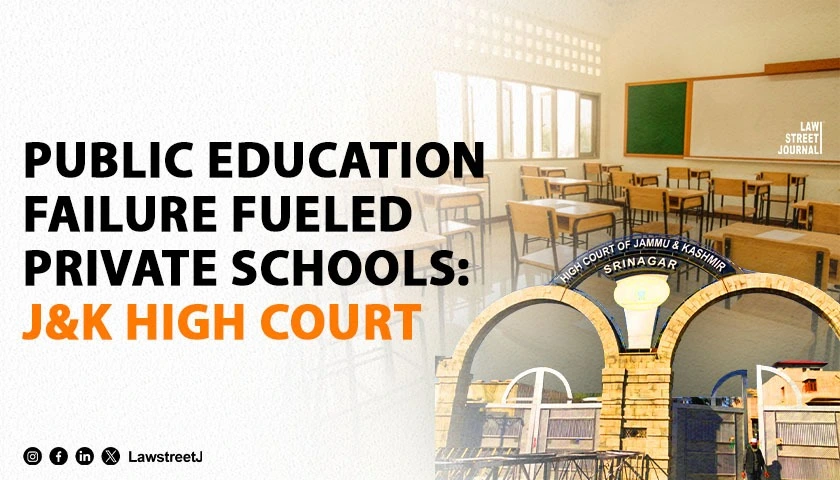
Jammu: The Jammu and Kashmir and Ladakh High Court has delivered a significant judgment upholding the validity of fee regulation mechanisms for private schools, while making critical observations on the state of public education and directing modifications to ensure judicial independence in the regulatory process.
Justices Sanjeev Kumar and Sanjay Parihar made crucial observations on the role of private education and the failure of the public education system while examining challenges to government orders regulating private school fees.
The Court was hearing Writ Petition (C) No. 1070/2022 filed by seven private schools challenging government orders establishing the Committee for Fixation and Regulation of Fee of Private Schools. The Court noted, “This petition, filed by the petitioners–private schools under Article 226 of the Constitution of India, seeks to challenge the following orders.”
Addressing the growth of private education in the region, the Court observed, “It is an undeniable fact that private schools have come to play a significant role in school education in India. Various factors, such as the increasing demand for quality education, the expansion of the middle class, and the perceived inadequacies of the public education system, have contributed to this trend.”
Highlighting the critical failure of public education, the Court stated, “The mushroom growth of private schools in Jammu and Kashmir, like in many other States, is largely a result of the failure of the public school education system. Private schools have outperformed public schools in terms of students’ learning outcomes and in providing basic infrastructure such as classrooms, toilets, and drinking water facilities.”
In a particularly striking observation, the Court remarked, “The public education system in the Union Territory has virtually collapsed and, in any case, is not coming up to the expectations of the citizens. Even the poorest of the poor longs to send his children to private schools with the hope that they would get better education which may help them come out of poverty.”
Acknowledging the reality of private education’s role, the Court observed, “We must, therefore, live in reality, and the reality is that the private education system, which was envisaged to supplement the educational needs of the citizens, has virtually come to supplant the public education system.”
Referring to the constitutional framework, the Court noted, “Article 41 of the Constitution of India casts an obligation on the State to make effective provision for securing, inter alia, the right to education within the limits of its economic capacity.”
On the balance between regulation and autonomy, the Court stated, “The Supreme Court has already permitted educational institutions to collect fees in a manner that generates sufficient surplus annually to expand infrastructure and provide better facilities. It is high time the Government also recognises the right of a person who has made huge investments in terms of money and time to establish a private educational institution without any support from the Government to derive reasonable profits.”
Clarifying the distinction between profiteering and legitimate returns, the Court held, “The term ‘profiteering’ does not mean that educational institutions must be run on a no-profit, no-loss basis. Profiteering is a practice of making or seeking to make an excessive or unfair profit.”
The Court also made critical findings regarding the composition of the Fee Fixation Committee, observing that “Section 20A, insofar as it provides that the Chairperson of the FFRC shall be a retired Judge of the High Court or a retired Government Officer of the rank of Financial Commissioner or above in the Union Territory of Jammu and Kashmir, is against the mandate of the judgment rendered by the Supreme Court in Islamic Academy of Education and Modern School.”
Issuing a key directive, the Court noted, “Learned counsel for respondents Nos. 1 and 2 has virtually conceded this position during the course of arguments and, therefore, they shall do well to substitute sub-section (2) of Section 20A by providing as under: ‘The Committee shall be headed by a Chairperson who has been a Judge of the High Court, to be nominated by the Chief Justice of the High Court of Jammu and Kashmir and Ladakh.’”
On transport fee regulation, the Court directed, “We hasten to observe that, to begin with, the FFRC shall constitute a committee which must, inter alia, comprise the Commissioner/Secretary to the Government, Transport Department, and the Commissioner/Secretary to the Government, Consumer Affairs and Public Distribution, to examine the issue and make recommendations for laying down broad guidelines for fixation of transport fees to be charged by private educational institutions.”
Before concluding, the Court urged regulatory reform, stating, “Before parting, we wish to implore the Government of the Union Territory of Jammu and Kashmir to give a fresh look to the Fee Fixation Regulations, 2022, so as to bring them in tune with the observations made in this judgment.”
Addressing the economic realities of private school establishment, the Court observed, “The establishment of a private educational institution is undoubtedly an occupation pursued by citizens by investing their money, time, and labour, and it would be like living in a fool’s paradise to think that such citizens, who have invested their life and property to raise an educational institution, are doing so only for the sake of charity.”
The Court further noted, “There may be some sincere efforts made by the Government to revamp the public education system, but such efforts are not showing any visible results on the ground.”
Accordingly, “The writ petition is disposed of in the above terms.”
Senior Advocate N.A. Beigh, along with Mr. Mohd. Murshid Rashid, appeared for the petitioners, while Mr. T.M. Shamsi, DSGI, along with Ms. Shagufta Maqbool, appeared for respondents Nos. 1 and 2.
Case Title: New Convent High School, Gogji Bagh, Srinagar & Others v. Union of India & Others


![Publicly slapping wife does not constitute outraging modesty: J&K HC [Read Order]](/secure/uploads/2024/02/lj_7549_husband-slapping-wife-publicly.webp)
![Jammu and Kashmir High Court Grants Bail To Gang Rape Accused, Emphasizes Presumption Of Innocence [Read Order]](/secure/uploads/2024/05/lj_6000_5007a767-4748-4bed-9dab-8fa14a4d262b.webp)
![Mere involvement of relatives in anti national activities in the past can not be a ground to deny Govt contracts: J&K and Ladakh HC [Read Judgment]](/secure/uploads/2024/06/lj_3301_79dd6df6-5b62-4057-8762-d0e460af98e6.webp)