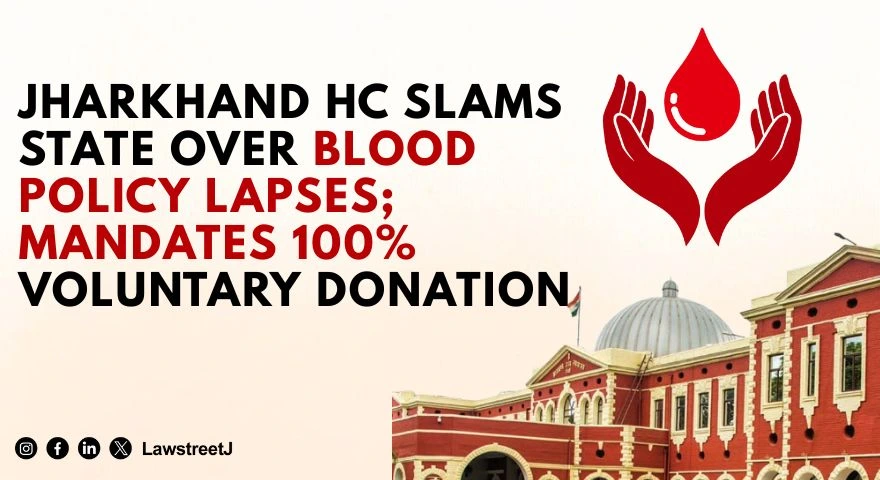
Jharkhand: The Jharkhand High Court has issued comprehensive directions to ensure implementation of the National Blood Policy, mandating that 100% of blood collection be secured through voluntary blood donation drives and directing the establishment of Blood Component Separation Units in every district within three months.
Chief Justice Tarlok Singh Chauhan and Justice Rajesh Shankar were hearing a batch of Public Interest Litigations, including W.P.(PIL) Nos. 6062 of 2025, 2971 of 2020, 2413 of 2021, and 4688 of 2025, concerning the failure of State authorities to implement replacement-free blood transfusion and related healthcare facilities.
At the outset, the Court expressed deep dissatisfaction with the State’s performance, observing:
“Though this Court is seized of this matter for more than four years in W.P.(PIL) No. 2413 of 2021, we have no hesitation in observing that the respondent-authorities have failed to implement Objective 8.5 of the National Blood Policy with respect to replacement-free blood transfusion in the State of Jharkhand.”
The Court noted that the decision to implement replacement-free blood transfusion “has been reaffirmed by the State Blood Transfusion Council (SBTC) in its various meetings, particularly dated 14.09.2017, 15.01.2018, 03.04.2018, 09.03.2018, and 31.10.2025,” yet remained unimplemented.
Identifying a fundamental violation of transfusion guidelines, the Court stated:
“Even Clause 2.1 of the Transfusion Guidelines, which categorically stipulates that relatives of patients should not be asked to arrange donors or blood, has not been followed till date, as it is only the relatives of the patients who are asked to arrange donors or blood.”
Criticising private healthcare facilities, the Court observed that “private hospitals/blood banks have not adhered to the condition of organising voluntary blood donation camps to cater to their respective demands and to provide safe blood to patients.” The Court noted that directions issued through letters dated August 24, 2018, November 20, 2018, and April 16, 2019, by the Secretary, Department of Health, and the Chief Medical Officer-cum-Civil Surgeon, Ranchi, “have fallen on deaf ears.”
Examining data furnished by the State, the Court found alarmingly low voluntary donation rates. It noted:
“Even in the counter affidavit dated 13.11.2025, the respondent-State has furnished data with respect to the number of blood donation camps organised by private entities over the last three months (July 2025 to September 2025), which indicates that only 13% of the total blood collection in July 2025 was secured through voluntary blood donation.”
While there was marginal improvement, with the rate “marginally increasing to 15–22% in August 2025 and 25% in September 2025,” the overall situation remained dismal. The State’s counter affidavit dated December 16, 2025, stated that “only 15% of blood collection is made through voluntary means.”
The Court identified serious deficiencies in Day Care Centres across nine districts, noting that reports revealed:
- essential drugs such as Iron Chelators and Hydroxyurea are not available;
- no data has been furnished regarding the availability of packed red blood cells; and
- the data does not specify whether the medical practitioners deputed in the said Day Care Centres are trained to treat patients suffering from Thalassemia and Sickle Cell Anaemia.
Expressing frustration over non-compliance with earlier directions, the Court observed:
“If this was not enough, the respondents also failed to comply with the order dated 26.02.2018 passed in W.P.(PIL) No. 3700 of 2015, whereby the respondent-State had submitted that Blood Component Separation Units (BCSUs) would be established in every district during 2018–19; however, till date, no such unit has been established in the State of Jharkhand.”
The Court found the State’s helpline infrastructure inadequate, observing:
“What compounds the issue further is that the toll-free helpline number provided by the respondent-State, i.e., 104, does not have any provision to register grievances or to provide any real-time assistance for arranging blood for patients in need.”
Highlighting staffing deficiencies, the Court noted:
“There is a lack of manpower in blood banks, as evident from paragraph no. 16 of the supplementary counter affidavit dated 16.12.2025. There is an absolute lack of manpower in all blood centres across the State of Jharkhand.”
The Court further pointed out that “in all blood banks, only one Medical Officer is deputed, in violation of the recommendations made by the Expert Working Group,” which mandates 2–8 Medical Officers depending on annual blood collection, along with counsellors, registered nurses, and blood centre technicians in specified numbers.
It was also observed that “regular inspection of blood banks is not carried out quarterly, which is mandatory as per the SOP issued by the Department of Health, Government of Jharkhand.”
Finding the circumstances to warrant immediate intervention, the Court stated:
“In the given circumstances, we deem it appropriate to issue the following directions.”
Accordingly, the Court directed that the Department of Health and the State Blood Transfusion Council (SBTC) “ensure that 100% of blood collection is secured through voluntary blood donation drives.”
Addressing private sector responsibility, the Court directed that “all private hospitals and blood banks conduct blood donation drives to meet their respective demands.”
On infrastructure development, the Court ordered that “Blood Component Separation Units (BCSUs) be established in every district of the State of Jharkhand within a period of three months.”
Regarding Day Care Centres, the Court directed authorities “to make all Day Care Centres fully functional in accordance with the National Health Mission Guidelines on Hemoglobinopathies in India (2016) and the Guidelines for the National Programme for Prevention and Management of Sickle Cell Disease (2023).”
On grievance redressal, the Court directed the establishment of “a separate dedicated grievance redressal mechanism, including a mobile application, website, and toll-free number, to provide real-time assistance for the arrangement of blood (without replacement) and to enable registration of grievances.”
Finally, concerning inspection and staffing, the Court directed authorities “to conduct inspections of all blood banks in the State of Jharkhand every three months and ensure the availability of adequate manpower as recommended in the Report of the Expert Working Group of the DGHS (F. No. 18-85/2018 dated 10.01.2019).”
The matter has been posted for compliance on March 20, 2026.
Mrs. Khusboo Kataruka appeared as Amicus Curiae along with Advocate Shubham Kataruka. Mr. Atul Gera appeared in person. Mr. Gaurav Raj, Assistant to Additional Advocate General-II, appeared for the State, while Dr. A.K. Singh appeared for RIMS, and Md. Shadab Ansari appeared for the intervenors.
Case Title: Court on its Own Motion v. State of Jharkhand & Ors.


![Supreme Court Collegium approves new Chief Justices for five key High Courts in India [Read Recommendations]](/secure/uploads/2023/12/lj_8000_380d1135-6f3a-4988-a00a-4d5cd5901815.jpg)
!['Arbitrary, impermissible,' SC quashes HC's resolution raising aggregate cut off marks on district judges appointment [Read Judgment]](/secure/uploads/2024/02/lj_3605_Rule-for-Judge-Selection.webp)


.jpeg)