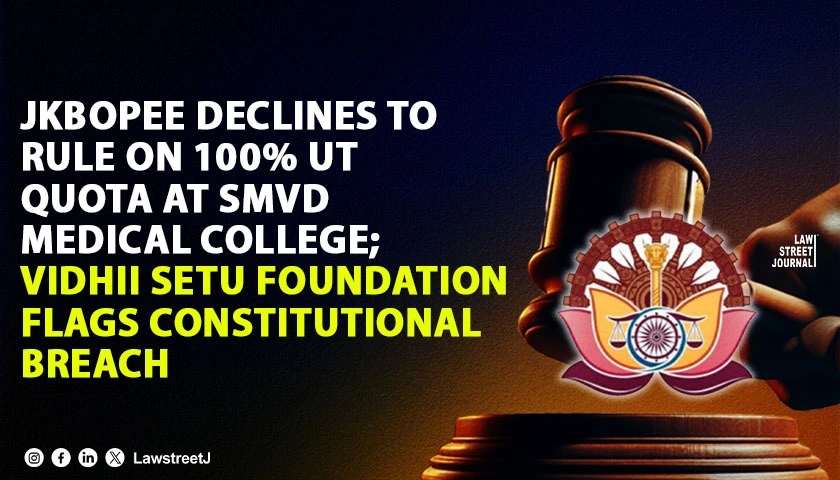
Jammu: The Jammu & Kashmir Board of Professional Entrance Examinations (JKBOPEE) has declined to address the legality of the 100 per cent Union Territory (UT) quota imposed at the newly established Shri Mata Vaishno Devi Institute of Medical Excellence (SMVDIME), triggering sharp criticism from legal experts and civil society groups.
The development came to light through a formal response issued by JKBOPEE to the Vidhii Setu Foundation, which had raised objections to the admission policy of the medical college. The Board stated that issues relating to policy decisions, including reservation and recognition, do not fall within its jurisdiction, and that its role is confined strictly to statutory functions.
The controversy traces back to a legal representation served on November 13, 2025, by the Vidhii Setu Foundation on the Shri Mata Vaishno Devi Shrine Board and JKBOPEE. The Foundation argued that SMVDIME was constructed entirely through donations made by Hindu devotees from across the country—amounting to hundreds of crores of rupees—and not through public exchequer funds. On this basis, it contended that treating the institution as a state-controlled asset and reserving all seats for local residents of the Union Territory violates the constitutional rights of the Hindu minority.
In its reply dated December 9, 2025, JKBOPEE refused to engage with the constitutional and legal issues raised, asserting that it neither formulates nor adjudicates such policies. This stance has been described by the Foundation as a “bureaucratic vacuum,” wherein a controversial policy is enforced without any authority willing to take responsibility for it.
Advocate Abhijeet K. Bhatt, Director of the Vidhii Setu Foundation, strongly criticised the response, calling it an abdication of responsibility. Questioning the accountability behind the policy, he stated that if JKBOPEE did not decide the quota framework, it remains unclear which authority did. He further alleged that the move amounts to a betrayal of the faith of millions of pilgrims who contributed to the establishment of the college.
Bhatt emphasised that the donations were voluntary and faith-driven, describing them as conscious investments in an institution of religious character rather than anonymous tax contributions. According to him, the imposition of absolute state control over admissions undermines the devotional trust placed by the contributors.
The Foundation also pointed to the demographic impact of the policy. It claimed that under the 100 per cent UT quota, only 6 out of 50 seats have gone to Hindu students, while 44 seats were allocated to students from other faiths. This, it argues, effectively erases the minority character of an institution established and funded by the Hindu community.
With administrative authorities declining to address the issue, the Vidhii Setu Foundation has announced plans to seek judicial intervention. Bhatt alleged that the Shrine Board is acting more as an extension of the UT administration than as a trustee of the Deity’s estate, and confirmed that the matter will now be taken to the High Court.


![Threatening Panchayat Members via Posters Not ‘Unlawful Activity’ Under UAPA: J&K HC [Read Order]](/secure/uploads/2025/08/lj_2997_Threatening_Panchayat_Members.webp)