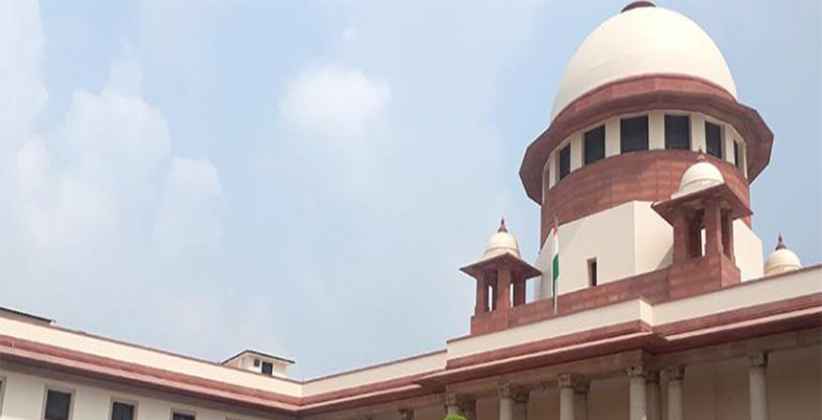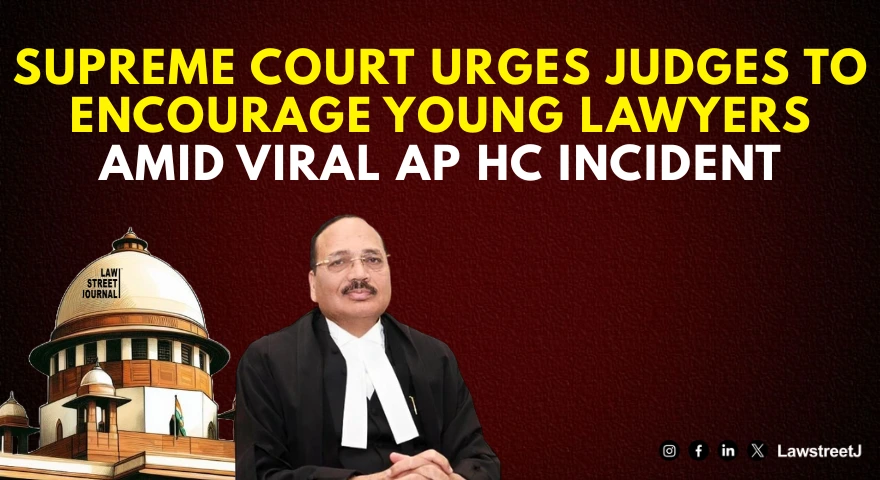
The Supreme Court on May 11, 2026 observed that members of the judiciary at all levels must exhibit patience, compassion and a spirit of encouragement towards all members of the bar, especially young lawyers, while dealing with suo motu writ petitions arising from a viral video showing an Andhra Pradesh High Court judge threatening a young advocate with police custody during a hearing on May 4, 2026.
A bench of Chief Justice of India Surya Kant and Justice Joymalya Bagchi, however, chose not to issue any directions in relation to the specific incident, noting that the matter had been amicably settled at the High Court level with the involvement of the Chief Justice and the Bar Association, that the judge's oral remarks had not translated into an executable order, and that the advocate concerned had no complaint. The Court noted that the judge had made the remarks under the impression that the young lawyer had struck the files on the podium in anger, though the lawyer's case was that the files had accidentally slipped from his hands.
Making pertinent observations on the responsibilities of both the bench and the bar towards young lawyers, the Court stated that “members of the judiciary at all levels must exhibit patience, compassion and spirit of encouragement towards all, especially young members of the bar” and that “while it is certainly a solemn duty of senior members of the bar to inculcate discipline, professional ethics and continuous learning, the responsibility does not lie with the bar alone, but with the bench as well, to nurture a sense of duty, integrity, so that every lawyer sees themselves as an officer of the court first.” Chief Justice Surya Kant also noted that the Court was “sensitizing judiciary at every level how to encourage younger members.”
The Court also addressed the role of media in circulating video clips from court hearings, making an “unequivocal observation” that “dissemination of decontextualised videos can cause unwarranted prejudice” and that media must “play a proactive role with a heightened sense of responsibility” in not circulating truncated video clips from hearings without context.
On the question of institutional mechanisms to prevent recurrence of such incidents, the Court directed that it would be appropriate for High Courts to constitute Grievance Redressal Committees involving members of Bar Councils and Bar Associations to address issues arising between the bar and the judiciary, observing that “such committees to be constituted at the district and taluka level also.” The bench lauded the Supreme Court Bar Association for taking steps to encourage and integrate younger members and urged the Bar Council of India and State Bar Councils to emulate those steps.
The proceedings arose from a viral video on social media in which Justice T. Rajsekhar Rao of the Andhra Pradesh High Court was seen calling the police to take custody of an advocate, orally rebuking him and stating “have I dismissed your writ petition? Only I've requested you to bring the order copy...Are you thinking you are a great Senior Advocate? Call the police...Not having at least 10 years standing and you will throw the bundle?” The order was later recalled by the judge following intervention by members of the bar. The Supreme Court Bar Association's Executive Committee, in a resolution expressing deep concern and shock, stated that the incident had caused serious concern among members of the bar across the country and had deeply disappointed young members of the legal profession, while emphasising that exercise of judicial power must reflect restraint, proportionality, fairness and compassion. The Bar Council of India called the incident deeply disturbing and called for administrative measures including withdrawal of judicial work from the judge, his immediate transfer to a far-off High Court, and his nomination for appropriate judicial training.
Senior Advocate Vikas Singh, President of the Supreme Court Bar Association, submitted before the bench that there should be an internal mechanism to ensure such incidents do not recur and stressed on the need for a mechanism to encourage young lawyers.
Case Details: Bar Council of India v. High Court of Andhra Pradesh, W.P.(C) No. 602 of 2026 and connected case, Supreme Court of India. Suo motu proceedings. Before Chief Justice of India Surya Kant and Justice Joymalya Bagchi. Order dated May 11, 2026.