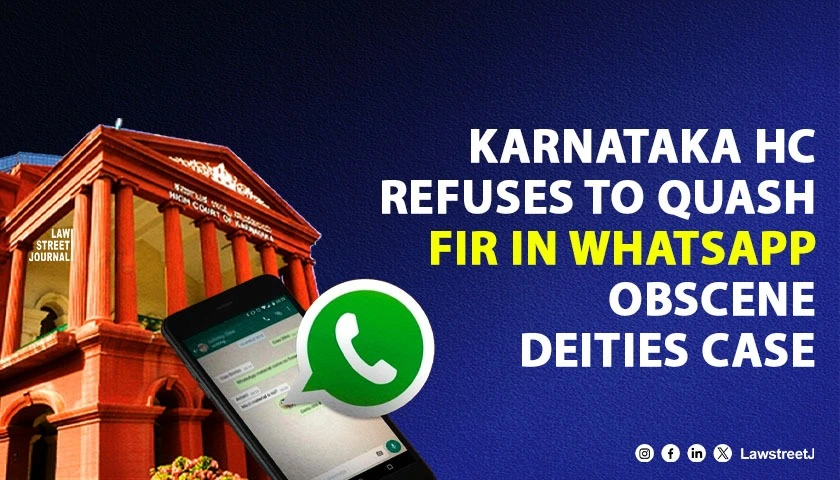
Karnataka: The Karnataka High Court has refused to quash a 2021 FIR registered against a man who was a member of a WhatsApp group allegedly circulating obscene depictions of Hindu deities, observing that a prima facie case was made out and that the material, on its face, has the tendency to outrage religious feelings and disturb communal harmony.
Justice M. Nagaprasanna delivered the judgment while dismissing a petition filed by Sirajuddin seeking to quash Crime No. 4 of 2021 registered for offences punishable under Section 295A of the IPC and Section 67 of the Information Technology Act, 2008.
The case arose from a complaint filed by K. Jayaraj Salian, who alleged that on January 23, 2021, he received a WhatsApp link from an unknown source under the name “Bajarangi Go Kallaru.” Upon accessing the link, he was added to a WhatsApp group consisting of six administrators and nearly 250 participants. According to the complainant, obscene and deeply offensive images depicting deities of the Hindu pantheon and certain political figures were repeatedly circulated in the group.
The petitioner contended that the Magistrate could not take cognizance of the offence under Section 295A of the IPC as the previous sanction, as required under Section 196(1) of the Cr.P.C., had not been obtained from any competent authority. He also argued that the Investigating Officer had been negligent and failed to make the necessary application under Section 67C of the IT Act directing intermediaries to preserve electronic content. The petitioner further submitted that he had no role, either directly or indirectly, in the alleged offence, except for the mere mention of his telephone number.
The Court examined two key issues: whether sanction under Section 196 of the Cr.P.C. is necessary for the registration of a crime and investigation under Section 295A of the IPC, and whether the ingredients of Section 295A of the IPC are prima facie made out in the case.
On the first issue, the Court held that Section 196 Cr.P.C. employs the expression “No Court shall take cognizance” of certain offences, including those punishable under Section 295A of the IPC, without previous sanction of the appropriate Government. The statutory embargo is explicit and unambiguous. The bar under Section 196 Cr.P.C. operates only at the stage when the Court proposes to take cognizance of the offence and does not fetter the police from registering an FIR or conducting an investigation.
The Court held that sanction would be required for an offence under Section 295A of the IPC only at the stage of cognizance and not for the registration of a crime or conduct of investigation. Investigation precedes prosecution. At the investigating stage, it is not known whether the material collected would ultimately warrant the filing of a charge sheet or closure of proceedings. To insist upon sanction even before investigation would be to put the cart before the horse and defeat the very object of investigation.
On the second issue, regarding whether the ingredients of Section 295A are prima facie made out, the Court noted that Section 295A of the IPC criminalises acts committed with deliberate and malicious intention to outrage religious feelings. The Court observed that the provision has been interpreted by the Supreme Court in several cases, striking a balance between freedom of expression under Article 19(1)(a) and the maintenance of public order.
The Court examined the investigation material produced before it and observed that it contained depictions of Hindu deities in an extraordinarily obscene, demeaning, and profane manner. The Court noted that the content was such that reproduction thereof in a judicial order would itself be inappropriate. It held that it suffices to observe that the material, on its face, has the tendency to outrage religious feelings and disturb communal harmony.
The Court further held that whether the petitioner had the requisite mens rea, the extent of his role, and the liability of other administrators are all matters that fall squarely within the domain of investigation. Premature interdiction by the Court would amount to stifling a lawful inquiry into allegations of serious import.
The Court held that the offence under Section 295A of the IPC is met in every word of its ingredients, albeit prima facie. Since the matter was still at the stage of investigation, the Court held that it could not interdict the investigation of an offence of such nature.
The Court noted with some concern that the Investigating Officer appeared to have failed to proceed uniformly against all administrators of the group. However, it observed that if the investigation reveals that any member was actively involved in permitting the circulation of such content, they must be brought to book.
Finding the petition meritless and holding that the prima facie ingredients of the offence under Section 295A of the IPC were made out, the Court rejected the petition. Since the crime dated back to 2021, the Court directed the Investigating Officer to conclude the investigation as expeditiously as possible, without brooking any delay.
Case Title: Sirajuddin v. The State of Karnataka & Anr.


![Karnataka High Court: Cabinet Rank Status Not Equivalent to Ministerial Position [Read Order]](/secure/uploads/2023/09/lj_2318_fc1b99b7-aeed-472b-836e-33750bedb394.jpg)


![Woman living in adultery cannot claim maintenance: Karnataka High Court [Read Order]](/secure/uploads/2023/10/lj_3083_Women_living.jpg)