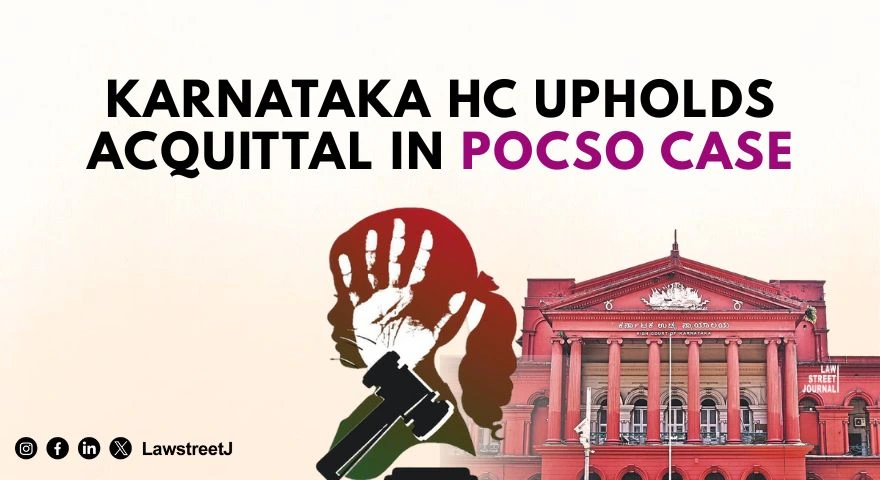
Karnataka: The Karnataka High Court has dismissed the State’s appeal against an acquittal order in a case involving allegations under the POCSO Act, citing inconsistencies in the victim’s testimony and failure to prove her minor status at the time of the alleged incident.
Justice H.P. Sandesh and Justice Venkatesh Naik T presided over the criminal appeal concerning charges of sexual assault and kidnapping.
The Court was hearing Criminal Appeal No. 800 of 2025 filed by the State of Karnataka challenging the judgment dated February 5, 2024, passed by the Additional District and Sessions Judge, FTSC-1, Udupi, which had acquitted the accused of offences punishable under Sections 366A, 376(1) and 354(A)(1)(i), (2) and (D) of the IPC and various provisions of the POCSO Act, 2012.
According to the prosecution’s case, the alleged incident occurred on April 25, 2022. The prosecution claimed that the victim was a minor and that Accused No. 2 had taken her to Latha Hotel, where he allegedly touched her hand and leg and committed sexual harassment. Subsequently, Accused No. 1 allegedly called her, induced her to accompany him, and took her to an old house where he allegedly subjected her to forcible sexual intercourse without her consent.
The Trial Court, after examining 24 prosecution witnesses and considering documentary evidence, acquitted both accused persons. It found critical deficiencies in the prosecution’s case, particularly regarding proof of the victim’s age and the consistency of her testimony.
The High Court observed that the Trial Court had correctly considered Rule 12(3) of the Juvenile Justice (Care and Protection of Children) Rules, 2007, which corresponds to Section 94 of the Juvenile Justice (Care and Protection of Children) Act, and noted that “age is not proved” in the present case. The Trial Court recorded that the victim herself admitted that “at the time of the alleged incident, she was aged about 18 years,” while her father stated that she was 17 years old, and the medical report indicated her age as 17 years and 6 months.
The High Court observed, “There is no consistency in the evidence of P.W.1 and P.W.2 and the documents produced by the prosecution.” The Court also noted the absence of an ossification test despite medical evidence being placed on record.
On the allegations of sexual assault, the High Court noted that the Trial Court had found that the victim “categorically says that, except touching her hand and leg, nothing else was done and thereafter, he left her at Thekkatte.” The Court further observed that even in her statement recorded under Section 164(5) of the CrPC before the Magistrate, “the victim girl has not stated anything about being subjected to forcible sexual acts.”
The High Court stated, “When P.W.1 herself has not stated anything about being subjected to forcible sexual acts, the evidence of P.W.2 will not come to the aid of the prosecution, and there is no medical evidence before the Court.”
The Court concluded, “The evidence of P.W.1, the victim girl, is inconsistent and not trustworthy. Although allegations are made against Accused Nos. 1 and 2, the evidence on record is contrary, and even the Section 164(5) statement does not support the allegation of sexual assault.”
In its final order, the Court held, “When all these materials are considered by the Trial Court, we do not find any ground to admit the appeal.”
Smt. Rashmi Patel (HCGP) appeared for the appellant-State, while Sri K. Prasanna Shetty appeared for Respondent No. 1, and Sri Tejas N. and Sri Sachin G. appeared for Respondent No. 2.
Case Title: State of Karnataka vs. Manikanta @ Manu & Ors.


![Karnataka High Court: Cabinet Rank Status Not Equivalent to Ministerial Position [Read Order]](/secure/uploads/2023/09/lj_2318_fc1b99b7-aeed-472b-836e-33750bedb394.jpg)


![Woman living in adultery cannot claim maintenance: Karnataka High Court [Read Order]](/secure/uploads/2023/10/lj_3083_Women_living.jpg)