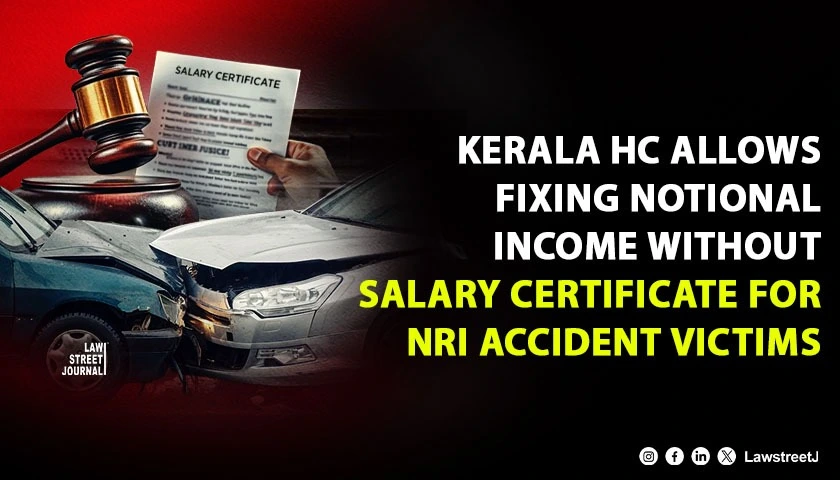
Kerala: The Kerala High Court has held that the notional income of an accident victim employed abroad can be fixed on the basis of factual aspects and reasonable estimation, even in the absence of a valid salary certificate authenticated under the Diplomatic and Consular Officers (Oaths and Fees) Act, 1948.
Justice Harisankar V. Menon enhanced the compensation awarded to Ameer Hamsa, an accident victim who suffered a traumatic brain injury while working as a Quality Control Officer in Saudi Arabia. The Court held that his functional disability should be treated as 100% and fixed his notional income at ₹22,500 per month, instead of ₹15,000 as determined by the Motor Accidents Claims Tribunal.
The case arose from an accident on June 24, 2016, when Ameer Hamsa, while walking along the Kamaleswaram–Thiruvallom main road, was hit by a vehicle and suffered serious injuries. He filed a claim petition before the Motor Accidents Claims Tribunal, Thiruvananthapuram, contending that he was employed in Saudi Arabia and earning a monthly income of around ₹75,000.
By its award dated August 26, 2020, the Tribunal found that no authenticated document had been produced in support of the claimed monthly income or educational qualifications and fixed the notional income at ₹15,000 per month. With respect to the disability certificate (Ext. A16), which assessed permanent disability at 88%, the Tribunal, after noting that the claimant was “mobilised in a wheelchair” and was not in a position to speak clearly or walk without support, assessed functional disability at 75% for the purpose of computing compensation. Against a total claim of ₹40,00,000, the Tribunal awarded compensation of ₹30,79,320.
Both the claimant and the insurance company filed cross appeals. Reliance General Insurance Company Limited, represented by Senior Counsel Mathews Jacob, contended that fixation of notional income at ₹15,000 per month was without justification and that compensation ought to have been determined in accordance with the principles laid down by the Supreme Court in Ramachandrappa v. Manager, Royal Sundaram Alliance Insurance Company Limited [(2011) 13 SCC 236].
The claimant, represented by Advocate A.R. Nimod, argued that the notional income required enhancement, taking note of his continued employment in Saudi Arabia as reflected in various documents. He relied on a disability certificate issued by a Medical Board constituted pursuant to the High Court’s directions, which quantified disability at 90%, and sought fixation of disability accordingly. He also claimed entitlement to bystander expenses for future periods and enhancement of compensation under the heads of “pain and suffering” and “loss of amenities in life.”
On the issue of notional income, Justice Menon acknowledged that the claimant had not produced a salary certificate in accordance with the Diplomatic and Consular Officers (Oaths and Fees) Act, 1948. However, the Court observed that “certain factual aspects cannot be lost sight of.”
The Court took note of Ext. A24, an appointment letter issued by Saudi Paper Manufacturing Company, Dammam, appointing the claimant with a monthly salary of 2,500 Saudi Riyals. The claimant had also produced identity cards (Exts. A25 and A26), including one issued by NORKA (Department of Non-Resident Keralite Affairs). Crucially, the Court examined Ext. A19, the bank statement covering the period from January 2003 to December 2018.
The Court observed that the bank statements revealed periodic remittances of substantial amounts from abroad. It noted a credit entry of more than ₹6,19,000 on March 3, 2016—barely three months prior to the accident. Similar remittances exceeding ₹1,00,000 were credited during several months in 2015 to the claimant’s NRI account with Syndicate Bank.
When these documents were considered alongside the appointment letter, averments in the claim petition, and the attested copy of the passport (Ext. A17), the Court found it evident that the claimant frequently travelled between India and Saudi Arabia. The Tribunal had also recorded that the claimant returned to India on March 6, 2016.
The Court held:
“In light of the above, I am of the opinion that, though no salary certificate—much less a certificate in accordance with the provisions of the Act of 1948—has been produced, a reasonable estimation of the notional income of the claimant is required to be carried out.”
Finding the fixation of notional income at ₹15,000 per month to be inadequate, the Court enhanced it to ₹22,500 per month, dismissing the insurance company’s appeal and allowing the claimant’s cross appeal on this issue.
On the question of disability, the insurance company argued that fixation of functional disability at 75% was excessive. However, the Court noted that pursuant to its directions, the claimant had been examined by a Medical Board at the Medical College Hospital, Thiruvananthapuram. The Medical Board, in its report dated October 18, 2024, found that the claimant suffered from psychiatric impairment due to a major neurocognitive disorder resulting from traumatic brain injury. With reference to the Rights of Persons with Disabilities Act, 2016, the Medical Board assessed disability at 90%.
Taking into account the Tribunal’s factual findings—namely, that the claimant was wheelchair-bound, unable to speak clearly, and incapable of walking without support—the Court held that the permanent disability of 90% ought to be treated as 100% functional disability.
The Court observed that the claimant, who was around 75 years of age at the time of adjudication, could not live independently without assistance due to psychiatric impairment arising from the brain injury.
Accordingly, the Court rejected the insurance company’s challenge and accepted the claimant’s plea, holding that functional disability should be quantified at 100%.
On the claim for future bystander expenses, the Court noted that although the Supreme Court had recognised such entitlement in cases of 100% functional disability, the claimant had failed to adduce evidence to establish expenditure on bystander care during the intervening period. Given the claimant’s advanced age, the Court held that the claim was not justified.
With respect to enhancement under the heads of “pain and suffering” and “loss of amenities in life,” the Court held that adequate compensation had already been awarded under other heads and found no reason for further enhancement.
The Court ultimately enhanced the total compensation from ₹30,79,320 to ₹38,29,320, granting an additional amount of ₹7,50,000. The principal enhancement was under the head of “compensation for continuing or permanent disability,” which was increased from ₹6,75,000 to ₹13,50,000, calculated as ₹22,500 × 12 × 5 × 100%.
Case Title: The Divisional Manager, Reliance General Insurance Company Limited v. Ameer Hamsa (and connected appeal)



![Kerala HC Quashes 498A Dowry Harassment Case Against Live-In Partner, Citing Lack of Relative Status [Read Order]](/secure/uploads/2023/08/lj_5693_1057c042-1e57-4e27-8c9e-25af0ec38ec4.jpg)
![Watching porn on mobile: Kerala HC highlights importance of mother cooked meals, outdoor sports [Read Order]](/secure/uploads/2023/09/lj_9155_Parental_supervision_of_mobile_phone_usage.jpg)
![Lakshadweep MP Mohammed Faizal Disqualified from Lok Sabha After Conviction Suspension Plea Rejected by Kerala High Court [Read Notice]](/secure/uploads/2023/10/lj_9640_87b5fd97-0e05-4ff8-9a99-3be1e4446192.jpg)