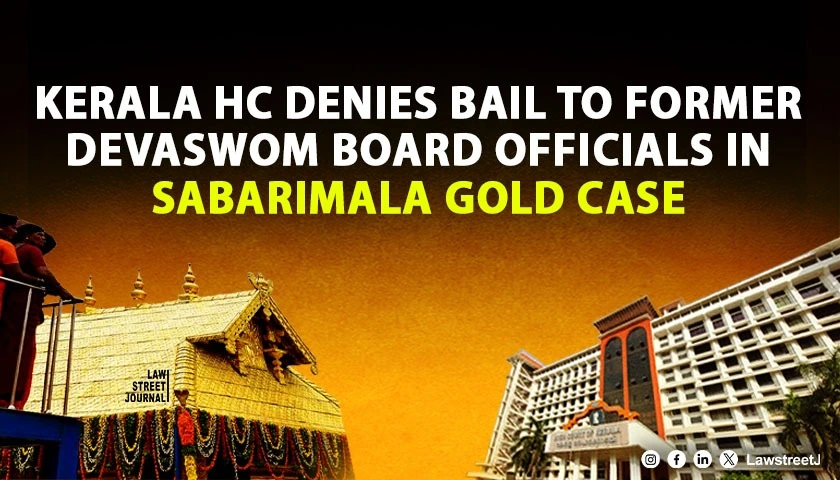
Kerala: The Kerala High Court has rejected bail applications filed by three former officials of the Travancore Devaswom Board, accused of misappropriating gold from sacred artefacts of the Sabarimala Temple, holding that the seriousness of the allegations and the stage of investigation did not warrant their release.
Justice A. Badharudeen, by an order dated December 19, 2025, dismissed the bail pleas of B. Murari Babu (former Administrative Officer), K.S. Baiju (former Thiruvabharanam Commissioner), and N. Vasu (former Devaswom Commissioner) in two connected crime cases registered by the Crime Branch.
The cases arise from two FIRs registered in October 2025 pursuant to earlier directions of the High Court, based on reports submitted by the Travancore Devaswom Board. Crime No. 3700 of 2025 relates to allegations that gold-cladded Dwarapalaka sculptures weighing about 42,800 grams were falsely described as copper plates and handed over for gold plating, though only 394.9 grams of gold was used, with the remaining 4,541.9 grams allegedly misappropriated. Crime No. 3701 of 2025 concerns door frames of the Sreekovil and other temple artefacts, where a similar modus operandi was allegedly adopted, with partial recovery of misappropriated gold already effected.
The offences alleged include Sections 120B, 403, 406, 409, 466, and 467 read with Section 34 of the IPC, along with Section 13(1)(a) of the Prevention of Corruption Act, which was added during the investigation.
Opposing bail, the prosecution contended that the accused officials, who were entrusted with the custody and protection of temple valuables, conspired with the first accused, Unnikrishnan Potti, to systematically misappropriate gold by falsifying records and describing gold-cladded artefacts as copper plates. The prosecution highlighted documentary inconsistencies, including letters and mahazars, and pointed out that Murari Babu’s mobile phone, seized during the investigation, remained locked and required his cooperation for forensic examination.
The Court undertook a detailed prima facie assessment of the materials on record, including letters exchanged between officials, mahazars, Board proceedings, and witness statements. It noted that Murari Babu’s letter dated June 17, 2019, claimed prior written permission from the Thantri even before such permission was actually issued, which, according to the Court, prima facie indicated mala fide intent. The Court also observed that despite references to faded gold in the Thantri’s communication, the officials consistently described the artefacts as copper.
With respect to K.S. Baiju, the Court held that his statutory responsibility as Thiruvabharanam Commissioner to preserve and safeguard temple ornaments had not been discharged, and his alleged failure to supervise the removal of the artefacts or verify their nature could not be brushed aside at the bail stage. The alibi raised by him was rejected as premature. In the case of N. Vasu, the Court found that witness statements and records indicated deliberate suppression of material facts while recommending action to the Board.
Justice Badharudeen described the allegations as unprecedented, observing that officials entrusted with protecting temple properties were alleged to have become instrumental in their misappropriation. Relying on the State of Chhattisgarh v. Aman Kumar Singh, the Court reiterated that corruption must be dealt with firmly and that courts are duty-bound to show zero tolerance.
While denying bail, the Court also expressed concern over apparent delays and lapses in the investigation, noting that certain accused were arrested belatedly and that the role of higher-level officials and Board members required deeper scrutiny. It emphasised that the investigation must not suffer from lethargy or selective action.
The Court rejected medical grounds raised by the accused, holding that ailments such as diabetes and hypertension could be managed through appropriate medical care while in custody. It also noted that the statutory period for police custody under the Bharatiya Nagarik Suraksha Sanhita, 2023, had not been exhausted.
Holding that the release of the accused at this stage would adversely affect the investigation and the interests of the deity and devotees, the Court concluded that the present case fell within the exception to the general rule of bail.
All bail applications were accordingly dismissed.
Case Title: K.S. Baiju v. State of Kerala & Anr. and connected cases
(Bail Application Nos. 14361, 14369, 14394, 14395, 14430 of 2025)



![Kerala HC Quashes 498A Dowry Harassment Case Against Live-In Partner, Citing Lack of Relative Status [Read Order]](/secure/uploads/2023/08/lj_5693_1057c042-1e57-4e27-8c9e-25af0ec38ec4.jpg)
![Watching porn on mobile: Kerala HC highlights importance of mother cooked meals, outdoor sports [Read Order]](/secure/uploads/2023/09/lj_9155_Parental_supervision_of_mobile_phone_usage.jpg)
![Lakshadweep MP Mohammed Faizal Disqualified from Lok Sabha After Conviction Suspension Plea Rejected by Kerala High Court [Read Notice]](/secure/uploads/2023/10/lj_9640_87b5fd97-0e05-4ff8-9a99-3be1e4446192.jpg)