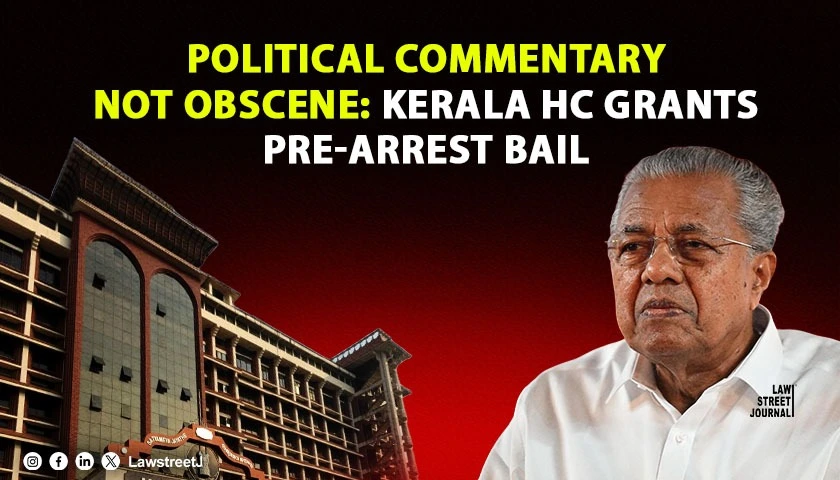
Kerala: The Kerala High Court on Friday (January 30) granted pre-arrest bail to the chief editor of Crime Online, a YouTube channel, who is accused of posting obscene content involving the Chief Minister, Pinarayi Vijayan.
Justice Kauser Edappagath held that the contents of the video posted by the accused did not contain any sexually explicit acts or conduct so as to attract Section 67A of the Information Technology Act, 2000, observing that the post amounted to political commentary rather than obscene material.
The court was dealing with Bail Application No. 12607 of 2025 filed by T.P. Nandakumar, the 64-year-old chief editor of the Crime Online channel, seeking pre-arrest bail in Crime No. 33/2025 of the Cyber Crime Police Station, Kochi. The court noted, “On 29 August 2025, the applicant posted a video on the said YouTube channel as well as on his Facebook account named Crime Story with a caption ‘What exactly did Pinarayi do by lifting Saritha Nair’s skirt… the video is out’.”
Addressing the charges invoked, the court observed, “On the same day itself, at 9.41 p.m., the Cyber Crime Police Station, Kochi registered a crime against the applicant for the offences punishable under Section 192 of the Bharatiya Nyaya Sanhita, 2023 (for short, the BNS), and Sections 67 and 67A of the Information Technology Act, 2000 (for short, the IT Act).”
Regarding the prosecution’s allegation, the court noted, “The allegation in Annexure 1 is that the above-mentioned video contains obscene material involving sexually explicit content, and that the applicant published it on his social media platforms with the intention of inciting public mutiny and tarnishing the reputation of the Hon’ble Chief Minister of Kerala, Sri Pinarayi Vijayan.”
Clarifying the scope of Section 67A of the IT Act, the court stated, “To attract Section 67A, the accused must publish, transmit, or cause to be published or transmitted in electronic form any material containing a sexually explicit act or conduct.”
On the meaning of “sexually explicit,” the bench observed, “The term ‘explicit’ means ‘stated clearly and precisely and/or prescribing or depicting sexual activity in a direct and detailed way’. According to Black’s Law Dictionary, ‘sexual activity’ is defined as ‘physical sexual activity or persons engaged in sexual relations’.”
The court further emphasized, “The term ‘sexually explicit’ is often used as a euphemism for pornography. It includes unsimulated sexual acts, sexual intercourse, and exposed genitalia. Therefore, to invoke Section 67A of the IT Act, the publication in question must depict actual or simulated sexual acts or intercourse.”
With respect to the contents of the video, the court held, “A reading of the same would reveal that the applicant was commenting on the allegation of molestation by a sitting MLA against a woman in the backdrop of a similar allegation in the year 2015 involving Smt. Saritha Nair. While criticising the alleged double standard shown by the ruling party and its head, the Hon’ble Chief Minister, in both instances, there was a comment that the said stand of the Chief Minister would amount to ‘politics with a skirt up’.”
The bench categorically stated, “By no stretch of imagination can it be characterised as sexually explicit content. In short, the contents of the video do not contain any sexually explicit acts or conduct.”
Addressing the prosecution’s case, the court observed, “Even as per the prosecution version, the alleged post was intended to incite public mutiny and tarnish the reputation of the Hon’ble Chief Minister. There is no allegation that the contents of the video would deprave or corrupt the minds of the people who view it, or are likely to excite lustful thoughts in them.”
On the existence of a prima facie case, the bench held, “No case of publication or transmission of material containing a sexually explicit act or conduct, as provided under Section 67A of the IT Act, has been prima facie made out against the applicant.”
Regarding the status of the investigation, the court noted, “The hard disk containing the alleged video was already seized by the police in connection with another crime. The investigation is almost over. Considering the allegations made against the applicant, his custodial interrogation appears unnecessary.”
The court also addressed the issue of criminal antecedents, stating, “The applicant does have criminal antecedents and is involved in several crimes involving similar offences. However, it is settled law that mere pendency of several criminal cases against an accused cannot, by itself, be a ground for refusal of pre-arrest bail if he is otherwise entitled to the same.”
With respect to Section 67 of the IT Act, the bench observed, “The offence under Section 67 is punishable with imprisonment for a term which may extend to three years and a fine which may extend to ₹5 lakhs, and on a second conviction, with imprisonment for a term which may extend to five years along with a fine which may extend to ₹10 lakhs. The prosecution has no case that the applicant was previously convicted under Section 67. Hence, the said offence is bailable in nature.”
In its final order, the court held, “For these reasons, I find this to be an appropriate case to grant pre-arrest bail to the applicant.”
Accordingly, the court granted bail on the condition that the applicant execute a bond for ₹1,00,000 with two solvent sureties and comply with several conditions, including appearing before the investigating officer every Saturday, cooperating with the investigation, and not leaving India without prior permission.
Sri S. Rajeev appeared for the applicant, while Sri U. Jayakrishnan, Senior Public Prosecutor, appeared for the State.
Case Title: T.P. Nandakumar v. State of Kerala & Anr.



![Kerala HC Quashes 498A Dowry Harassment Case Against Live-In Partner, Citing Lack of Relative Status [Read Order]](/secure/uploads/2023/08/lj_5693_1057c042-1e57-4e27-8c9e-25af0ec38ec4.jpg)
![Watching porn on mobile: Kerala HC highlights importance of mother cooked meals, outdoor sports [Read Order]](/secure/uploads/2023/09/lj_9155_Parental_supervision_of_mobile_phone_usage.jpg)
![Lakshadweep MP Mohammed Faizal Disqualified from Lok Sabha After Conviction Suspension Plea Rejected by Kerala High Court [Read Notice]](/secure/uploads/2023/10/lj_9640_87b5fd97-0e05-4ff8-9a99-3be1e4446192.jpg)