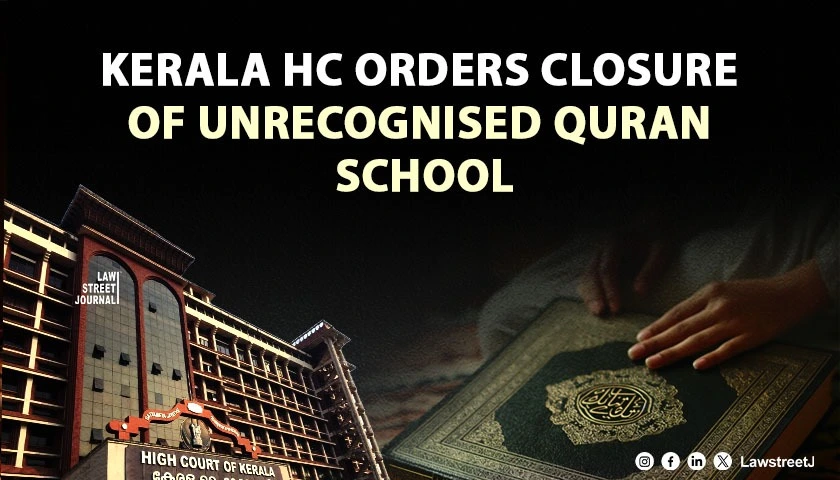
Kerala: The Kerala High Court has directed the shutdown of an educational institution that was imparting Quran and allied subjects to approximately 300 students without obtaining mandatory recognition from the State Government, holding that religious instruction in schools without governmental permission violates the Right of Children to Free and Compulsory Education Act, 2009.
Justice Harisankar V. Menon passed the order while hearing two connected writ petitions concerning Ma’din Knowledge Garden Public School, Punnayur, Thrissur District, which was operating as a preschool imparting religious education.
The petitioners approached the Court alleging that the institution was being run without the requisite licence or recognition under the RTE Act. Based on their complaint, educational authorities conducted inspections and found that the school was operating without valid State recognition.
The institution, in its counter-affidavit, admitted that it was “imparting preschool education to about 300 students, teaching Quran and allied subjects.” The school attempted to defend its operations by relying on an accreditation dated November 28, 2024, from the National Institute of Open Schooling (NIOS), arguing that this constituted valid recognition.
However, the Court rejected this contention, holding that Section 18 of the RTE Act mandates every educational institution to obtain appropriate recognition from the concerned State Government, and that NIOS accreditation does not substitute for State recognition.
Justice Menon placed significant reliance on the precedent set by the Kerala High Court in Trustee, Hidaya Educational & Charitable Trust v. State of Kerala and Others [2020 (1) KHC 775], a landmark judgment dealing with religious instruction in schools.
Quoting extensively from the Hidaya Trust judgment, the Court noted:
“The RTE Act was enacted by Parliament after the insertion of Article 21A in the Constitution. Under Section 29, the Act mandates that the curriculum and evaluation procedure should be as laid down by the appropriate authority specified by the Government. The appropriate authority, as defined under Section 2(a)(ii)(A) in relation to schools within the State, is the State Government. In such circumstances, no school which is required to have recognition shall impart any religious instruction or religious study without permission from the State Government.”
The Hidaya Trust judgment had specifically addressed a case where an institution was imparting religious instruction exclusively following the Islamic religion, observing:
“In this case, there is a clear finding that the petitioner imparts religious instruction exclusively following the Islamic religion. This cannot be permitted, since it offends the very fabric of a secular society. The Government is justified in ordering the closure of the school.”
The Court emphasised that under the constitutional and statutory framework, while the Government may permit religious instruction in schools, such permission must be obtained from the State Government, which is the appropriate authority under the RTE Act.
The Hidaya Trust precedent had directed the Secretary of the General Education Department to issue a general Government Order directing all recognised private schools in the State to desist from imparting religious instruction or religious study without the Government’s permission, warning that violations could result in closure and derecognition.
In the present case, Justice Menon held that the educational institution was not entitled to function without valid recognition from the State Government as required under Section 18 of the RTE Act. The Court directed the competent authorities to take note of the findings and take appropriate steps to shut down the institution.
However, taking a pragmatic approach and considering the submission of counsel that reasonable time should be granted for making alternative arrangements for students, the Court permitted the institution to continue operations for the academic year 2025–26, after which it must cease operations.
The Court allowed the writ petition filed by the complainants seeking closure of the school and dismissed the writ petition filed by the school challenging the closure direction.
The judgment reaffirms the principle that educational institutions must comply with statutory requirements for recognition and cannot impart religious instruction without obtaining permission from the appropriate governmental authority, in keeping with the secular fabric of the Constitution and the mandate of the RTE Act.
Appearances:
For Petitioners (WP(C) 21615/2023): Sri. S.K. Adhithyan, Sri. Manu Mohan, Smt. Shahina Noushad, Shri. Krishna S. Karunakaran, Shri. Jai Prakash Choudhary, Advocates
For Petitioner (WP(C) 28053/2024): Sri. P.S. Abdul Kareem, Shri. Nazif K.N., Advocates
For Respondents: Smt. Jayasree K.P., Sri. P.S. Abdul Kareem, Shri. John Joseph, Shri. Nazif K.N., Sri. Sunil Nath, Government Pleader
Case Title: Moithunnykutty & Anr. v. The District Collector & Ors.



![Kerala HC Quashes 498A Dowry Harassment Case Against Live-In Partner, Citing Lack of Relative Status [Read Order]](/secure/uploads/2023/08/lj_5693_1057c042-1e57-4e27-8c9e-25af0ec38ec4.jpg)
![Watching porn on mobile: Kerala HC highlights importance of mother cooked meals, outdoor sports [Read Order]](/secure/uploads/2023/09/lj_9155_Parental_supervision_of_mobile_phone_usage.jpg)
![Lakshadweep MP Mohammed Faizal Disqualified from Lok Sabha After Conviction Suspension Plea Rejected by Kerala High Court [Read Notice]](/secure/uploads/2023/10/lj_9640_87b5fd97-0e05-4ff8-9a99-3be1e4446192.jpg)