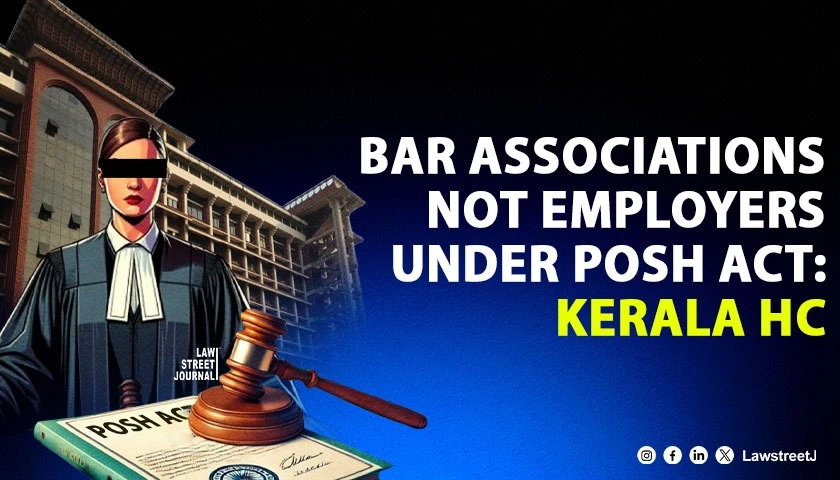
Kerala: The Kerala High Court has quashed an Internal Complaints Committee (ICC) constituted by the Kollam Bar Association, holding that bar associations cannot be treated as “employers” under the Sexual Harassment of Women at Workplace (Prevention, Prohibition and Redressal) Act, 2013, and therefore lack the authority to constitute such committees.
Justice P.M. Manoj delivered the judgment on January 27, 2026, in a writ petition filed by an advocate challenging the ICC inquiry and his subsequent suspension from the bar association following a sexual harassment complaint by a fellow advocate.
The case arose when the complainant, a 24-year-old woman advocate, alleged harassment during a visit to the petitioner’s residence-cum-office in June 2024 for the purpose of document notarization. Following the complaint, the Kollam Bar Association constituted an ICC and conducted an inquiry. The ICC’s report led to the petitioner’s suspension from bar membership.
The petitioner challenged the ICC’s jurisdiction on multiple grounds. He argued that the alleged incident occurred at his private residence, which does not fall within the definition of a “workplace” under the POSH Act. Further, neither party was an employee of the bar association, and no employer–employee relationship existed. The petitioner contended that bar associations function like voluntary associations or clubs and are not establishments covered by the Act.
The Court examined Section 4 of the POSH Act, which mandates that every employer of a workplace shall constitute an ICC. Section 2(g) defines an “employer” as the head of an organization or any person responsible for the management, supervision, and control of the workplace.
Justice Manoj held that bar associations cannot be treated as employers under these provisions. The Court noted that the Bar Council of Kerala—not individual bar associations—is the primary statutory body regulating advocates, with powers to enroll advocates, adjudicate misconduct, and safeguard their interests under the Advocates Act, 1961.
Distinguishing between bar councils and bar associations, the Court observed that bar associations are recognized only for welfare fund purposes under the Kerala Advocates Welfare Fund Act, 1980. They are not equipped to discharge contractual obligations characteristic of an employer–employee relationship.
The Court also rejected the argument that the Supreme Court’s directions in Aureliano Fernandes v. State of Goa, requiring statutory professional bodies to constitute ICCs, applied to bar associations. It clarified that while such directions may extend to bar councils, they do not apply to individual bar associations, which lack statutory authority to act as employers.
Further, the Court held that the authority to constitute an ICC vests exclusively in an employer of a workplace, and the explicit wording of Section 4 contemplates an entity discharging contractual obligations toward employees. Since bar associations do not employ their members, they fall outside this mandate.
The Court noted that advocates are not employees of bar associations. Membership is voluntary and governed by bylaws. Treating advocates as employees would necessitate the application of labour laws, which was never contemplated by the legislative framework.
On the issue of maintainability, the Court held that writ petitions against bar associations are maintainable, relying on earlier Kerala High Court decisions in Abdul Azeez v. Alappuzha Bar Association and Jose Kuttiyani v. High Court Advocates Association. The Court rejected the respondents’ reliance on contrary precedent from the Bombay High Court.
The Court further emphasized that the appropriate forum for addressing professional misconduct by advocates is the Bar Council of Kerala under Section 35 of the Advocates Act, 1961, and not internal committees of bar associations constituted under the POSH Act.
Accordingly, the Court set aside the ICC report and disposed of the writ petition. It clarified that it had not examined the factual merits of the harassment allegations or issues of natural justice, leaving those questions open.
Case Title: Xxx v. The Kollam Bar Association & Ors.



![Kerala HC Quashes 498A Dowry Harassment Case Against Live-In Partner, Citing Lack of Relative Status [Read Order]](/secure/uploads/2023/08/lj_5693_1057c042-1e57-4e27-8c9e-25af0ec38ec4.jpg)
![Watching porn on mobile: Kerala HC highlights importance of mother cooked meals, outdoor sports [Read Order]](/secure/uploads/2023/09/lj_9155_Parental_supervision_of_mobile_phone_usage.jpg)
![Lakshadweep MP Mohammed Faizal Disqualified from Lok Sabha After Conviction Suspension Plea Rejected by Kerala High Court [Read Notice]](/secure/uploads/2023/10/lj_9640_87b5fd97-0e05-4ff8-9a99-3be1e4446192.jpg)