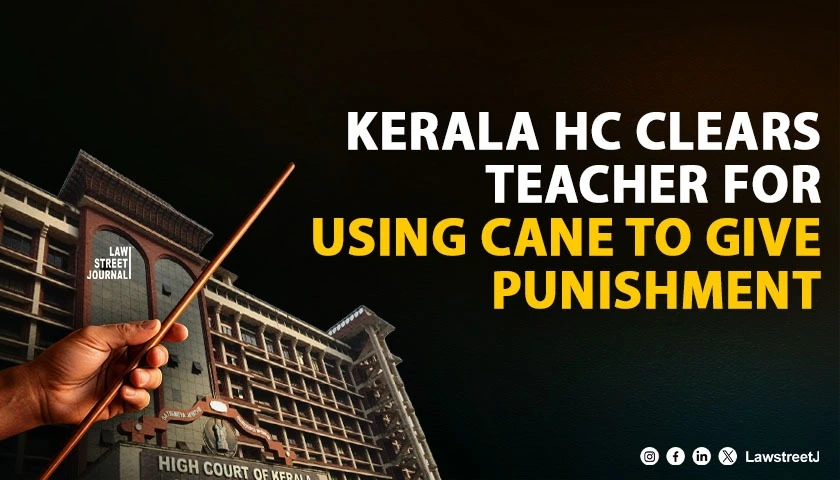
Kerala: In an important judgment clarifying the extent of lawful authority that teachers possess in maintaining school discipline, the Kerala High Court has quashed criminal proceedings against a teacher who used a cane to discipline a student.
A single-judge bench of Justice C. Pratheep Kumar, in an order dated February 3, 2026, held that when a teacher acts with bona fide intention to improve or correct a student through minimum corporal punishment, it does not constitute an offence under the Bharatiya Nyaya Sanhita or the Juvenile Justice (Care and Protection of Children) Act.
The petitioner, Sibin S.V., aged 36 years, was a teacher who faced criminal prosecution in Sessions Case No. 1401 of 2025 before the Additional Sessions Court (Atrocities & Sexual Violence against Women and Children), Thiruvananthapuram, arising out of Crime No. 293/2025 of Vizhinjam Police Station. He was charged under Section 118(1) of the Bharatiya Nyaya Sanhita and Section 75 of the Juvenile Justice (Care and Protection of Children) Act for allegedly beating a student with a cane on his buttocks.
According to the prosecution case, the accused, who was the teacher of the de facto complainant, on February 10, 2025, at about 12:30 p.m., at the staff room of VPS Malankara School, Venganoor, voluntarily caused hurt to the de facto complainant by beating him with a cane on his buttocks. The FIR was registered on February 13, 2025, three days after the alleged incident. The Accident Register-cum-Wound Certificate issued from the Community Health Centre, Vizhinjam, showed that the child was brought to the hospital only on February 13, 2025, at about 7:00 p.m., with a history of pain over the buttocks. Notably, the wound certificate indicated that no external injuries were observed by the doctor who treated the victim.
The petitioner approached the High Court under Section 528 of the Bharatiya Nagarik Suraksha Sanhita, 2023, seeking to quash all further proceedings against him. Learned counsel for the petitioner contended that this was a false case foisted against him and that the allegations levelled did not constitute the offences as charged. The petition was strongly opposed by the Public Prosecutor, while the de facto complainant, despite being served with notice, did not appear before the Court.
The Court observed that for an offence to be made out under Section 118(1) of the BNS, the weapon used must be a dangerous one. Section 118(1) of the Bharatiya Nyaya Sanhita provides that whoever voluntarily causes hurt by means of any instrument for shooting, stabbing, or cutting, or any instrument which, used as a weapon of offence, is likely to cause death, or by means of fire, heated substance, poison, corrosive substance, explosive substance, or deleterious substance, shall be punished with imprisonment which may extend to three years, or with fine which may extend to twenty thousand rupees, or with both.
The Court held that since the weapon allegedly used by the petitioner was only a cane, the same does not amount to a dangerous weapon as defined under Section 118(1) of the BNS. Therefore, the allegations against the petitioner did not constitute an offence under Section 118(1) of the BNS. This finding was crucial in determining whether the prosecution could be sustained on the charge under the Bharatiya Nyaya Sanhita.
The Court then turned to examine the larger question of the extent to which a teacher could lawfully inflict corporal punishment on a student under his control. Justice Pratheep Kumar referred to earlier decisions of the Kerala High Court that had dealt with this issue comprehensively. In K.A. Abdul Vahid v. State of Kerala [2005 (2) KLT 72], the Court had held that when a student is sent to a school, the parents give an implied authority to the teacher to maintain school discipline and to train the student based on the rules of the school. When a student does not behave properly or act according to the rules, and if the teacher chastises him with corporal punishment for improving his character and conduct, the Court has to ascertain whether the act of the teacher was bona fide or not.
The Court in Abdul Vahid’s case observed that Sections 88 and 89 of the Indian Penal Code (now replaced by corresponding provisions in the BNS) were relevant to such situations. These provisions deal with acts done by consent in good faith for a person’s benefit and acts done in good faith for the benefit of a child by or with the consent of the guardian. The Court held that when a cane is used to inflict corporal punishment on erring students with bona fide intention to improve them, maintain discipline, and make them adhere to prescribed standards, the teacher has no intention to inflict any harm upon the students.
The Court emphasized that parents, when they send a child to a school, give an implied authority to the teacher to enforce discipline and correct students who commit errors. If corporal punishment is given in the process of maintaining such discipline to make the student adhere to prescribed standards of the school, which are necessary for the upliftment and development of the child, including the development of character and conduct, it cannot be said to be an act intended to injure the student. However, the Court clarified that this principle is not absolute and depends upon the facts of each case.
The Court held that if a teacher, out of fury and excitement, inflicts injuries harmful to the health of a tender-aged student, it cannot be accepted as a right conferred on such teacher because of express or implied parental authority. Therefore, there cannot be any generalized principle in such situations, and the acts of a teacher must be assessed based on the facts placed before the Court in each case.
In Rajan @ Raju v. Sub Inspector of Police, Farook Police Station & Anr. [2019 (1) KLT 119], the Court reiterated that parents, teachers, and persons in loco parentis are entitled, as a disciplinary measure, to apply a reasonable degree of force to children or pupils old enough to understand the purpose of such act. However, if the punishment is imposed out of spite or for a non-disciplinary reason, or if the force used is unreasonable or excessive, it is unlawful.
The Court noted that a school teacher, by virtue of his peculiar position, must have the authority to enforce discipline and correct a pupil put in his charge. When a parent entrusts a child to a teacher, the parent impliedly consents to the teacher exercising such authority. However, the nature and gravity of corporal punishment inflicted would determine whether penal liability is attracted.
In Jomi v. State of Kerala [2024 (2) KLD 230], the Court held that where there is no malafide intention on the part of the teacher in inflicting corporal punishment for the well-being of the student and for maintaining institutional discipline, the offence under Section 75 of the Juvenile Justice Act is not attracted.
Applying these principles, Justice Pratheep Kumar observed that the petitioner had only used minimum corporal punishment for enforcing discipline in the school. There was no material to show any guilty intention to cause hurt or cruelty. The absence of external injuries in the medical report was also considered significant.
The Court concluded that no useful purpose would be served by continuing the proceedings against the petitioner. Accordingly, the Criminal Miscellaneous Case was allowed, and all further proceedings in SC No. 1401/2025 arising out of Crime No. 293/2025 of Vizhinjam Police Station were quashed under Section 528 of the BNSS.
Appearances:
For the Petitioner/Accused: Sri M.R. Sarin, Sri P. Santhoshkumar (Karumkulam), Smt. Parvathi Krishna, Sri Aji S., Sri Midhun Soman
For the State: Sri Breez M.S., Senior Public Prosecutor
Case Title: Sibin S.V. v. State of Kerala & Anr., Crl.MC No. 7868 of 2025



![Kerala HC Quashes 498A Dowry Harassment Case Against Live-In Partner, Citing Lack of Relative Status [Read Order]](/secure/uploads/2023/08/lj_5693_1057c042-1e57-4e27-8c9e-25af0ec38ec4.jpg)
![Watching porn on mobile: Kerala HC highlights importance of mother cooked meals, outdoor sports [Read Order]](/secure/uploads/2023/09/lj_9155_Parental_supervision_of_mobile_phone_usage.jpg)
![Lakshadweep MP Mohammed Faizal Disqualified from Lok Sabha After Conviction Suspension Plea Rejected by Kerala High Court [Read Notice]](/secure/uploads/2023/10/lj_9640_87b5fd97-0e05-4ff8-9a99-3be1e4446192.jpg)