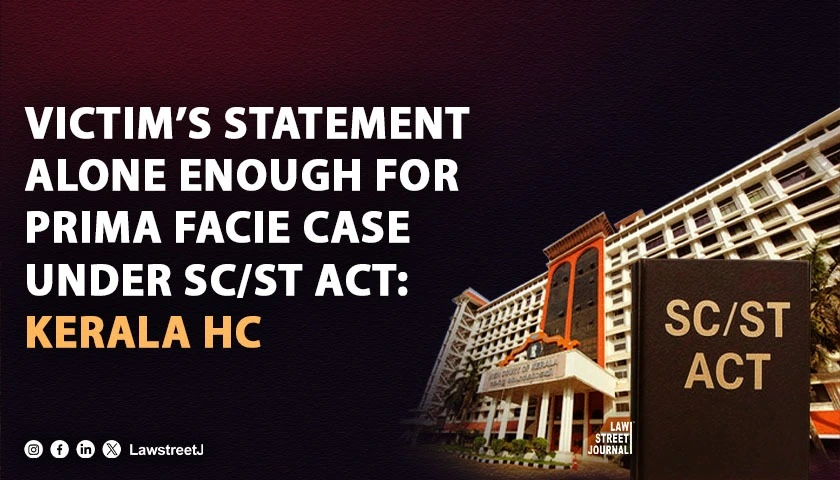
Kerala: The Kerala High Court has ruled that the statement of the victim alone can establish a prima facie case under the Scheduled Castes and Scheduled Tribes (Prevention of Atrocities) Act, 2018, and that an accused cannot be discharged merely because witness statements do not corroborate the allegations.
Justice A. Badharudeen delivered the decision while dismissing a criminal appeal filed by the accused, challenging the rejection of her discharge petition by the Special Court trying offences under the SC/ST (PoA) Act, 2018.
The accused had argued that while the complainant’s statement contained allegations of being called by her caste name in public, the statement of Witness No. 2 and other witnesses did not disclose any overt acts sufficient to fasten criminal culpability on her. She contended that the absence of corroboration warranted her discharge from the proceedings.
The Court found that the complainant’s statement specifically alleged that at about 4:00 p.m. on March 31, 2023, the accused abused her by calling her caste name in the presence of cleaning staff at the Bharat Services Facility Management Office. It noted that this statement prima facie disclosed the ingredients of offences under Sections 3(1)(r) and 3(1)(s) of the SC/ST (PoA) Act, 2018.
In a detailed discussion on the evidentiary standard for discharge, the Court underscored that the law does not insist on a plurality of witnesses to prove an offence. The evidence of a solitary, wholly reliable witness would suffice, the Court said. The mere statement of the aggrieved person would prima facie disclose the ingredients of the offences, and the absence of corroboration from other witnesses would not, by itself, be a ground to discharge the accused.
The Court also explained the essential ingredients required to constitute offences under Sections 3(1)(r) and 3(1)(s) of the Act. There must be an “intentional insult or intimidation” by a non-member of the Scheduled Caste or Scheduled Tribe against a member of such community, with the intention to humiliate such member within public view. Abusing a member by calling out their caste name within public view would attract the offence under Section 3(1)(r), the Court clarified.
On the standard for discharge, the Court held that while considering a plea for discharge, the duty of the Court is to examine the prosecution records to ascertain whether a prima facie case is made out or whether at least a strong suspicion exists to frame charges. However, mere suspicion would not suffice, the Court observed.
Finding no infirmity in the Special Court’s order, the High Court upheld the rejection of the discharge petition and dismissed the criminal appeal.
Case Title: Reshmi Saseendran v. State of Kerala and Another



![Kerala HC Quashes 498A Dowry Harassment Case Against Live-In Partner, Citing Lack of Relative Status [Read Order]](/secure/uploads/2023/08/lj_5693_1057c042-1e57-4e27-8c9e-25af0ec38ec4.jpg)
![Watching porn on mobile: Kerala HC highlights importance of mother cooked meals, outdoor sports [Read Order]](/secure/uploads/2023/09/lj_9155_Parental_supervision_of_mobile_phone_usage.jpg)
![Lakshadweep MP Mohammed Faizal Disqualified from Lok Sabha After Conviction Suspension Plea Rejected by Kerala High Court [Read Notice]](/secure/uploads/2023/10/lj_9640_87b5fd97-0e05-4ff8-9a99-3be1e4446192.jpg)