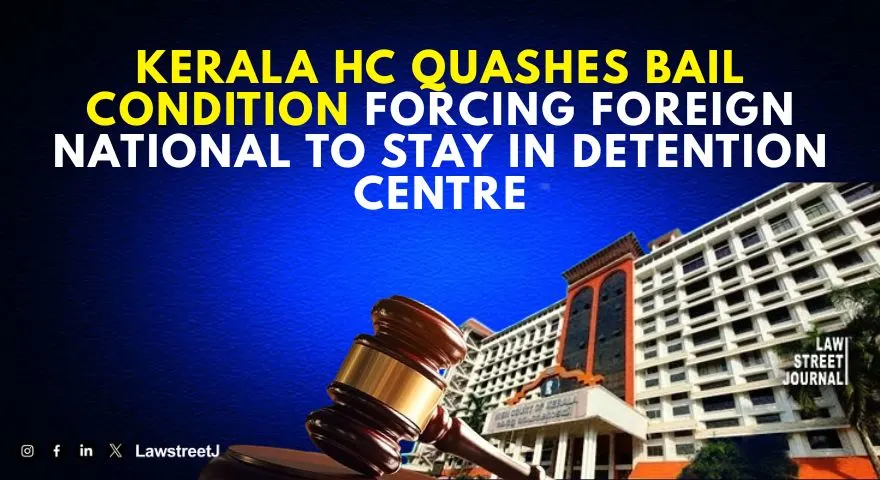
Kerala: The Kerala High Court has delivered a landmark judgment holding that criminal courts cannot impose conditions directing a foreign national to remain in a detention or transit centre after granting bail, as such conditions violate the fundamental right to personal liberty guaranteed under Article 21 of the Constitution.
Dr. Justice Kauser Edappagath was hearing a writ petition filed by Apple Barua, a 26-year-old Bangladeshi national, challenging the conditions imposed while granting him default bail under Section 167(2) of the Code of Criminal Procedure, 1973.
The petitioner was the first accused in Crime No. 871 of 2023 of Valiyathura Police Station and was charged with offences under Sections 465, 468, 471, 419 read with Section 34 of the IPC, Section 14(a) of the Foreigners Act, 1946, and Sections 12(1A) and 12(1)(b) of the Passport Act, 1967.
The prosecution alleged that the petitioner, along with a co-accused, forged documents for cheating purposes, committed impersonation, illegally obtained an Indian passport, and attempted to exit India through Thiruvananthapuram International Airport by deceiving immigration officials.
While granting default bail, the jurisdictional Magistrate imposed two contentious conditions: that the petitioner “shall remain in Transit Home, Kottiyam, Kollam District till the disposal of the case” under strict supervision of the Civil Authority, and that the Home Manager shall not release him without court orders.
Counsel for the petitioner submitted that these conditions constitute a form of continued and indefinite detention, defeating the very purpose of default bail, besides violating the fundamental rights guaranteed to the petitioner under Article 21. It was argued that the Foreigners Order, 1948 only enables Civil Authorities to place foreigners in detention centres, and “such a power cannot be extended to the Magistrate or Court while granting bail.”
The Deputy Solicitor General of India, representing the Foreigners Regional Registration Officer, contended that the petitioner had entered India illegally, obtained an Indian passport fraudulently, and that relaxing the conditions “could lead to his obtaining fake Indian documents under a different identity.” It was argued that since Article 19 does not grant foreigners the right to move freely within India, the Magistrate was justified in imposing the conditions.
The Public Prosecutor added that relaxing the conditions posed “a significant risk of the petitioner evading court procedures and colluding with accused No. 2 to commit similar offences.”
The court examined the statutory framework, noting that Section 437(3) of the Cr.P.C. mandates specific conditions while releasing persons accused of serious offences, including ensuring attendance, preventing commission of similar offences, and preventing tampering with evidence. The provision also permits imposing, “in the interests of justice, such other conditions as it considers necessary.”
Addressing the scope of bail conditions, the court observed, “The object of bail is neither punitive nor preventive. The object of imposing conditions of bail is to ensure that the accused does not interfere with or obstruct the investigation in any manner, remains available for investigation, does not tamper with or destroy evidence, does not commit any offence, remains regularly present before the trial court, and does not create obstacles in the expeditious conclusion of the trial.”
Crucially, the court held, “The bail conditions must be consistent with the object of imposing conditions and must not be so onerous as to frustrate the order of bail itself.”
Examining the phrase “interest of justice” under Section 437(3), the court relied on Kunal Kumar Tiwari v. State of Bihar, where it was held that “though palpably such wordings are capable of accepting a broader meaning, such conditions cannot be arbitrary, fanciful, or extend beyond the ends of the provision.”
The court also relied on Frank Vitus v. Narcotics Control Bureau, where the Supreme Court held that “a broader meaning cannot be assigned to the words ‘interest of justice’ in Section 437(3) of the Cr.P.C., and bail conditions cannot be fanciful, arbitrary, or freakish.”
On the fundamental rights aspect, the court stated, “The right to be enlarged on statutory bail under Section 167(2) of the Cr.P.C. is a fundamental right and not merely a statutory right. The said right flows from Article 21 of the Constitution of India and is an indefeasible part of the right to personal liberty.”
The court emphasized that “the court cannot frustrate or defeat this right of the accused through unreasonable conditions. Though while granting bail, the court can impose conditions in the interest of justice, restricting the exercise of fundamental rights of an accused under the cover of such a condition is not legally sustainable.”
Analyzing the Foreigners Order, 1948, the court noted that under Clause 11, Civil Authorities can impose movement restrictions on foreigners. However, it clarified that “the said power is wholly independent of the power to grant bail.” The court further held that notwithstanding the grant of bail, the power to arrest and detain a foreigner can be exercised only if the Central Government makes an order under Clause (g) of Section 3(2) of the Act.
The court categorically held that “the power vested with the Civil Authority under the Foreigners Order, 1948 to impose restrictions on the movement of a foreigner cannot be imported into sub-clause (3) of Section 437 of the Cr.P.C., nor can it be incorporated as a condition while granting bail to a foreign national.”
In a critical observation, the court held that “directions to remain in a detention centre or transit home while granting bail to a foreign national would amount to keeping the accused in some form of confinement even after release on bail, defeating the very purpose of bail.”
Addressing constitutional protections, the court stated that “such a condition is violative of the fundamental right guaranteed under Article 21 of the Constitution, which is available not only to Indian citizens but also to foreign nationals. A foreign national facing trial in India is entitled to the right to life and dignity under Article 21.”
Summarising its findings, the court held that “the Magistrate or Sessions Court, while granting bail to a foreign national, cannot impose a condition directing detention in a detention home or transit home till the conclusion of the trial. The Magistrate or Court does not have such power either under the Cr.P.C. or the Bharatiya Nagarik Suraksha Sanhita, 2023.”
The court further emphasized that “the phrase ‘interest of justice’ under clause (c) of Section 437(3) of the Cr.P.C. cannot be stretched to include such a power. Confinement in a transit home without statutory backing amounts to judicial overreach.”
In its final determination, the court held that “the direction in Ext. P2 requiring the petitioner to remain in a transit home converts the bail order into a detention order under the Foreigners Order, 1948. Therefore, condition Nos. 4 and 5 in Ext. P2 are not legally sustainable and are liable to be quashed.”
Following the Supreme Court’s guidance in Frank Vitus v. Narcotics Control Bureau, the court directed the Foreigners Regional Registration Officer to pass appropriate orders in accordance with law after hearing the petitioner within one month.
Accordingly, the impugned conditions were deleted and the writ petition was disposed of.
Kum. Niharika Hema Raj appeared for the petitioner, while Smt. O.M. Shalina, Deputy Solicitor General of India, and Sri Sangeetha Raj N.R., Public Prosecutor, appeared for the respondents.
Case Title: Apple Barua v. State of Kerala & Anr.



![Kerala HC Quashes 498A Dowry Harassment Case Against Live-In Partner, Citing Lack of Relative Status [Read Order]](/secure/uploads/2023/08/lj_5693_1057c042-1e57-4e27-8c9e-25af0ec38ec4.jpg)
![Watching porn on mobile: Kerala HC highlights importance of mother cooked meals, outdoor sports [Read Order]](/secure/uploads/2023/09/lj_9155_Parental_supervision_of_mobile_phone_usage.jpg)
![Lakshadweep MP Mohammed Faizal Disqualified from Lok Sabha After Conviction Suspension Plea Rejected by Kerala High Court [Read Notice]](/secure/uploads/2023/10/lj_9640_87b5fd97-0e05-4ff8-9a99-3be1e4446192.jpg)