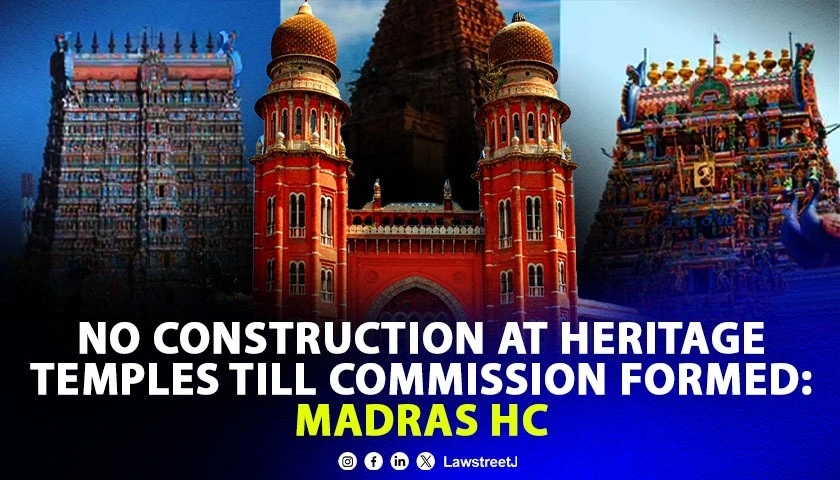
Chennai: The Madras High Court has ordered a complete ban on civil construction and developmental work at all archaeologically important temples and heritage structures in Tamil Nadu until the State Heritage Commission is constituted and becomes functional.
A Division Bench of Justices R. Suresh Kumar and S. Sounthar delivered the order on January 29, 2026, expressing frustration over the government’s delay in establishing the commission despite the Tamil Nadu Heritage Commission Act, 2012 having come into effect on March 1, 2024.
The case arose from writ petitions challenging proposed civil constructions at the Arulmigu Arunachaleswarar Temple in Tiruvannamalai, one of Tamil Nadu’s most significant heritage temples. Petitioners A. Radhakrishnan and T.R. Ramesh challenged the temple administration’s plans to undertake construction within the temple premises without obtaining approval from the Heritage Commission.
The Court noted that despite granting the government one month in its previous order dated November 13, 2025, to constitute the commission, minimal progress had been made. By the deadline of December 13, 2025, the government had only issued the Tamil Nadu Heritage Commission Rules on November 26, 2025, and constituted a Screening Committee on December 16, 2025.
The Bench observed that a notification inviting applications for the position of Chairman of the Heritage Commission was uploaded on the Department of Archaeology website on January 19, 2026, without specifying a date and allowing only seven days for applications. The Court found this inadequate, noting that even the website (www.tnarch.gov.in) was inaccessible when the Bench attempted to verify the notification.
The Court emphasized that since the Heritage Commission Act had come into force, permanent constructions within heritage temple premises should require permission from the Commission. It observed that had the Commission been constituted earlier, the proposed civil constructions at the Arunachaleswarar Temple would have been subject to expert scrutiny before proceeding.
The Bench directed the government to publish the notification inviting applications for the Chairman’s position in four leading Tamil dailies and two leading English dailies with statewide circulation within seven days. The application period was extended to at least two weeks to enable eminent persons to apply.
The Court further directed that applications be self-formatted, containing candidate details along with supporting documents. After the fifteen-day period, the Screening Committee constituted under G.O. (Ms) No. 496 dated December 16, 2025, shall scrutinize and shortlist at least three candidates. The names of the shortlisted candidates shall be placed before the Court in a sealed cover on the next hearing date, scheduled for March 5, 2026.
The Screening Committee comprises the Chief Secretary to the Government as Chairman, the Additional Chief Secretary to the Government (Tourism, Culture and Religious Endowments Department), and Thiru S. Rajavelu, retired Professor of Tamil University, Thanjavur, who serves as Advisor-Coordinator (Chief), Archaeology, for the Hindu Religious and Charitable Endowments Department.
The Court clarified that the ban on civil construction in archaeologically important temples and heritage structures shall remain in force until the Heritage Commission is constituted, becomes functional, and grants requisite permission. However, the Bench explicitly stated that the restriction does not apply to the conduct of festivals, including kumbhabhishekam and samprokshanam, in temples under the HR & CE Department.
The Court emphasized that Tamil Nadu is home to numerous temples and religious institutions of immense heritage value, and any construction or developmental activity undertaken by the HR & CE Department or any other authority must receive prior approval from the Heritage Commission.
The Bench also expressed concern that civil constructions were proceeding based on permissions granted by the State Government, the State Level Expert Committee, or the Regional Level Expert Committee—constituted pursuant to orders of a coordinate Bench—without oversight from the Heritage Commission, which ought to have been the competent authority.
The Court noted that although some preparatory steps had been taken pursuant to its earlier order dated October 9, 2025, the core requirement of constituting the Commission remained unfulfilled nearly ten months after the Act came into force.
The prohibitory order dated October 9, 2025, specifically concerning constructions at the Arunachaleswarar Temple, shall continue until further orders of the Court.
Case Title: A. Radhakrishnan v. The Secretary to the Government, Tourism, Culture and Endowments Department & Others, connected with T.R. Ramesh v. State of Tamil Nadu & Others



![TN Medical Council declares change of gender identity of LGBTQIA+ as misconduct [Read Notification]](/secure/uploads/2022/12/lj_5268_5cebb05a-97fb-40fb-8045-25cdf8f4207a.jpg)
![Madras High Court Directs Tamil Nadu Government to Ensure Quota for Transgenders in Local Body Elections [Read Order]](/secure/uploads/2023/08/lj_2507_7a03d113-08b1-4670-b6fb-9058aee481d0.jpg)
![Anti Corruption sleuths acted like "puppets in The Muppet Show", HC notice to ex TN CM in disproportionate assets case [Read Order]](/secure/uploads/2023/09/lj_8675_7b37fc02-1b2d-4f4a-9816-3df20545b37e.jpg)