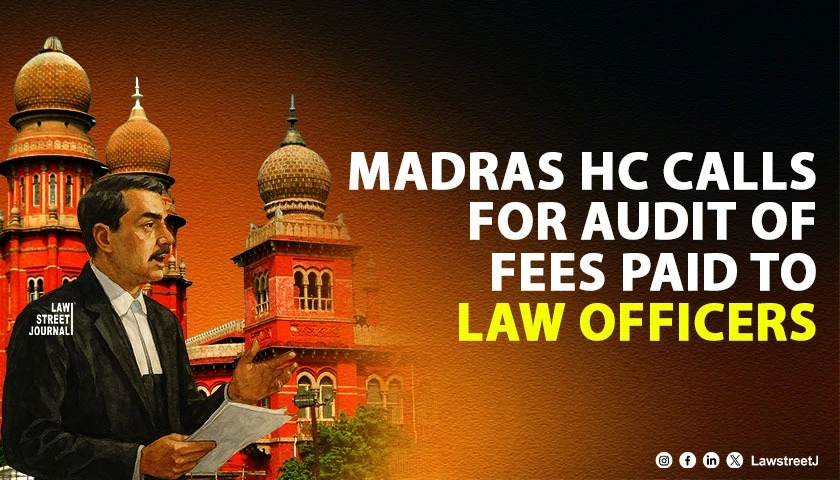
Chennai: The Madras High Court has observed that it is time that an audit be undertaken regarding the payment of fees to law officers, expressing dismay at the scandalously high amounts paid to some law officers and senior counsel by government and quasi-government institutions, including local bodies. The Court also criticised the practice of Additional Advocate Generals appearing even in small matters where their presence is not required, which even a novice government counsel could handle.
Justice G. R. Swaminathan delivered these strong observations on December 19, 2025, while disposing of a writ petition filed by P. Thirumalai, a former standing counsel for the Madurai City Municipal Corporation, seeking settlement of his pending fee bills.
The petitioner had served as standing counsel for the Madurai City Municipal Corporation for over 14 years from 1992 to 2006, representing the Corporation in the Madurai District Courts. His grievance was that the Corporation had not settled his fee bills. According to the petitioner, the Corporation had to pay a sum of ₹14,07,807, but it paid only ₹1,02,037, and the balance amount of ₹13,05,770 remained unpaid.
The petitioner had earlier filed WP(MD) No. 9282 of 2006 seeking payment, which was disposed of on November 14, 2006, with a direction to the respondent to consider his representation and pass an appropriate order. Pursuant to that direction, an order was passed, which the petitioner challenged through the present writ petition.
The respondent Corporation filed its counter affidavit stating that the local body was ready to honour the petitioner’s claim provided the claim bill was in order. The Corporation pointed out that along with the fee bills, copies of the judgments and decrees must be enclosed. The Corporation alleged that on account of non-submission of judgments within time, in quite a few cases—particularly public auction cases—the Corporation faced heavy loss, and that was why the petitioner was removed from the panel of lawyers. The Corporation stated that it was unable to pay the petitioner due to non-submission of copies of the judgments.
The petitioner’s counsel submitted that the petitioner had appeared in 818 cases and was now in penurious circumstances. When the petitioner approached an advocate’s clerk for obtaining certified copies, the clerk demanded ₹750 for each certified copy, which the petitioner was not in a position to afford.
The Court proceeded on the premise that the submission regarding the petitioner’s financial wherewithal was factually correct, stating that it did not wish to doubt the statement of counsel that the petitioner was unable even to engage a clerk for obtaining certified copies for the 818 cases in which he had appeared.
The Court directed the petitioner to approach the Chairman/Secretary of the Legal Services Authority, Madurai District Court, and hand over the list of cases in which he had appeared. The Chairman/Secretary of the Legal Services Authority was directed to verify the list furnished by the petitioner and, upon verification, arrange to obtain the certified copies and issue the same to the petitioner within two months from the date of receipt of a copy of the order.
The Court further directed that the petitioner shall thereafter submit his fee bills by enclosing the copies issued by the Legal Services Authority, and the Madurai Corporation shall settle the fee bills without interest within a period of two months thereafter. Interest was denied since the petitioner had mounted his challenge after a lapse of 18 years, and the Corporation could not be blamed for non-payment when the submission of the fee bills was not in order.
The Court also directed that the Legal Services Authority may raise an invoice towards the cost incurred for issuing certified copies, which shall be enclosed along with the fee bills, and the Madurai Corporation shall pay the invoice amount directly to the Legal Services Authority and settle the petitioner’s fee bills after duly deducting the same.
While disposing of the petition, Justice Swaminathan made strong observations on the state of payment of fees to law officers. The Court observed that the petitioner’s total claim appeared to be a pittance compared to the number of his appearances, and that payment had been withheld by citing procedural aspects.
The Court stated, “I cannot help wondering at the scandalously high amounts paid to some of the law officers and senior counsel by the government and quasi-government institutions, including local bodies.”
The Court cited the instance of Madurai Kamarajar University, which was in financial doldrums and had filed writ petitions seeking to avoid paying dues to its retired staff. The Court noted that a particular senior counsel was paid ₹4,00,000 per appearance by the university, while the university was pleading that its financial situation was such that it was unable to pay the dues of its retired staff.
The Court observed that Additional Advocate Generals appear even in small matters where their presence is not really required, which even a novice government counsel could handle, and that “all this is done for a few pennies. Marking appearance is a matter of money.”
Justice Swaminathan stated, “It is time that an audit is undertaken regarding the payment of fees to law officers.” The Court acknowledged that the Supreme Court had recently declined to order an enquiry into the payment of exorbitant fees to the Advocate General of Madhya Pradesh by the Madhya Pradesh Nurses Registration Council. However, the Court emphasised that “while courts cannot enquire into the quantum of fees paid to senior counsel and Additional Advocate Generals, good governance requires that funds from the public exchequer are drawn on a measured basis and not given away capriciously to a favoured few.”
The Court noted that recently a Division Bench presided over by Justice S.M. Subramaniam had indicated that an Additional Advocate General cannot appear in every matter, and that their presence should be required only where the nature of the case warrants such appearance.
Expressing concern over the proliferation of law officers, the Court observed, “In order to appease various constituencies, ruling governments appoint a needlessly high number of law officers. It is a matter of embarrassment that in the State of Tamil Nadu, there are close to a dozen Additional Advocate Generals. When I entered the Bar in 1991, we had only an Advocate General. There was no Additional Advocate General at all.”
The Court observed that when too many law officers are appointed, each of them necessarily has to be given work, which leads to the allotment of matters that do not even require their services. When such cases are called, government counsel seek adjournment or pass-over on the ground that the Additional Advocate General has been engaged but is elsewhere.
Justice Swaminathan expressed hope that “at least in the Madurai Bench of the Madras High Court, such practices will cease and the Additional Advocate Generals will turn a new leaf from 2026.”
The Court noted that it was not the only court to express dismay at the state of affairs, referring to similar observations made by the Allahabad High Court, which went a step further by directing that the matter be placed before the Uttar Pradesh Cabinet in Ishan International Educational Society through its Director v. Shri Mukul Singhal, Principal Secretary (2022 LiveLaw (AB) 271).
The Court prefaced its order with a quote attributed to the Holy Prophet (PBUH): “Pay the worker before his sweat dries,” observing that this principle is a facet of fairness, is eminently applicable in labour jurisprudence, and could also be invoked in the present case.
Case Title: P. Thirumalai v. The Madurai City Municipal Corporation, W.P.(MD) No. 26707 of 2022



![TN Medical Council declares change of gender identity of LGBTQIA+ as misconduct [Read Notification]](/secure/uploads/2022/12/lj_5268_5cebb05a-97fb-40fb-8045-25cdf8f4207a.jpg)
![Madras High Court Directs Tamil Nadu Government to Ensure Quota for Transgenders in Local Body Elections [Read Order]](/secure/uploads/2023/08/lj_2507_7a03d113-08b1-4670-b6fb-9058aee481d0.jpg)
![Anti Corruption sleuths acted like "puppets in The Muppet Show", HC notice to ex TN CM in disproportionate assets case [Read Order]](/secure/uploads/2023/09/lj_8675_7b37fc02-1b2d-4f4a-9816-3df20545b37e.jpg)