


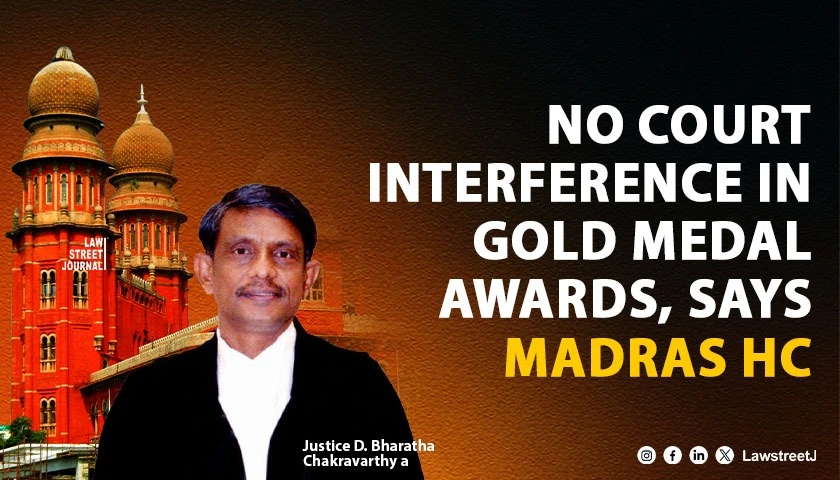
Chennai: The Madras High Court has declined to interfere with the decision of academic authorities regarding the conferment of gold medals, observing that such matters should be left to academicians. The Court refused to follow a Delhi High Court precedent which had interpreted absenteeism differently from a failed attempt in the context of academic honours.
Justice D. Bharatha Chakravarthy was dealing with W.P. No. 31106 of 2022 filed by H. Vennila, seeking a writ of certiorarified mandamus to quash the order dated 19.11.2021 passed by Bharathidasan Government College for Women and to direct the respondents to award her a gold medal for her meritorious academic performance in the B.Com (Corporate Secretaryship) course conducted during 2015–2018.
The Court noted the factual disparity, observing:
“The 5th respondent, namely Vijayalakshmi, who scored only 1923/2600 marks, i.e., 109 marks less than the petitioner, was granted the gold medal. The petitioner therefore made a representation to the respondents, which was rejected by the impugned order.”
The petitioner’s counsel submitted that the gold medal was denied solely on the ground that the petitioner was absent for one examination in the first semester. It was argued that the petitioner was absent due to dengue fever and that when she appeared for the examination in the ensuing semester as an arrear paper, she cleared it in the first attempt itself.
The Court noted the petitioner’s reliance on a Delhi High Court precedent, stating:
“The learned counsel for the petitioner relied upon the judgment of the Delhi High Court in W.P.(C) No. 2028 of 2016, Abhinav Pandey v. Guru Gobind Singh Indraprastha University & Ors., where the Court considered an identical issue. The Delhi High Court held that a candidate who was absent on account of illness and cleared the examination in the next attempt should not be treated as having cleared the subject in a second attempt.”
The Court further noted that the said judgment was affirmed by the Division Bench of the Delhi High Court in L.P.A. No. 248 of 2018 by judgment dated 16.10.2018.
The respondents, however, submitted that the grant of a gold medal is not a statutory right but an academic scheme framed by the authorities. It was contended that Pondicherry University issued a circular dated 04.06.2018, applicable to the relevant academic year, which clearly stipulated that all subjects must be cleared in the first attempt.
The Court examined the circular dated 04.06.2018, which stated:
“Gold Medals are to be awarded to the Top Rank Holder of each course in the ensuing Convocation of the Pondicherry University. It is to be noted that the candidate who comes under the top three positions should have completed their End Semester/Annual Examinations conducted during May 2018 and passed all the examinations in the first attempt itself.”
The Court observed that the interpretation of the term “first attempt” was central to the dispute. While acknowledging that the Delhi High Court had interpreted a similar rule to exclude absenteeism from being treated as an attempt, the Madras High Court declined to adopt that view.
The Court held:
“Since the word ‘attempt’ is not defined in the circular or in any relevant statute, it cannot be given a rigid meaning and must depend on the context in which it is sought to be construed.”
Emphasising academic autonomy, the Court observed that the conferment of a gold medal is an academic scheme intended to recognise academic excellence and motivate students, and that no enforceable legal right is involved.
The Court further reasoned that the interpretation of such academic criteria should be left to academicians, particularly when applied uniformly to all students. The Court also noted that another student suffering from illness might still choose to appear for an examination and score lower marks, and therefore, no violation of equality could be alleged.
Respectfully disagreeing with the Delhi High Court, the Court held that academic matters involving inter-se student competition should not ordinarily invite judicial interference.
The Court also noted that the 5th respondent had already been awarded the gold medal along with other toppers and that interference at this stage would be unfair to them.
However, recognising the petitioner’s exceptional academic merit, the Court observed that she had secured 109 marks more than the next candidate and would still lead even if zero marks were attributed to the second attempt. Taking a balanced view, the Court directed the second respondent college—now an autonomous institution—to issue an academic certificate on merit to the petitioner, certifying her as a gold medallist and topper for the year, in the same format as issued to the 5th respondent.
Accordingly, the writ petition was disposed of with no order as to costs.
Case Title: H. Vennila v. State & Ors.



![TN Medical Council declares change of gender identity of LGBTQIA+ as misconduct [Read Notification]](/secure/uploads/2022/12/lj_5268_5cebb05a-97fb-40fb-8045-25cdf8f4207a.jpg)
![Madras High Court Directs Tamil Nadu Government to Ensure Quota for Transgenders in Local Body Elections [Read Order]](/secure/uploads/2023/08/lj_2507_7a03d113-08b1-4670-b6fb-9058aee481d0.jpg)
![Anti Corruption sleuths acted like "puppets in The Muppet Show", HC notice to ex TN CM in disproportionate assets case [Read Order]](/secure/uploads/2023/09/lj_8675_7b37fc02-1b2d-4f4a-9816-3df20545b37e.jpg)
.jpeg)


.jpeg)

