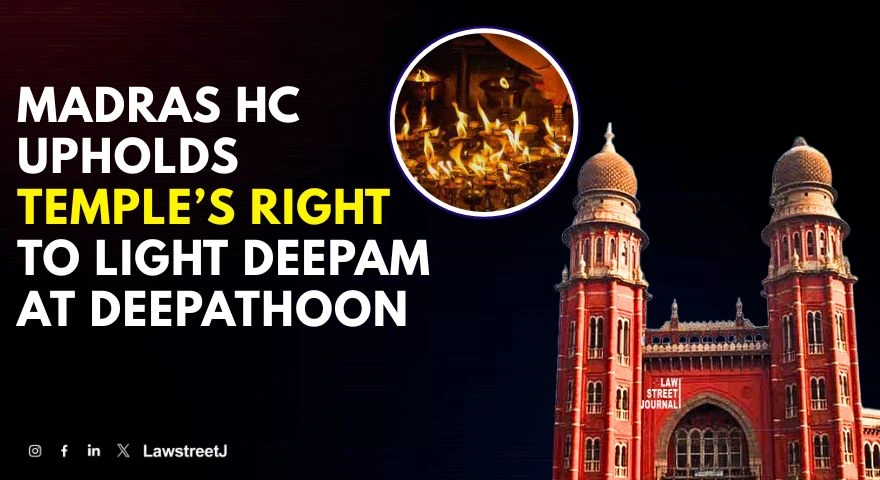
Chennai: The Madurai Bench of the Madras High Court has directed the temple management to light the Karthigai Deepam at the Deepathoon (ancient stone lamp pillar) located on the lower peak of Thirupparankundram Hill, in addition to the existing practice of lighting it near the Uchi Pillaiyar Temple.
Justice G.R. Swaminathan delivered the judgment on December 1, 2025, while disposing of five connected writ petitions filed by Hindu devotees seeking permission to light the festival lamp at the hilltop Deepathoon, a practice they claimed had been discontinued.
The petitioners, who described themselves as devout followers of Lord Muruga, challenged the temple executive officer’s decision to light the Karthigai Deepam only at the Deepa Mandapam near the Uchi Pillaiyar Temple located halfway up the hill. They sought directions to resume the tradition of lighting the lamp at the stone pillar situated on one of the hill’s peaks.
The case involved a complex historical backdrop. Thirupparankundram Hill houses both the ancient Arulmigu Subramania Swamy Temple at its base and the Sikkandar Badhusha Dargah at its summit. Ownership disputes between the Hindu temple management and Muslim Dargah trustees have been the subject of multiple civil suits dating back a century.
The most significant litigation was O.S. No. 4 of 1920, where the Sub-Judge of Madura decreed that the temple owned the entire hill except three specific areas: the Nellithope burial ground, the flight of steps leading to the mosque, and the actual site where the mosque stands. This judgment was upheld by the Privy Council, which held that the unoccupied portions of the hill belonged to the temple and had been in its possession from time immemorial.
The respondents—including the state government, temple management, Dargah trustees, and the Waqf Board—strongly opposed the petitioners’ prayer. They argued that the petitioners lacked standing to maintain the writ petitions, that the issue required civil-court adjudication for proper demarcation, and that the matter was barred by res judicata based on earlier court orders from 2014 and 2017 that had rejected similar requests.
The Court rejected these contentions systematically. On the question of locus standi, Justice Swaminathan held that the petitioners, as devotees entitled to worship at the temple, were “persons having interest” under Section 6(15) of the Tamil Nadu Hindu Religious and Charitable Endowments Act, 1959, and therefore had the right to maintain the petitions.
On the issue of demarcation, the Court found that the boundaries had already been conclusively settled by the 1920 decree and subsequent litigation. The Deepathoon is located on the lower of two peaks, approximately 50 metres away from the Dargah, which sits on the highest peak. The Court noted that the trial judge in the 1920 case had himself recognized the existence of two distinct peaks, with the Hindu shrine at the base of the lower peak and the mosque at the higher summit.
The Court also dismissed the plea of res judicata. While an earlier petition in 2014 had been rejected because it sought lighting at the hilltop itself (which belongs to the Muslims), the present petitioners sought lighting only at the Deepathoon on the lower peak, which falls within temple property. The divergence in relief sought meant the earlier judgment did not operate as a bar.
In a significant observation, the Court held that this was not merely a question of custom but of legal right. The temple management had a duty to protect its properties as declared in the 1920 decree. The Court emphasized that lighting the lamp at the Deepathoon was necessary to assert the temple’s title and prevent any encroachment, particularly given past attempts by the Dargah management to disturb the status quo.
The Court drew attention to Tamil literary tradition, citing ancient Sangam literature dating back nearly 2,000 years that referred to Thirupparankundram as the hill of Lord Muruga. It also noted the Tamil tradition of lighting lamps atop hills during Karthigai, as practiced at other sacred sites like Thiruvannamalai. The Court observed that a Deepathoon, by its very nature and purpose, is meant for lighting lamps.
Justice Swaminathan noted that the Dargah itself had been compounded and was located at a safe distance from the Deepathoon. He also pointed to evidence showing that the temple management had recently covered the Deepathoon—an action the Dargah had not objected to, indicating tacit acknowledgment that the structure fell within temple control.
The Court quashed the executive officer’s decision as lacking jurisdiction, noting that such a significant matter should have been decided by the temple’s Trust Board rather than the executive officer alone. However, given that the board had not taken an independent stand, the Court proceeded to decide the matter directly rather than remanding it.
Emphasizing that lighting a lamp is a sacred act that cannot offend sensibilities, the Court directed the temple management to light the Karthigai Deepam at the Deepathoon from this year onwards, in addition to lighting it at the usual places. The Court ordered the Commissioner of Police, Madurai City, to ensure compliance with its directions and to prevent any interference.
The Court allowed four of the five writ petitions and dismissed the fifth, which had opposed lighting the lamp at the hilltop. In concluding, Justice Swaminathan observed that the balance of convenience favoured the petitioners, as lighting the lamp would not affect the Dargah’s rights but failing to do so could jeopardise the temple’s legitimate property interests.
Case Title: Rama Ravikumar v. The District Collector & Others (W.P.(MD) Nos. 32317, 33112, 33197, 33724, 34051 of 2025)



![TN Medical Council declares change of gender identity of LGBTQIA+ as misconduct [Read Notification]](/secure/uploads/2022/12/lj_5268_5cebb05a-97fb-40fb-8045-25cdf8f4207a.jpg)
![Madras High Court Directs Tamil Nadu Government to Ensure Quota for Transgenders in Local Body Elections [Read Order]](/secure/uploads/2023/08/lj_2507_7a03d113-08b1-4670-b6fb-9058aee481d0.jpg)
![Anti Corruption sleuths acted like "puppets in The Muppet Show", HC notice to ex TN CM in disproportionate assets case [Read Order]](/secure/uploads/2023/09/lj_8675_7b37fc02-1b2d-4f4a-9816-3df20545b37e.jpg)