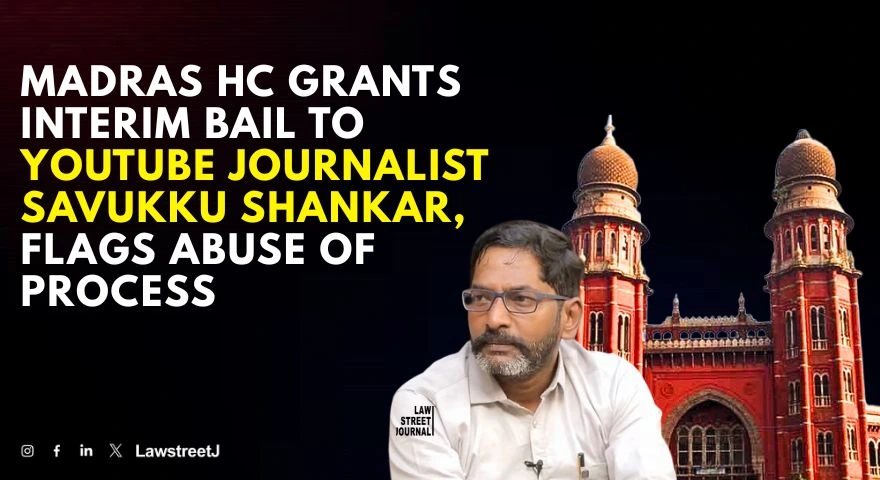
Chennai: The Madras High Court has granted interim bail for 12 weeks to YouTube journalist A. Shankar, popularly known as Savukku Shankar, observing that his repeated incarceration and the manner in which criminal law had been invoked against him raised serious concerns of abuse of process and violation of personal liberty under Article 21 of the Constitution. The Court emphasized that the repeated clamping down of an individual who has the right to dissent under Article 19(1)(a) would not send the right signal to citizens.
A Division Bench comprising Justice S.M. Subramaniam and Justice P. Dhanabal delivered the decision on December 26, 2025, while allowing petitions filed by the journalist’s mother, A. Kamala, seeking medical treatment for her son and challenging his solitary confinement. The petitioner stated that her son is presently confined in Central Prison-II, Puzhal, Chennai.
According to the petitioner, Mr. A. Shankar, also known as Savukku Shankar, is a video journalist and the CEO of Savukku Media (OPC) Private Limited, who has been engaged in exposing corruption and malpractices in governmental and administrative functions through his YouTube channel, “Savukku Media.” Owing to his whistle-blowing activities and investigative journalism, he has allegedly been subjected to continuous hardship and harassment by authorities attempting to silence him. Unable to tolerate the exposure of illegalities, misuse of power, and the critiques and comments made by him, politicians wielding power and police officials have, according to the petitioner, persistently foisted one criminal case after another against him.
The Court noted the troubling history of detention orders against the journalist. A detention order passed on May 12, 2024, was set aside by the High Court on August 9, 2024. Merely three days thereafter, a second detention order was issued on August 12, 2024. Subsequently, yet another detention order was passed, which was later withdrawn by the Government itself before the Supreme Court of India.
In the present case, the petitioner submitted that one Nithish, engaged as an anchor on Shankar’s media platform “Savukku Media,” received an unauthorized transfer of ₹94,000 to his mobile number linked with his GPay account on December 12, 2025, at about 3:30 PM. While Nithish was in the process of lodging a complaint regarding the unauthorized transfer, the police allegedly arrested the petitioner’s son on December 13, 2025. It was contended that although the FIR was registered on December 12, 2025, at 7:45 PM, the police arrived to secure Shankar’s arrest at 6:30 AM on December 13, 2025. The petitioner argued that the sequence and timing of events clearly indicated that the alleged transfer was orchestrated as a trap to falsely implicate her son and secure his arrest in a fabricated criminal case.
The Court expressed its inability to understand why one particular individual, a YouTube journalist, had repeatedly been incarcerated by the law-enforcement agency. The Court observed, “It raises suspicion as to whether the petitioner’s son herein has become a target of the ruling dispensation, as alleged by her.”
The Court highlighted that the history of the case showed repeated invocation of the Goondas Act against the journalist for expressing his views through YouTube videos on the actions of the State Government. The Court remarked that it was “highly unusual” that the same individual was subjected to successive detention orders, with the second order being passed immediately after the first was set aside, raising serious questions about abuse of process by the State’s law-enforcement machinery.
The Bench placed reliance on its earlier judgment dated August 9, 2024, authored by Justice S.M. Subramaniam while sitting in a Division Bench, which had set aside one of the detention orders against Mr. Shankar. That judgment contained extensive observations on freedom of speech and expression, which were quoted at length in the present order.
On freedom of speech, the Court had observed that it would never stifle or attempt to strangulate Article 19(1)(a) of the Constitution, and that indirect censorship through preventive detention would be a hopeless pursuit. The Court further noted that in the age of the internet, information is abundant, and prosecuting every individual for allegedly false information is neither practical nor desirable unless it threatens public order.
The Court also emphasized that democracy cannot survive if only uniform or “acceptable” views are permitted, and that dissent, even if unpleasant, is an inevitable part of a democratic society. It observed that people consuming information on social media are best placed to judge opinions expressed therein.
In the present order, the Court observed that the allegations made in the affidavit were serious in nature and alleged repeated mental harassment of the petitioner’s son, which could cause serious disrepute to the law-enforcement agency. The Court reiterated that due process of law cannot be misused to target individuals who have fallen out of favour with the State Government, and that professionalism and discipline of uniformed personnel must not be compromised.
The Court held that the repeated curtailment of Mr. Shankar’s personal liberty under Article 21 could only be construed as an abuse of process of law. Reliance was placed on the Supreme Court’s decision in Arnab Manoranjan Goswami v. State of Maharashtra, which underscored that courts must act as the first line of defence against deprivation of liberty.
The Court also relied on Mukesh Kishanpuria v. State of West Bengal and Arvind Kejriwal v. Directorate of Enforcement, which recognize the power of courts to grant interim bail under compelling circumstances, even where regular bail may not be justified.
The Bench took note of the petitioner’s submission that her son is a cardiac patient who has undergone major cardiac surgery involving the implantation of two stents due to severe coronary blockages, and that he is also a chronic diabetic. The Court observed that the right to health forms an integral part of Article 21 and extends to prison inmates.
After examining the medical records and the circumstances surrounding the prisoner’s confinement, the Court found it fit to grant interim bail to Mr. Shankar for a period of 12 weeks from December 26, 2025, in connection with 17 criminal cases registered against him across various police stations.
The Court directed that Mr. Shankar shall execute a personal bond of ₹1,00,000 before the Superintendent of Prison and be released forthwith. Conditions were imposed, including restrictions on travel abroad, non-interference with witnesses, disclosure of residence to the investigating officer, and surrender before prison authorities on or before March 25, 2026. The Court clarified that the grant of interim bail would not amount to an expression of opinion on the merits of the pending criminal cases.
Case Title: A. Kamala v. The Inspector of Police, J1-Saidapet Police Station & Ors., W.P.M.P.Crl. No. 839 of 2025 in W.P. No. 1791 of 2025 and H.C.P. No. 2754 of 2025.



![TN Medical Council declares change of gender identity of LGBTQIA+ as misconduct [Read Notification]](/secure/uploads/2022/12/lj_5268_5cebb05a-97fb-40fb-8045-25cdf8f4207a.jpg)
![Madras High Court Directs Tamil Nadu Government to Ensure Quota for Transgenders in Local Body Elections [Read Order]](/secure/uploads/2023/08/lj_2507_7a03d113-08b1-4670-b6fb-9058aee481d0.jpg)
![Anti Corruption sleuths acted like "puppets in The Muppet Show", HC notice to ex TN CM in disproportionate assets case [Read Order]](/secure/uploads/2023/09/lj_8675_7b37fc02-1b2d-4f4a-9816-3df20545b37e.jpg)