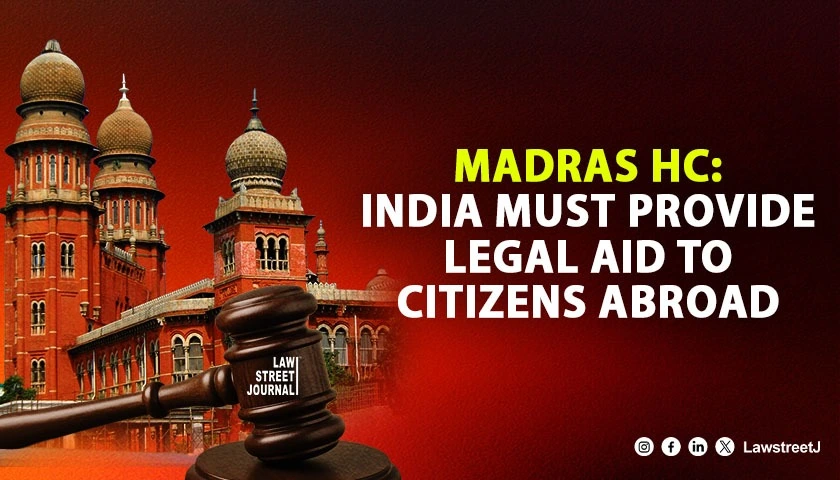
Chennai: The Madras High Court has ruled that the Government of India has a constitutional duty to provide legal assistance to Indian citizens facing employment disputes abroad, invoking ancient Indian jurisprudence on Rajadharma (duties of a king) and principles from Kautilya’s Arthashastra, alongside constitutional provisions, to establish the State’s obligation towards overseas workers.
Justice G.R. Swaminathan delivered the order on December 16, 2025, while hearing a petition filed by Malarvizhi @ Kottaithai, the widow of Ayyappan Marimuthu, who died while working in Cameroon. The petitioner sought intervention to secure compensation promised but not paid by the employer. The Court directed the Government of India to formulate a comprehensive policy framework for providing legal assistance to Indian citizens abroad.
The petitioner’s husband, employed by Africa First Matches Industry S.A. in Yaoundé, Cameroon, passed away on October 13, 2021. The employer had undertaken to pay compensation through a letter dated October 19, 2021, but failed to honour the commitment. The petitioner, unable to pursue legal remedies abroad, approached the High Court seeking government intervention.
The Additional Solicitor General submitted that consular assistance had been provided and that the Under Secretary had written to the High Commission in Cameroon regarding the compensation. However, the government contended that the company was no longer functioning as the person-in-charge had died, that funding a legal battle abroad would be expensive, and that Legal Services Authority resources could not be deployed, as the Act applies only within Indian territory.
The Court held that there could be only one answer—in the affirmative—premised on the nature of the Indian State as a welfare state. The Court referred to the Supreme Court’s decision in Gaurav Kumar Bansal v. Union of India, which held that a welfare state is the protector of its citizens not only within the country but also outside it. The concept of parens patriae recognises the State as the protector of its citizens, particularly when they are unable to protect themselves.
The Court noted that Article 38(1) declares that the State shall strive to promote the welfare of the people. The Preamble, read with Articles 38, 39, and 39-A, enjoins the State to secure the rights guaranteed by the Constitution, and where citizens cannot assert their rights, the State must protect and fight for them.
In a significant observation drawing on ancient Indian jurisprudence, Justice Swaminathan invoked the doctrine of Rajadharma. Citing Justice M. Rama Jois’s work on the Legal and Constitutional History of India, the Court noted that Kautilya’s Arthashastra declares that “in the happiness of his subjects lies the king’s happiness; in their welfare, his welfare.” The Court also cited Manu’s declaration that the highest duty of a king is to protect his subjects, observing that the expression “Government” must be substituted for “king” in the contemporary context.
The Court emphasised that the Government earns huge foreign exchange through inward remittances, making the nation’s exchequer a direct beneficiary. It held:
“When the Government is receiving such benefit from migrant workers, it has a correlative and corresponding duty to rush to their rescue when issues arise out of such overseas employment.”
The Court further cited the Shanti Parva of the Mahabharata, which states that “the king who receives one-sixth of the income and still fails to protect the people becomes a sinner.”
Justice Swaminathan also reflected on the practice of citing ancient texts in judicial decisions, observing:
“If Latin maxims can be quoted and judgments can rest on them, one need not shy away from citing our own heritage and sources, which can be in Sanskrit or Tamil or any Indian language.”
The Court expressed a wish for the compilation of “Swadeshi maxims” embodying the distilled wisdom of Indian society.
Invoking Article 51-A(f), which mandates every citizen to value and preserve India’s composite culture, the Court observed:
“When principles and doctrines can be borrowed from other jurisdictions and international conventions, there cannot be any objection to invoking principles from our ancient jurisprudence.”
Synthesising constitutional provisions with ancient jurisprudence, the Court concluded:
“The constitutional provisions and the Preamble, construed in the light of the doctrine of Rajadharma, postulate that the Government of India has a duty to provide legal aid to its citizens not only within the territory of India but also outside it.”
Accordingly, the Court directed the Government of India to formulate a comprehensive and feasible policy framework for providing legal assistance to Indian citizens abroad. Addressing the petitioner’s case, the Court held that the government must take up the matter at the highest echelons of the Government of Cameroon, bring pressure on persons who stepped into the employer’s shoes, issue legal notices, step up mediation, and, if necessary, wage a formal legal battle.
Case Title: Malarvizhi @ Kottaithai v. The Secretary to Government of India & Ors.
[W.P.(MD) No. 17073 of 2022]



![TN Medical Council declares change of gender identity of LGBTQIA+ as misconduct [Read Notification]](/secure/uploads/2022/12/lj_5268_5cebb05a-97fb-40fb-8045-25cdf8f4207a.jpg)
![Madras High Court Directs Tamil Nadu Government to Ensure Quota for Transgenders in Local Body Elections [Read Order]](/secure/uploads/2023/08/lj_2507_7a03d113-08b1-4670-b6fb-9058aee481d0.jpg)
![Anti Corruption sleuths acted like "puppets in The Muppet Show", HC notice to ex TN CM in disproportionate assets case [Read Order]](/secure/uploads/2023/09/lj_8675_7b37fc02-1b2d-4f4a-9816-3df20545b37e.jpg)