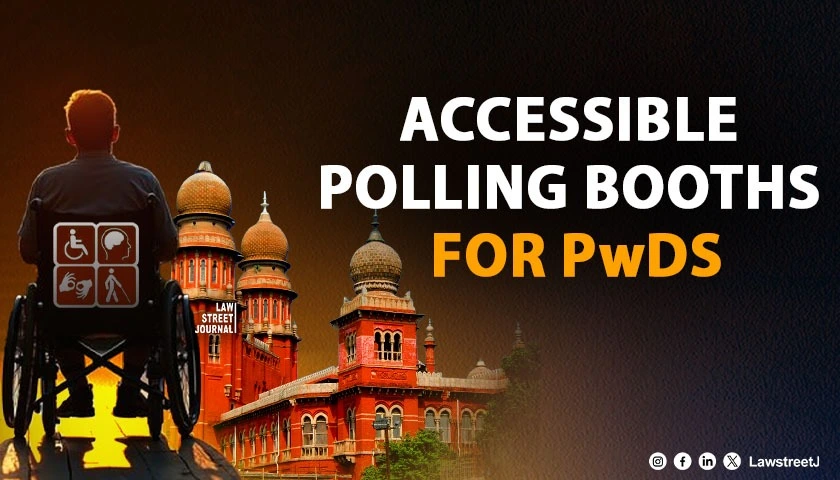
Chennai: The Madras High Court has directed the Election Commission of India to ensure that permanent ramps are constructed in all schools and public buildings routinely notified as polling booths, in strict compliance with the Rights of Persons with Disabilities Act, 2016.
The Court also directed the Election Commission to expeditiously complete the process of making its websites accessible and usable for persons with disabilities.
The directions were issued by a division bench comprising Chief Justice Sushrut Arvind Dharmadhikari and Justice G. Arul Murugan while disposing of a writ petition filed by Vaishnavi Jayakumar, a person with disability from Chennai. She had sought a direction compelling the Election Commission to notify only those polling booths that fully comply with the assured minimum facilities prescribed under its own guidelines, and to make all electoral information available on its websites in formats accessible to persons with disabilities.
The petitioner’s counsel argued that despite the Rights of Persons with Disabilities Act, 2016, which places a statutory duty on the Election Commission to ensure that all polling stations are accessible and that all electoral materials are easily understandable, persistent shortfalls continued on the ground. In particular, permanent ramps had not been installed at most polling booths. Instead, temporary arrangements using wooden planks were put in place a few days before each election, which were frequently defective and failed to provide genuine accessibility. Even during the recently concluded State Assembly elections, several such problems were reported and brought to the notice of the Election Commission.
The Election Commission, through its Standing Counsel, submitted that it had already issued comprehensive instructions to all States and Union Territories directing the construction of permanent ramps and the provision of other facilities for voters with disabilities. The Commission stated that it was ensuring compliance with those directions and that any shortfalls brought to its notice would be suitably addressed. The Advocate General for Tamil Nadu similarly submitted that the Chief Secretary had convened meetings with district authorities to ensure that all facilities, including ramps, were in place for the recent elections.
The Court traced the legal framework governing the issue. It noted that under the Rights of Persons with Disabilities Act, 2016, public buildings — including government and private buildings accessed by the general public, as well as educational institutions — are mandated to provide permanent facilities for easy access to persons with disabilities. It further observed that Section 11 of the Act casts a mandatory duty on the Election Commission to ensure that all polling stations are sufficiently equipped and accessible.
The Court further noted that this obligation had been reinforced by the Supreme Court as far back as 2007, when it directed the Election Commission to issue appropriate instructions to all State Governments for the construction of permanent ramps in all public buildings housing polling stations. The Election Commission itself had subsequently issued circulars in 2005 and 2007, along with detailed consolidated guidelines in 2023, all of which mandated permanent ramps with a gradient not exceeding 1:12 at every polling station.
Despite this long trail of directions and guidelines, the Court found that in most educational institutions and public buildings routinely used as polling booths, permanent ramps were simply not available. The Court observed that these buildings are, in any case, independently obligated under the 2016 Act to provide permanent accessibility infrastructure, and that their continued non-compliance was unacceptable.
On the question of digital accessibility, the Court noted that the Election Commission had already written to the Ministry of Electronics and Information Technology requesting an audit of its websites and applications in line with the Guidelines for Indian Government Websites 3.0 and the Web Content Accessibility Guidelines 2.1. The Court directed the Commission to take further expeditious steps to complete the process of making its digital platforms accessible and usable for persons with disabilities.
Accordingly, the Court disposed of the petition with two directions: first, that permanent ramps be constructed at all routinely notified polling booths, particularly in educational institutions and public buildings, in strict compliance with the Rights of Persons with Disabilities Act, 2016; and second, that the Election Commission expeditiously complete the process of making its websites accessible to persons with disabilities.
Case Title: Vaishnavi Jayakumar v. Election Commission of India

![TN Medical Council declares change of gender identity of LGBTQIA+ as misconduct [Read Notification]](/secure/uploads/2022/12/lj_5268_5cebb05a-97fb-40fb-8045-25cdf8f4207a.jpg)
![Madras High Court Directs Tamil Nadu Government to Ensure Quota for Transgenders in Local Body Elections [Read Order]](/secure/uploads/2023/08/lj_2507_7a03d113-08b1-4670-b6fb-9058aee481d0.jpg)
![Anti Corruption sleuths acted like "puppets in The Muppet Show", HC notice to ex TN CM in disproportionate assets case [Read Order]](/secure/uploads/2023/09/lj_8675_7b37fc02-1b2d-4f4a-9816-3df20545b37e.jpg)