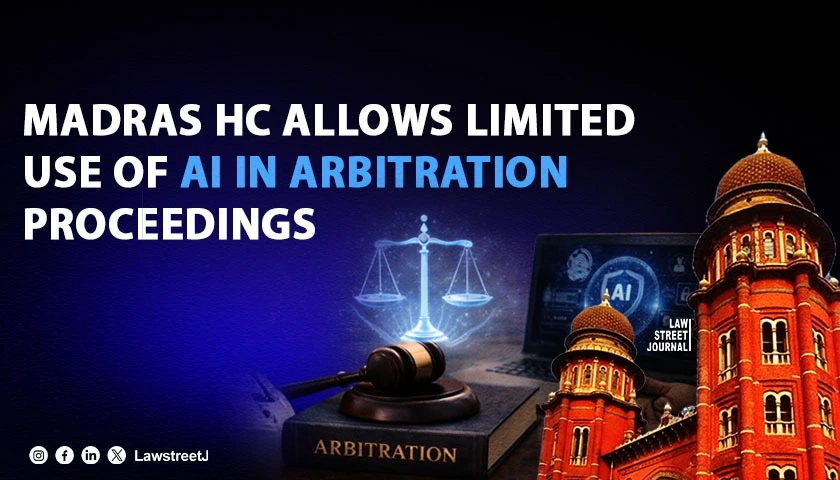
Chennai: The Madras High Court has delivered a groundbreaking order permitting the use of an AI-assisted algorithm called “SuperlawCourts” to support court proceedings, while establishing clear boundaries to preserve judicial independence and human decision-making.
Justice N. Anand Venkatesh made crucial observations on the role and limitations of artificial intelligence in judicial proceedings, emphasizing that the system functions solely as a record-management assistant and does not replace legal reasoning or judicial determination.
The Court was dealing with multiple connected arbitration matters, including Arb O.P. (COM.DIV.) No. 247 of 2022 and related applications, between M/s. Gammon-OJSC Mosmetrostory JV and Chennai Metro Rail Limited. The Court noted:
“When the matter was taken up for hearing today, the algorithm SuperlawCourts was demonstrated before this Court.”
Explaining the fundamental purpose of the AI system, the Court observed:
“SuperlawCourts is a computer-assisted system designed to help legal professionals locate, organise, and understand information contained strictly within the documents placed before it for a particular matter.”
The Court emphasized the critical limitations of the system, stating:
“It is not intended to replace legal reasoning, judicial determination, or counsel’s professional judgment.”
In establishing strict operational boundaries, the Court highlighted key safeguards, including strict confinement to the record. It observed:
“SuperlawCourts works exclusively on the documents provided for the matter. It does not consult external sources, general knowledge, or materials outside the record.”
On accuracy and reliability, the Court noted:
“If the record does not contain information in a traceable form, the system states that such information is not found in the documents provided, rather than generating an unsupported response.”
Emphasizing the prohibition on legal inference, the Court stated:
“The system does not draw conclusions, assess credibility, interpret intent, or express legal views. It only presents what the documents state.”
Addressing transparency and verification, the Court observed:
“Outputs are based on identifiable portions of the record, allowing lawyers and the Court to independently verify context.”
Explaining the document-processing methodology, the Court noted that the system:
“creates a dedicated digital workspace, comparable to a sealed record room in judicial chambers,”
where documents are converted into searchable text using Optical Character Recognition.
On the AI’s role in responding to queries, the Court stated:
“The AI Partner’s role is limited to re-expressing or summarising the retrieved excerpts in clear language. It cannot introduce new facts, make assumptions, or apply legal reasoning.”
In a significant observation on transparency, the Court directed:
“Whatever interactions take place with the algorithm on the side of the counsel appearing on either side, as well as the Court, a separate link will be provided, and anyone who wishes to ascertain the level of interaction that has taken place with the algorithm can click the link and verify the same.”
Highlighting the limited scope of AI assistance, the Court observed:
“This is the first case where the assistance of Artificial Intelligence is going to be used by the Court. Hence, it was agreed that a draft order will be prepared containing the facts of the case and the arguments put forth by both sides, covering the pleadings, evidence, and findings of the arbitral tribunal.”
Clarifying the termination point of AI involvement, the Court stated:
“Upon such circulation, the reliance placed on Artificial Intelligence also comes to an end. Therefore, what will be verified by both sides will be the accuracy of recording the facts of the case and the submissions made on either side, including the pleadings and evidence.”
In its procedural directions, the Court recorded:
“The demonstration of the working of the algorithm was done with the participation of the learned counsel appearing on either side, as well as this Court. Prima facie, both the parties and the Court are satisfied with the working method of the algorithm.”
The Court further directed that counsel would work with the algorithm for one week and report on its effectiveness, with the final hearing scheduled for February 12, 2026.
Summing up the nature of the AI assistance, the Court described the system as:
“an exceptionally organised and cautious record assistant: it prepares the papers, creates a reliable finding aid, and presents relevant excerpts on request, while remaining strictly bound to the record and leaving all legal judgment to human decision-makers.”
Mr. Sivanandaraj, Senior Counsel, appeared for the petitioner, while Mr. K. Harishankar appeared for the respondent.
Case Title: M/s. Gammon-OJSC Mosmetrostory JV v. M/s. Chennai Metro Rail Limited



![TN Medical Council declares change of gender identity of LGBTQIA+ as misconduct [Read Notification]](/secure/uploads/2022/12/lj_5268_5cebb05a-97fb-40fb-8045-25cdf8f4207a.jpg)
![Madras High Court Directs Tamil Nadu Government to Ensure Quota for Transgenders in Local Body Elections [Read Order]](/secure/uploads/2023/08/lj_2507_7a03d113-08b1-4670-b6fb-9058aee481d0.jpg)
![Anti Corruption sleuths acted like "puppets in The Muppet Show", HC notice to ex TN CM in disproportionate assets case [Read Order]](/secure/uploads/2023/09/lj_8675_7b37fc02-1b2d-4f4a-9816-3df20545b37e.jpg)