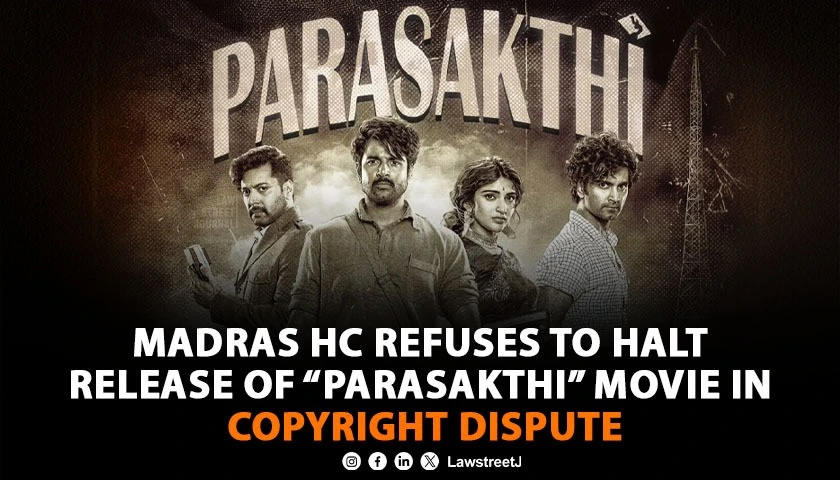
Chennai: The Madras High Court has refused to halt the release of the movie Parasakthi following a plea alleging copyright infringement, holding that the plaintiff failed to establish even a prima facie case that his script was copied.
Justice Senthilkumar Ramamoorthy dismissed the interim injunction application filed by scriptwriter K.V. Rajendran (also known as Varun Rajendran), who claimed that the movie copied his script titled Chemmozhi, which he had registered with the South Indian Film Writers’ Association (SWAN) on January 27, 2010.
The plaintiff asserted that he authored a two-part script running to 56 typed pages, inspired by his connection to M. Rasendran, one of the martyrs of the anti-Hindi agitation. He claimed that out of deep love for the Tamil language, he created the script Chemmozhi and later met various participants of the anti-Hindi agitation to obtain additional information.
The plaintiff alleged that after learning the defendants were producing a movie by copying his script, he lodged a complaint with SWAN on January 15, 2025. He also claimed that director Sudha Kongara, the first defendant, had previously plagiarized stories written by others, relying on a YouTube video posted on January 26, 2025.
However, the Court noted several critical deficiencies in the plaintiff’s case. First, it observed a fundamental mismatch between the relief sought in the main suit and the interim application. While the suit sought only to restrain the defendants from displaying certain names as writers and original concept creators, the interim application sought the far broader relief of preventing the entire movie’s release. The Court held that since the interim relief travelled beyond the scope of the plaint’s prayer, it was liable to be rejected on this ground alone.
On merits, the Court found it impossible to reach even a prima facie finding of copyright infringement based on the materials on record. Dawn Pictures Private Limited, the producer (fourth defendant), had categorically denied the plagiarism allegations in its counter-affidavit. The producer stated that upon careful comparative reading, there was “no similarity whatsoever between the two works in any legally protectable sense,” asserting that the characters, narrative structure, dialogues, emotional pitch, sequencing of events, and overall cinematic treatment were wholly distinct and independently conceived.
Significantly, the producer revealed that it had entered into an Expert Consultant Agreement dated June 16, 2025, with Ayyasamy Ramasamy, a student leader and participant in the 1965 anti-Hindi agitation, who expressly consented to the filmmakers referencing his life experiences, personal recollections, and historical inputs on a work-for-hire basis. This suggested an independent source for the movie’s content.
The Court held that the balance of convenience was decidedly against the plaintiff. It noted that the movie was scheduled for release on January 10, 2026, and was a big-budget production with multiple stakeholders who would be adversely affected by an injunction. The producer had asserted that any interference would cause huge financial losses.
Critically, the Court found delay and laches on the plaintiff’s part. The plaintiff admitted in both his plaint and supporting affidavits that he became aware of efforts to make the movie by late 2023, yet chose to institute the suit only in December 2025, just days before the scheduled release. This delay weighed heavily against granting interim relief.
The Court also noted that the plaintiff had prayed for damages in addition to injunctive relief. Since monetary compensation could adequately remedy any eventual finding of copyright infringement, the plaintiff had not demonstrated irreparable harm that would justify preventing the movie’s release.
Regarding the second application seeking the constitution of an expert committee by SWAN to compare the two scripts, the Court had earlier directed the writers’ association to examine the complaint and submit a report. However, no report had been filed by the date of hearing. The Court observed that copying is ordinarily required to be adjudicated from the perspective of an average common reader or viewer, and therefore the probative value of any expert committee report would require careful consideration during final disposal.
The Court disposed of both applications by dismissing the injunction application without costs and directing SWAN to submit its report in a sealed envelope, with its relevance and weight to be determined during the final trial. The main copyright infringement suit has been listed for hearing on January 28, 2026.
Senior Counsel P.S. Raman appeared for director Sudha Kongara, while Senior Counsel P.H. Arvindh Pandian represented the producer. The judgment clears the path for the movie’s scheduled release on January 10, 2026.
Case Title: K.V. Rajendran @ Varun Rajendran v. Sudha Kongara and Others



![TN Medical Council declares change of gender identity of LGBTQIA+ as misconduct [Read Notification]](/secure/uploads/2022/12/lj_5268_5cebb05a-97fb-40fb-8045-25cdf8f4207a.jpg)
![Madras High Court Directs Tamil Nadu Government to Ensure Quota for Transgenders in Local Body Elections [Read Order]](/secure/uploads/2023/08/lj_2507_7a03d113-08b1-4670-b6fb-9058aee481d0.jpg)
![Anti Corruption sleuths acted like "puppets in The Muppet Show", HC notice to ex TN CM in disproportionate assets case [Read Order]](/secure/uploads/2023/09/lj_8675_7b37fc02-1b2d-4f4a-9816-3df20545b37e.jpg)