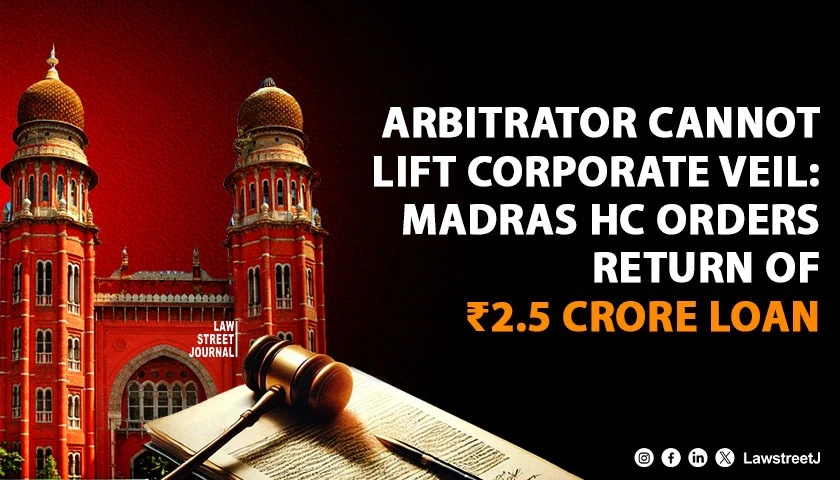
Chennai: The Madras High Court has partly set aside an arbitral award and held that an arbitral tribunal has no jurisdiction to pierce the corporate veil or treat a non-signatory as an alter ego for fastening liability, reiterating that arbitration is strictly a matter of consent and that an arbitrator’s authority is confined to the agreement between the parties.
The Court of Justice N. Anand Venkatesh modified the award and directed the respondent to repay the loan amount of ₹2.5 crore with interest at 12% per annum.
The dispute arose out of a Memorandum of Understanding dated 11.12.2015, under which the petitioner advanced ₹2.50 crore to the respondent to enable it to furnish a performance bank guarantee of ₹3.52 crore to the Kolkata Port Trust. The amount was to be returned within 30 to 89 days. When repayment was not made and the cheque issued towards security was dishonoured, arbitration was invoked pursuant to the MoU.
Before the arbitrator, the respondent contended that the transaction was not merely a financial arrangement but part of a larger commercial collaboration involving equipment supply through a special purpose vehicle. To substantiate this, the respondent relied on two subsequent MoUs executed with M/s Collate Consultants Pvt. Ltd. for equipment supply. The arbitral tribunal accepted this theory and held that since the signatory of Collate Consultants was the same person involved with the petitioner, the entity was the “alter ego” of the petitioner. On this basis, the tribunal held that the petitioner had breached obligations relating to equipment supply and consequently awarded damages equivalent to the forfeited bank guarantee, fastening liability of ₹3.52 crore plus 18% interest on the petitioner.
Challenging this, the petitioner argued before the High Court that the arbitrator had travelled beyond the MoU, which contained no clause imposing any obligation on the petitioner to supply equipment. It was submitted that the entire damages award stemmed from the impermissible act of lifting the corporate veil, especially when Collate Consultants was not a party to the arbitration agreement. The petitioner further argued that the arbitrator had granted unliquidated damages without any evidence or pleading regarding actual loss under Section 73 of the Contract Act.
The respondent defended the award, asserting that the MoU was integrally linked to performance of the work and that the petitioner’s failure to ensure equipment supply resulted in cancellation of the KOPT contract and forfeiture of the bank guarantee.
The High Court found merit in the petitioner’s challenge. Relying on settled principles, the Court emphasized that “arbitration rests on consent” and an arbitrator’s jurisdiction is strictly traceable to the arbitration agreement. The Court noted that Collate Consultants Pvt. Ltd. was not a signatory to the MoU dated 11.12.2015 and had entered into independent agreements with the respondent. In such circumstances, the arbitrator “had no power to pierce the corporate veil so as to bind other parties who have not consented to arbitrate,” and the entire reasoning treating Collate Consultants as the alter ego of the petitioner was therefore in excess of jurisdiction.
The Court further observed that the original MoU did not contain any stipulation requiring the petitioner to supply equipment, and that such obligations arose only under separate agreements to which the petitioner was not a party. The Court held that the arbitrator’s approach violated the fundamental rule that arbitral tribunals cannot extend obligations to non-signatories except under narrowly defined doctrines recognized by courts—not by arbitral bodies.
Importantly, the Court also held that the damages award suffered from a complete absence of pleadings and proof. The respondent had not demonstrated actual loss flowing from the alleged breach, and merely adopting the forfeited bank guarantee amount—especially when it included the petitioner’s own contribution—was unjustified. The Court reiterated that under Section 73 of the Contract Act, “a mere breach of contract does not automatically entitle a party to damages unless loss naturally flowing from the breach is pleaded and proved,” and that the MoU did not contain any pre-estimated damages clause under Section 74.
The High Court further noted that the National Company Law Appellate Tribunal had earlier held the MoU to be an independent financial transaction, a finding affirmed by the Supreme Court. In light of this binding determination, the arbitrator’s attempt to club the MoU with later equipment-supply arrangements was held to be untenable.
Accordingly, the Court concluded that the portion of the award fastening liability of ₹3.52 crore plus interest on the petitioner was unsustainable. However, the petitioner was held entitled to recovery of the principal sum of ₹2.50 crore. Modifying the award, the Court directed repayment of the loan along with interest at 12% per annum from 11.12.2015 till realisation, and set aside the remaining portion of the award relating to damages.
Case Title: M/s Sugesan Transport Pvt. Ltd. vs. M/s E.C. Bose & Company Pvt. Ltd.



![TN Medical Council declares change of gender identity of LGBTQIA+ as misconduct [Read Notification]](/secure/uploads/2022/12/lj_5268_5cebb05a-97fb-40fb-8045-25cdf8f4207a.jpg)
![Madras High Court Directs Tamil Nadu Government to Ensure Quota for Transgenders in Local Body Elections [Read Order]](/secure/uploads/2023/08/lj_2507_7a03d113-08b1-4670-b6fb-9058aee481d0.jpg)
![Anti Corruption sleuths acted like "puppets in The Muppet Show", HC notice to ex TN CM in disproportionate assets case [Read Order]](/secure/uploads/2023/09/lj_8675_7b37fc02-1b2d-4f4a-9816-3df20545b37e.jpg)