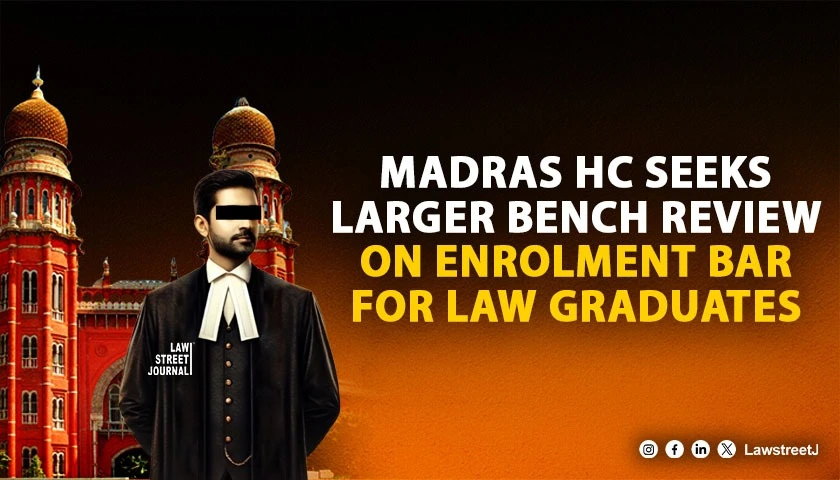
Chennai: The Madurai Bench of the Madras High Court has referred to a larger Bench the question of whether courts can impose additional disqualifications for advocate enrolment beyond those specified in the Advocates Act, 1961, expressing concern that a decade-old judicial direction barring enrolment of law graduates with pending criminal cases may amount to judicial overreach.
Justice G.R. Swaminathan and Justice R. Kalaimathi delivered the order on January 7, 2026, observing that when a validly enacted legislation occupies the field, it may not be open to courts to prescribe further disqualifications in the exercise of writ jurisdiction.
The Court was dealing with a writ petition filed by S. Bhaskarapandian, who obtained a law degree in 1984 but could not enrol as an advocate due to his appointment as a Village Administrative Officer. After retiring from service on January 30, 2014, he applied for enrolment on July 23, 2014; however, his application could not be processed due to his implication in two criminal cases.
The petitioner’s application was blocked by a 2015 Single Judge direction in S.M. Anantha Murugan v. The Chairman, which directed the Bar Council of India to instruct State Bar Councils not to enrol any law graduate with pending criminal cases, except in cases involving bailable offences punishable up to three years and compoundable offences arising out of matrimonial, family, or civil disputes.
This direction was subsequently affirmed by a Full Bench in 2017, which described it as “only a temporary measure” and directed the Bar Council of India to bring forth appropriate amendments within six months. However, the petitioner’s counsel submitted that no such amendments have been made in the last ten years and that the direction continues to hold the field.
The Court observed,
“The Full Bench took the view that the direction itself is a temporary measure. But the fact remains that the Bar Council of India has not issued any direction in this regard, and the direction of the learned Single Judge continues to hold the field for more than a decade.”
The Bench examined Section 24A of the Advocates Act, 1961, which catalogues specific disqualifications for enrolment, including conviction for an offence involving moral turpitude, conviction under the Untouchability (Offences) Act, 1955, and dismissal or removal from State employment on charges involving moral turpitude.
The Court further stated,
“We are of the view that when a validly passed legislation is occupying the field, it may not be open to the writ court to prescribe further disqualifications in the exercise of its jurisdiction under Article 226 of the Constitution of India.”
Reliance was placed on the Supreme Court’s decision in Ashwini Kumar Upadhyay v. Union of India, where a petition seeking to debar legislators from practising as advocates was dismissed. The Supreme Court held that the Bar Council of India is vested with the authority to regulate enrolments and that any restrictions must be expressly provided in the Advocates Act or the Rules framed thereunder.
The Court further observed that the judiciary cannot usurp functions assigned to the legislature and that, in the absence of any express restriction imposed by the Bar Council of India, the relief sought could not be granted.
The Bench emphasized the principle of literal interpretation of statutes, citing Gurudevdatta VKSSS Maryadit v. State of Maharashtra, wherein the Supreme Court held that when statutory language is clear and unambiguous, courts are bound to give effect to its plain meaning.
It was also observed that where the statute speaks of conviction as a disqualification, it may not be open to a writ court to treat mere implication in a criminal case as a bar to enrolment.
The Bench further invoked the presumption of innocence as a human right, relying on Narendra Singh v. State of Madhya Pradesh. Disagreeing with a recent Division Bench decision that construed the judicial direction as a rule within the ambit of Section 34 of the Advocates Act, the Court stated:
“With the greatest of respect to the Hon’ble Division Bench, we cannot endorse the view that a judicial direction can be construed as a Rule made under Section 34 of the Advocates Act, 1961.”
The Court also examined the scope of Section 34, which empowers High Courts to frame rules laying down conditions for advocates to practise. Relying on R. Muthu Krishnan v. High Court of Madras, it held that Section 34 regulates practice and does not confer rule-making power concerning disciplinary control or enrolment.
The Bench observed:
“If Section 34 does not empower the High Court to frame rules pertaining to disciplinary jurisdiction, we fail to understand how it would authorise the imposition of conditions for enrolment.”
Distinguishing between legislative rule-making on the administrative side and judicial orders, the Court stated:
“By no stretch of imagination can a judicial order passed by a Single Judge partake the character of a rule made by the High Court.”
However, noting that it was bound by the earlier coordinate Division Bench and Full Bench decisions affirming the direction in S.M. Anantha Murugan, the Court observed that it could not issue any contrary direction.
Accordingly, the Bench directed the Registry to place the papers before the Chief Justice for consideration of the constitution of a larger Bench to resolve the issue.
Case Title: S. Bhaskarapandian v. The Chairman/Secretary, Bar Council of Tamil Nadu



![TN Medical Council declares change of gender identity of LGBTQIA+ as misconduct [Read Notification]](/secure/uploads/2022/12/lj_5268_5cebb05a-97fb-40fb-8045-25cdf8f4207a.jpg)
![Madras High Court Directs Tamil Nadu Government to Ensure Quota for Transgenders in Local Body Elections [Read Order]](/secure/uploads/2023/08/lj_2507_7a03d113-08b1-4670-b6fb-9058aee481d0.jpg)
![Anti Corruption sleuths acted like "puppets in The Muppet Show", HC notice to ex TN CM in disproportionate assets case [Read Order]](/secure/uploads/2023/09/lj_8675_7b37fc02-1b2d-4f4a-9816-3df20545b37e.jpg)