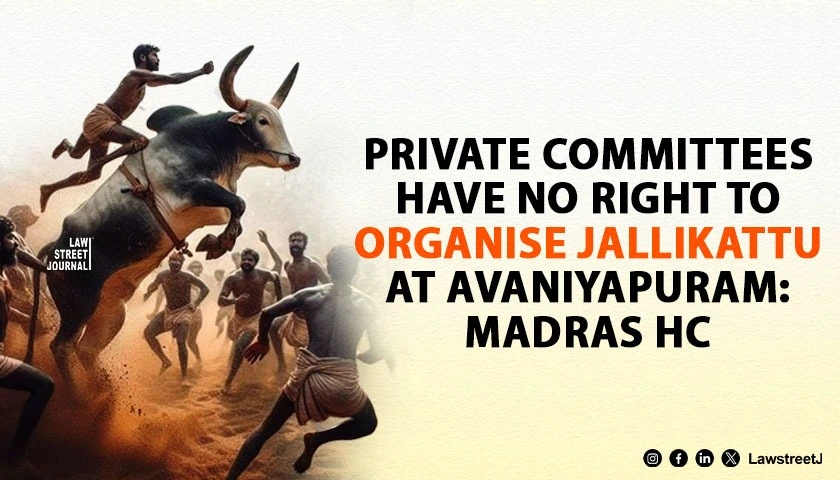
Chennai: The Madras High Court has held that private individuals or self-styled village committees cannot claim an independent right to organize Jallikattu at Avaniyapuram, as the internationally acclaimed festival is organized directly by the State Government with the assistance of villagers through an Advisory Committee.
A Division Bench of Justice Dr. G. Jayachandran and Justice K.K. Ramakrishnan passed the order on January 7, 2026, while disposing of a writ petition filed by P. Murugan, who claimed to be the President of the Avaniyapuram Village Jallikattu Committee.
The petitioner had sought a writ of mandamus directing the authorities to grant permission to the Avaniyapuram Village Jallikattu Committee and to provide adequate police protection to conduct the Jallikattu festival at Avaniyapuram village on January 15, 2026.
The Additional Advocate General, appearing for the official respondents, submitted that under the Tamil Nadu Regulation of Jallikattu Act, 2009, and the Standard Operating Procedure issued by the Animal Welfare Department on November 21, 2025, Jallikattu at Avaniyapuram is organized by State Revenue Officials with the assistance of villagers who are part of an Advisory Committee.
The Court noted that, considering the international importance of the Jallikattu conducted at Avaniyapuram, Alanganallur, and Palamedu, the State itself directly organizes the events. Therefore, the petitioner could not claim any independent right to seek permission for his committee to conduct Jallikattu at Avaniyapuram village.
Counsel for the petitioner submitted that, at the very least, the Advisory Committee should comprise collective representation from all communities in the village.
In response, the Additional Advocate General stated that the Advisory Committee would be constituted in accordance with the practice followed in previous years, while also taking into account the guidelines issued by the Court in a batch of writ petitions in W.P.(MD) No. 526 of 2020, dated January 13, 2020.
Recording these submissions, the Court disposed of the writ petition with no order as to costs.
Case Title: P. Murugan v. The District Collector, Madurai & Others



![TN Medical Council declares change of gender identity of LGBTQIA+ as misconduct [Read Notification]](/secure/uploads/2022/12/lj_5268_5cebb05a-97fb-40fb-8045-25cdf8f4207a.jpg)
![Madras High Court Directs Tamil Nadu Government to Ensure Quota for Transgenders in Local Body Elections [Read Order]](/secure/uploads/2023/08/lj_2507_7a03d113-08b1-4670-b6fb-9058aee481d0.jpg)
![Anti Corruption sleuths acted like "puppets in The Muppet Show", HC notice to ex TN CM in disproportionate assets case [Read Order]](/secure/uploads/2023/09/lj_8675_7b37fc02-1b2d-4f4a-9816-3df20545b37e.jpg)