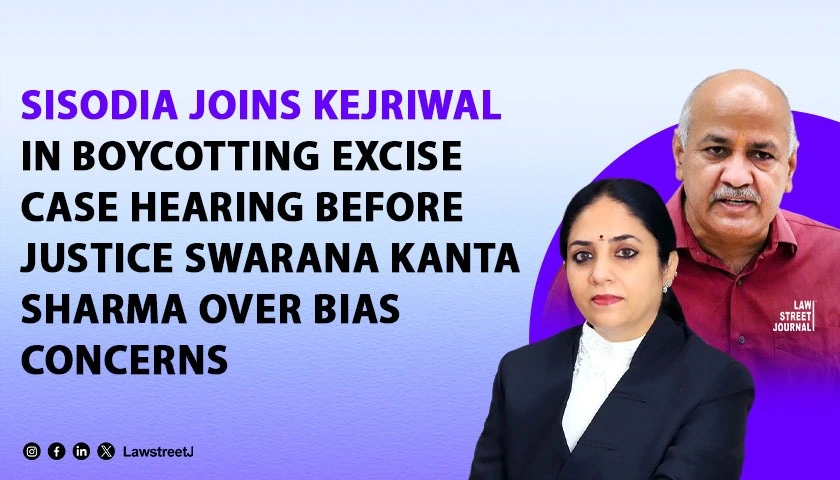
New Delhi: Former Delhi Deputy Chief Minister and senior Aam Aadmi Party leader Manish Sisodia has decided not to participate in or argue further in the excise policy case proceedings before Justice Swarana Kanta Sharma of the Delhi High Court, joining AAP chief Arvind Kejriwal, who had taken a similar decision earlier.
In a letter addressed to Justice Sharma, Sisodia stated that his doubts over the judge’s impartiality in the case remain unresolved. He cited Justice Sharma’s repeated public attendance at Akhil Bharatiya Adhivakta Parishad events, her children’s professional engagement with a Central government panel, and what he described as the appearance of closeness between her children and government law officers appearing against him in the case.
Sisodia’s letter comes in response to Justice Sharma’s order dated April 20, 2026, in which she rejected the recusal applications filed by Kejriwal, Sisodia, and other accused in the case. In her order, Justice Sharma observed that a politician cannot be allowed to sow seeds of mistrust in the judiciary and that the recusal application amounted to putting the judiciary on trial. She also held that her children being government panel counsel cannot be held against her, as they have the right to practise law.
In his letter, Sisodia directly addressed this reasoning. He stated that no one had argued that the judge’s children cannot practise law, nor that they cannot become government counsel if selected through a fair, transparent, and merit-based process. However, Sisodia questioned whether there was not a duty on the judge to disclose these circumstances to the parties at the threshold of the proceedings, and whether a corresponding duty lay on the Solicitor General to place these facts before the court and the litigants with complete fairness.
“Was there not, at the very least, a duty on the part of the parent-judge to disclose these circumstances to the parties at the very threshold? Was there not a corresponding duty upon the Ld. Solicitor General, Mr. Tushar Mehta, to place these facts before the Court and the litigants with complete fairness? Was there not a duty to pause and ask whether a matter of such extraordinary political sensitivity demanded a higher degree of caution, disclosure, and institutional self-scrutiny?” the letter stated.
Sisodia drew a parallel between his position and that of Kejriwal, stating that his concern, too, was not born out of hostility to the court but from a deep unease that continuing to participate despite these circumstances would require him to act against his own conscience while pretending before his fellow countrymen that all doubts stood resolved.
“My concern too, much like Mr. Kejriwal’s, is not born out of hostility to the Court. It is born of a deep unease that, if I continue to participate despite these circumstances, I would be acting against my own conscience while pretending before my fellow countrymen that all doubts stand resolved. The question before me is therefore a simple one: can I, with honesty, continue to take part in these proceedings while carrying a serious apprehension about the appearance of impartial justice? After much reflection, my answer is similar to Mr. Kejriwal’s. I cannot,” the letter concluded.
The excise policy case originated in 2022 when the Central Bureau of Investigation registered an FIR alleging that the Delhi Excise Policy of 2021–22 was manipulated to facilitate monopolisation and cartelisation of the liquor trade in Delhi. The CBI alleged that AAP and its leaders received kickbacks from liquor manufacturers due to manipulation of the policy. The Enforcement Directorate subsequently registered a case under the Prevention of Money Laundering Act.
A trial court, on February 27, 2026, discharged Kejriwal and 22 other accused in the case. The CBI challenged the discharge order, and the matter came up before Justice Sharma. On March 9, Justice Sharma issued notice in the matter, stayed the trial court’s direction for departmental proceedings against the CBI officer who investigated the case, gave a prima facie finding that some observations made by the trial court were erroneous, and directed the trial court to defer the PMLA proceedings based on the CBI’s case.
Kejriwal and other accused—Manish Sisodia, Durgesh Pathak, Vijay Nair, Arun Pillai, and Chanpreet Singh Rayat—subsequently filed applications seeking Justice Sharma’s recusal. Justice Sharma rejected these applications on April 20, deciding to continue hearing the matter. Kejriwal and Sisodia have now both announced their decision to boycott the proceedings.
Case Details
- Court: High Court of Delhi
- Judge: Justice Swarana Kanta Sharma
- Other Accused: Durgesh Pathak, Vijay Nair, Arun Pillai, and Chanpreet Singh Rayat

![Delhi High Court Sets Aside Arbitral Tribunal's Award Against NHAI in Highway Project Delay Case [Read Judgment]](/secure/uploads/2023/07/lj_9605_23374c2e-392c-4491-a2fe-f2f12fc5272f.jpg)
![Delhi Court Rejects Stay Request in Defamation Case Against Rajasthan CM Ashok Gehlot [Read Order]](/secure/uploads/2023/08/lj_5208_80de1ddc-d76a-4f7f-b180-408e3ae14fb4.jpg)