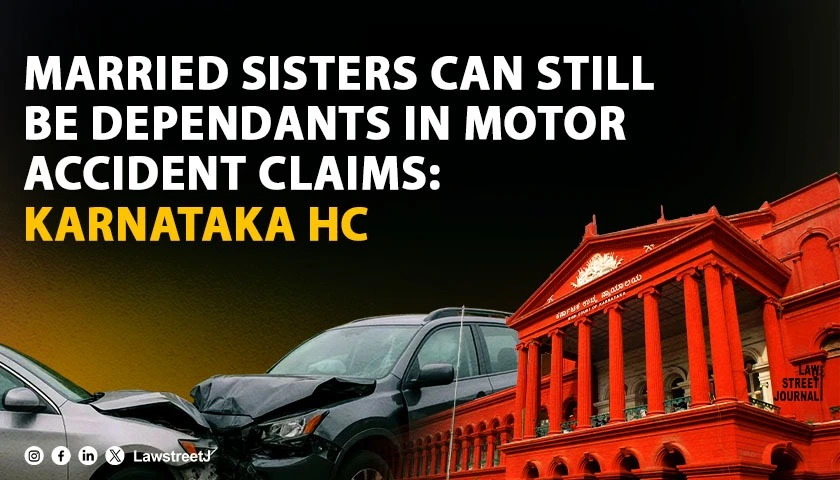
Bengaluru: The Karnataka High Court has clarified that married daughters or sisters cannot be excluded from claiming compensation in motor accident cases merely because they reside with their husbands.
The court of Justice Umesh M. Adiga, deciding cross-appeals arising from a 2018 accident claim, noted that family structures in India often involve continued financial and emotional ties between married women and their parental households.
The case concerned the death of a 44-year-old unmarried man, Prem Prakash Menezes. His brother and two married sisters sought compensation, asserting that the deceased regularly contributed to the family’s upkeep. The insurer disputed this, arguing that married sisters living in their matrimonial homes should not be treated as dependants.
Rejecting this contention, the Court observed that dependency cannot be assessed solely on the basis of marital residence. “In our social context, it is not uncommon for daughters and sisters, even after marriage, to maintain a close relationship with their parental family. The earning member of the family often contributes towards their welfare and social needs,” the Court said while upholding their status as dependants.
Noting that there was no contrary evidence from the insurer and that the deceased’s parents were no longer alive, the Court accepted the siblings’ claim that he had been supporting them. It also referred to the Supreme Court’s decision in National Insurance Company Ltd. v. Birendar & Others (2020), wherein it was held that married children or siblings may still qualify as dependants in appropriate circumstances.
The Bench went on to revise the compensation awarded by the Motor Accident Claims Tribunal, finding that the notional income adopted earlier was on the lower side. Applying the income chart issued by the Karnataka State Legal Services Authority, along with future prospects and conventional heads of compensation, the Court enhanced the total award from ₹10.6 lakh to ₹13.05 lakh.
Both the vehicle owner and insurer were held jointly and severally liable, with a direction to deposit the enhanced amount within six weeks.
Case Title: The National Insurance Company Ltd. v. George Menezes & Others


![Karnataka High Court: Cabinet Rank Status Not Equivalent to Ministerial Position [Read Order]](/secure/uploads/2023/09/lj_2318_fc1b99b7-aeed-472b-836e-33750bedb394.jpg)


![Woman living in adultery cannot claim maintenance: Karnataka High Court [Read Order]](/secure/uploads/2023/10/lj_3083_Women_living.jpg)