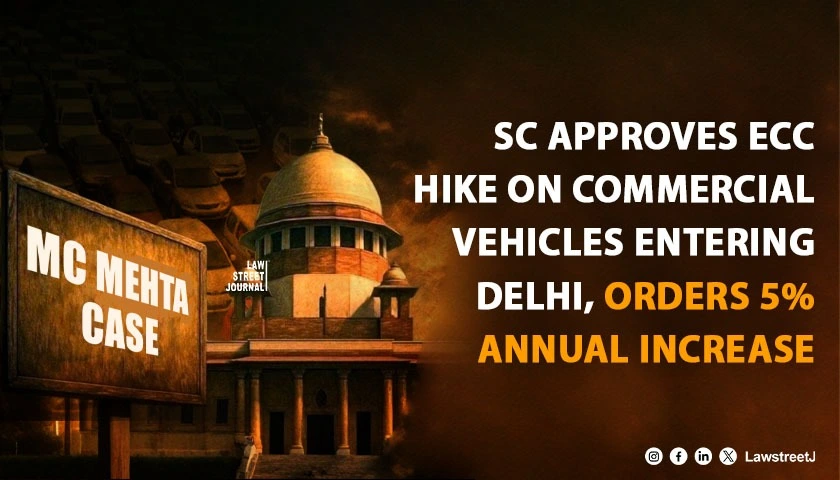
New Delhi: The Supreme Court of India has approved a significant revision in the Environment Compensation Charge (ECC) levied on commercial vehicles entering Delhi, with effect from April 1, 2026. The Bench, comprising Chief Justice Surya Kant, Justice Joymalya Bagchi, and Justice Vipul M. Pancholi, passed the order on March 12, 2026, accepting the recommendations of the Commission for Air Quality Management (CAQM).
The Court, after considering the CAQM’s proposal, stated that it found “the same to be reasonable, just, and fair” and accordingly approved the revised rates. Under the revision, light-duty vehicles and two-axle trucks will now be charged Rs. 2,000, up from Rs. 1,400. Three-axle and four-axle trucks and above will be charged Rs. 4,000, increased from Rs. 2,600.
The Court further approved an annual enhancement of 5% in ECC rates with effect from April 1 each year, to be rounded off to the nearest ten rupees and notified by the Government of NCT of Delhi. The CAQM had justified this recommendation by noting that the revision was aimed at discouraging the “entry of diesel commercial vehicles into Delhi,” while “taking into account inflation, increases in vehicle operating costs, and annual increases in NHAI toll rates.” The Commission also noted an approximate 4.8% compounded annual increase in NHAI toll rates since 2018.
The CAQM further observed that the revision would “broadly restore the deterrence value of ECC as originally fixed in 2015 and reinstate a significant cost differential between transit through Delhi and diversion via peripheral expressways,” a position the Court endorsed without qualification.
The Court directed that all commercial and heavy vehicles not required to enter Delhi for the supply of essential commodities must use peripheral expressways, noting that doing so would also exempt them from payment of the revised ECC. The Municipal Corporation of Delhi (MCD) was directed to undertake rationalisation of its toll structure, address existing disparities in vehicle classification, and conduct a comprehensive traffic and revenue study to assess traffic potential and route diversion patterns.
The National Highways Authority of India (NHAI) and MCD were further directed to work in coordination to ensure compliance with the earlier order dated January 21, 2026, particularly regarding the relocation of toll plazas.
The proceedings arise from the landmark M.C. Mehta v. Union of India and Others case concerning vehicular pollution in Delhi, in which the Court has, for decades, overseen measures including ECC regulation, diversion of heavy vehicles through peripheral expressways, and coordination among agencies such as CAQM, MCD, and NHAI.
Case Details:
Case Title: M.C. Mehta v. Union of India and Others
Case No.: Writ Petition (Civil) No. 13029 of 1985
Court: Supreme Court of India
Order Date: March 12, 2026 (uploaded on April 17, 2026)
Coram: Chief Justice Surya Kant, Justice Joymalya Bagchi, and Justice Vipul M. Pancholi