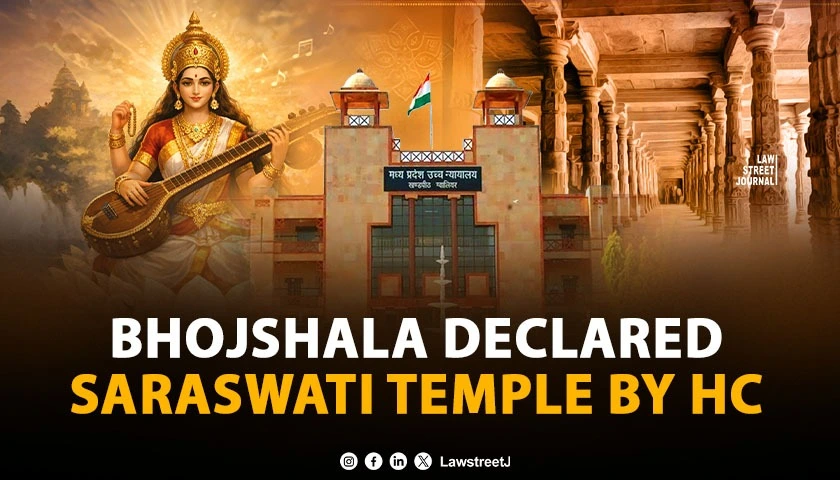
Madhya Pradesh: The Madhya Pradesh High Court on May 15, 2026 declared the disputed Bhojshala-Kamal Maula Mosque complex in Dhar district to be a temple dedicated to Goddess Saraswati (Vagdevi), and quashed a 2003 order issued by the Archaeological Survey of India (ASI) regulating Hindu worship at the site while permitting the Muslim community to offer Friday namaz. A Division Bench comprising Justice Vijay Kumar Shukla and Justice Alok Awasthi allowed a batch of writ petitions filed by Hindu Front for Justice and others in Hindu Front for Justice v. Union of India, Ministry of Culture. While securing Hindu rights of worship, the Court also protected the religious interests of the Muslim community by permitting them to apply to the State for allotment of alternate land in Dhar district for construction of a mosque.
Background
Bhojshala is an 11th-century monument in Dhar, Madhya Pradesh, protected under the Ancient Monuments and Archaeological Sites and Remains Act, 1958, and administered by the ASI. The site has long been the subject of competing religious claims: the Hindu community regards it as the temple of Goddess Saraswati (Vagdevi) established by King Bhoja in 1034 A.D., while the Muslim community considers portions of the complex, including the Kamal Maula Mosque, as a site of Islamic prayer.
In 2003, the ASI issued a circular creating a shared-use arrangement: the Hindu community was permitted to perform puja on Tuesdays and the Muslim community was allowed to offer namaz on Fridays. The present petitions challenged this circular as unconstitutional and sought restoration of exclusive Hindu worship rights at the site, prohibition on the offering of namaz within the complex, and repatriation of the idol of Goddess Saraswati currently housed in the British Museum in London, which the petitioners alleged was desecrated and removed during the British period.
In 2024, the High Court directed the ASI to conduct a scientific survey of the site. The Supreme Court refused to stay the survey but directed that its outcome could not be acted upon until further orders. Following the filing of the survey report, the High Court commenced final hearing on April 6, 2026, and thereafter directed the ASI to upload the videographic record of the survey proceedings on a digital platform and provide access to the parties. Justice Shukla also personally visited the disputed site on March 24 to physically inspect the complex and understand its layout.
ASI Survey Findings
The ASI, in its report filed before the High Court, stated that its investigation and study of the Bhojshala complex revealed that the existing structure was constructed using parts of earlier temples. The report noted that the decorated pillars and pilasters, from their art and architecture, appeared to be components of earlier temples that were reused while constructing the colonnades of the mosque over a high basalt platform. The report further observed that a pillar decorated with niches in all four directions depicted mutilated images of deities, and that standing images on two pilasters had been chopped off and rendered beyond recognition.
Petitioners’ Contentions
Counsel appearing for the Hindu petitioners argued that Bhojshala was originally a temple dating to the reign of King Bhoja, dedicated to Goddess Saraswati, and that the present structure bore archaeological, historical, and inscription-based evidence of a pre-existing Hindu religious site. They urged that the ASI’s 2003 circular impermissibly restricted the rights of the Hindu community to worship at a site of undisputed Hindu religious character, contrary to the guarantees under Articles 25 and 26 of the Constitution. They further sought reestablishment of the idol of Goddess Saraswati, which had been taken to London by the British after its alleged desecration.
Counsel for petitioners belonging to the Jain community sought the right to offer prayers at the site, contending that the idol presently housed in the British Museum was of the Jain Goddess Ambika and that the site bore architectural features similar to the temples at Mount Abu.
Respondents’ Contentions
Counsel appearing for the Muslim community parties contended that historical records from the Khilji period and contemporaneous accounts did not mention destruction of any Saraswati temple at Dhar, and that there was therefore no evidentiary basis for the claim that the mosque had been constructed over a demolished temple. They also relied upon a 1935 Alaan (proclamation) issued by the erstwhile Dhar ruler’s state permitting the Muslim community to offer namaz at the site, arguing that this established a long-standing recognised right of worship.
Counsel for the Government submitted that the 1935 Alaan was invalid in law, as the site had already been declared a protected monument under the Ancient Monument Preservation Act, 1904 prior to its issuance, and that the ASI accordingly functioned as the lawful custodian and guardian of the site with exclusive authority over its management and use.
Court’s Analysis and Findings
The Bench held that historical literature and archaeological evidence conclusively established the character of the Bhojshala complex as a centre of Sanskrit learning and as the site of a temple dedicated to Goddess Saraswati. The Court observed that continuity of Hindu worship at the site had never been extinguished, though it had been regulated over time. Relying on the ASI survey report and archaeological and historical material on record, the Bench recorded a finding that the disputed area was Bhojshala with a temple of Goddess Vagdevi Saraswati.
The Court stated that it had considered the archaeological and historical facts, ASI notifications, and the survey report, and had decided the matter in light of the statutory provisions of the ASI Act and the precedent laid down by the Supreme Court in the Ayodhya judgment. The Court underscored that every government bears a constitutional obligation to ensure preservation and protection not only of ancient monuments and historically and archaeologically important structures, including temples, but also of the sanctum sanctorum and deities of spiritual importance.
On the 2003 ASI circular, the Court quashed it to the extent that it restricted the rights of the Hindu community to worship within the complex and permitted offering of namaz by the Muslim community. The Court declared: “2003 ASI order to the extent restricting the right of Hindus to worship within the Bhojshala complex and also the order permitting prayer by Muslim community are quashed.” The ASI will continue to exercise overall supervisory administration, conservation, and management of the property. The Central Government and the ASI have been directed to take a decision on administration and management of the Bhojshala temple and the Sanskrit learning centre within the property.
The Court balanced its findings by securing the religious rights of the Muslim community in terms of future accommodation. It directed that if the Muslim party (Respondent No. 8, Maulana Kamaluddin Welfare Society) or any duly constituted waqf body submits an application for allotment of land within Dhar district for construction of a mosque or place of prayer, the State Government may consider the application in accordance with law for allotment of permanent and suitable land in Dhar district for construction and administration of a mosque and related religious facilities.
Direction Regarding Idol in British Museum
On the prayer seeking return and reinstallation of the idol of Goddess Saraswati currently housed in the British Museum in London, the Court noted that the petitioners had already made multiple representations to the Government of India. The Court directed that the Government of India may consider the representations seeking return of the idol of Goddess Saraswati from the British Museum and its reinstallation within the Bhojshala complex.
Case Details: Hindu Front for Justice v. Union of India, Ministry of Culture & Ors., Madhya Pradesh High Court (Indore Bench), WP 10497/2022 and WP 10484/2022. Before Justice Vijay Kumar Shukla and Justice Alok Awasthi. Judgment dated May 15, 2026.

.jpeg)
![Supporting defamatory WhatsApp posts doesn’t constitute involvement in offence of defamation: MP HC [Read Order]](/secure/uploads/2024/09/lj_6675_WhatsApp_Image_2024-09-16_at_12.24.54_PM.webp)