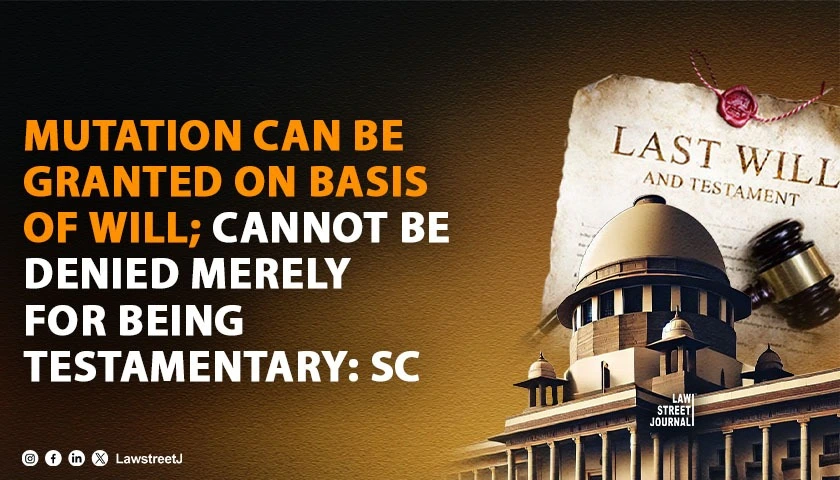
New Delhi: The Supreme Court has held that there is no legal bar on carrying out mutation of land records on the basis of a will, and that mutation cannot be denied merely because the claim is founded on a testamentary document. The Court clarified that mutation entries remain subject to adjudication by competent civil courts and do not confer title.
A Bench comprising Justice Sanjay Karol and Justice Manoj Misra delivered the judgment while setting aside an order passed by the High Court of Madhya Pradesh at Indore and restoring mutation in favour of a legatee under a registered will.
Roda alias Rodilal was the recorded tenure holder of several survey numbers of land measuring 5.580 hectares, situated at Mouza Bhopali. He died on November 6, 2019. The appellant, claiming to be a legatee under a registered will dated May 1, 2017, applied for mutation under Section 110 of the Madhya Pradesh Land Revenue Code, 1959. The first respondent objected to the mutation, claiming possession over one of the survey numbers on the basis of a written sale agreement allegedly executed by the deceased, and sought to prevent mutation in favour of the appellant.
The Tehsildar, after recording statements of witnesses, including attesting witnesses to the will, ordered mutation in favour of the appellant, subject to determination of rights in any pending civil suit. Appeals filed by the first respondent before the Sub-Divisional Officer and the Commissioner were dismissed.
Aggrieved, the first respondent approached the High Court by filing a miscellaneous petition under Article 227 of the Constitution of India. The High Court, relying on its earlier decision in Ranjit v. Smt. Nandita Singh, set aside the orders passed by the revenue authorities and directed that the names of the legal heirs of the deceased, as per the Hindu Succession Act, 1956, be mutated. It further directed that if no legal heirs were available, the land be recorded in the name of the State Government. This direction was made subject to the outcome of any pending civil suit.
The appellant contended before the Supreme Court that the High Court’s order suffered from non-application of mind, particularly in view of the Madhya Pradesh Bhu-Rajasv Sanhita (Bhu-Abhilekhon Mein Namantaran) Niyam, 2018, which expressly permits mutation based on a will. It was argued that the earlier decision in Ranjit, holding that mutation could not be granted on the basis of a will, was no longer good law. Reliance was also placed on the Full Bench decision of the Madhya Pradesh High Court in Anand Choudhary v. State of Madhya Pradesh, which held that an application for mutation based on a will cannot be rejected at the threshold.
It was further submitted that there was no serious challenge to the execution of the registered will and that the first respondent was not a legal heir of the testator. His claim, based on an unregistered agreement for sale and adverse possession, could not override mutation based on a will. The appellant emphasized that mutation proceedings are summary in nature, meant for fiscal purposes, and do not determine title, which can only be decided by a competent civil court.
The first respondent argued that the appellant was not a natural heir and that the will was surrounded by suspicious circumstances. It was contended that unless the will was validated by a competent civil court, it could not be made the basis of mutation. The respondent also claimed to have produced satisfactory evidence of possession over the disputed land.
The Supreme Court observed that Sections 109 and 110 of the 1959 Code provide for reporting and mutation of acquisition of rights in land. Rights in immovable property may be acquired through various modes such as sale, gift, mortgage, lease, or by devolution through a will or inheritance upon the death of the title holder. The Court noted that neither Section 109 nor Section 110 restricts acquisition of rights to any particular mode, and the 2018 Niyam expressly recognises acquisition through a will.
The Court held that there is nothing in the 1959 Code that proscribes acquisition of rights in land through a will. Consequently, an application for mutation based on a will must be examined on its merits and cannot be rejected solely because it is founded on a testamentary document.
The Court noted that the Tehsildar had followed due procedure by calling for reports, issuing public notices inviting objections, and recording evidence before allowing mutation on the basis of the will. The appellate authorities had affirmed the order. In such circumstances, when the matter reached the High Court under Article 227, the High Court was required to examine whether there was any jurisdictional error or legal infirmity in the orders passed by the revenue authorities.
The Supreme Court held that the High Court erred in setting aside the mutation orders without examining their merits and solely on the basis of an earlier decision that mutation based on a will was impermissible. This approach was found to be incorrect, particularly in light of the statutory framework and the Full Bench ruling in Anand Choudhary.
The Court reiterated that mutation does not confer any right, title, or interest and is only for fiscal purposes. Where no serious dispute is raised by the natural legal heirs of the deceased, and there is no statutory bar, mutation based on a will should not be denied, as doing so would adversely affect revenue administration.
In the present case, none of the legal heirs of the deceased tenure holder had challenged the will, which was a registered document. The objection was raised only by a third party claiming possession on the basis of an unregistered agreement for sale, without any decree of specific performance. In such circumstances, the Court found no jurisdictional error or legal infirmity in the mutation orders warranting interference under Article 227.
Allowing the appeal, the Supreme Court set aside the High Court’s judgment and restored the orders passed by the revenue authorities. The Court clarified that the mutation entry shall remain subject to adjudication by a competent civil or revenue court.
Case Title: Tarachandra v. Bhawarlal and Another