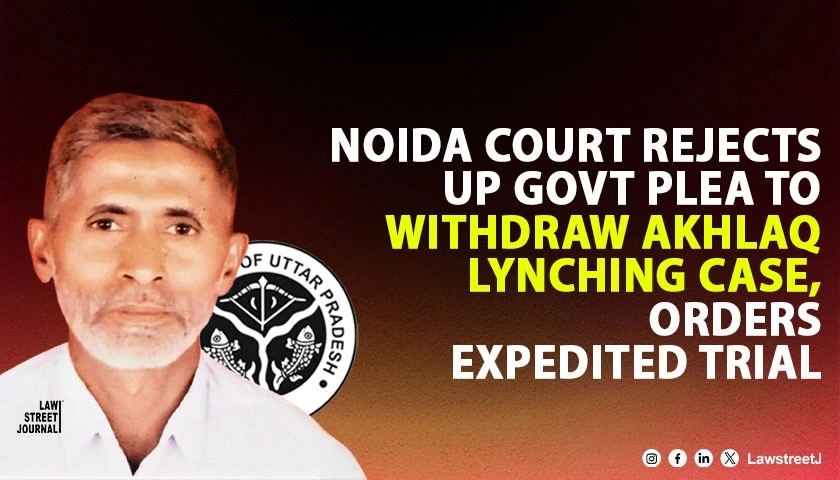
Noida: A Fast Track Court in Gautam Buddha Nagar (Noida), Uttar Pradesh, has rejected the State government’s application seeking withdrawal of criminal prosecution against the accused in the 2015 Mohammad Akhlaq lynching case, holding that the grounds cited were without basis and that the serious nature of the crime warrants an expeditious trial.
Additional Sessions Judge Saurabh Dwivedi heard Sessions Trial No. 148/2016, arising out of Crime No. 241/2015 registered at Jarcha Police Station, wherein the accused face charges under Sections 148, 149, 307, 302, 323, 504, 506, 427, and 458 of the Indian Penal Code, along with Section 7 of the Criminal Law Amendment Act.
The case pertains to the tragic incident of September 28, 2015, when complainant Ikraman lodged an FIR against the accused following the death of her husband, Mohammad Akhlaq, and grievous injuries sustained by her son, Danish. The prosecution case alleged that the accused, suspecting the consumption of beef, attacked the victims. A forensic examination of the meat recovered from the scene confirmed it to be cow meat.
Assistant District Government Advocate (Criminal) Bhag Singh Bhati, representing the prosecution, filed an application under Section 321 Cr.P.C. seeking withdrawal of charges. The application cited contradictions in witness statements recorded under Section 161 Cr.P.C., noting that Ikraman named 10 accused, witness Shaista mentioned 16 names (10 plus 6 additional), and Danish mentioned 19 names (10, 6, and 3 additional).
The prosecution application stated that after investigation, a chargesheet was filed and the accused were released on bail. Charges were framed on February 25, 2021, and the case was listed for evidence. It was submitted that only one witness, Shaista (daughter of Akhlaq), had been examined as a prosecution witness. The application further claimed that the incident involved recovery of five sticks, iron rods, and bricks from the accused, with no firearms or sharp-edged weapons used, and that there was no evidence of prior enmity between the parties.
The prosecution relied on a government order dated August 26, 2025, issued by the Justice Department (Criminal) of the Uttar Pradesh Government, seeking permission to withdraw the prosecution against the accused.
However, the victim’s advocates strongly opposed the application, contending that it was “based on misleading facts and contrary to social harmony.” They argued that, as the complainant, the victim’s side had a full right to be heard and to oppose the withdrawal.
The objection emphasized that “the truth of the facts stated in the application can only be determined after trial” and that since charges had already been framed, withdrawal at this stage was inappropriate. It was further submitted that “no grounds have been presented in the application which clarify that withdrawing this prosecution would be proper and just.”
Highlighting the gravity of the offence, the victim’s side stated, “The present sessions trial relates to a serious crime in which the complainant’s husband, Akhlaq, died and her son, Danish, suffered life-threatening injuries and remained hospitalized for months.” They further alleged that the application was “motivated by political reasons.”
The objection also criticized the Assistant District Government Advocate for not properly examining the facts before filing the withdrawal application. Relying on the Supreme Court judgment in Shiv Nandan Paswan v. State of Bihar [1987 SCR (1) 702], it was argued that the victim has the right to object in court. Reference was also made to the Supreme Court’s guidelines in Tehseen S. Poonawalla v. Union of India [2018 (9) SCC 501] concerning crimes arising from mob violence.
The accused filed their own objection supporting the prosecution’s withdrawal application, contending that the victim’s advocate could only assist the Public Prosecutor and had no independent right to oppose the withdrawal, relying on various Supreme Court precedents.
The court examined the rival submissions and applicable legal principles. Noting that the case had progressed substantially—with charges framed on February 25, 2021, and the principal witness Shaista’s examination spanning over 54 pages (5 pages of chief examination and 49 pages of cross-examination, which remained incomplete)—the court found the prosecution’s grounds inadequate.
The court observed:
“The prosecution’s application makes witness statements under Section 161 Cr.P.C. the basis, but after these statements, the chargesheet was filed and the court, after applying judicial mind, framed charges. Examination of these statements does not clarify that the witness evidence is so tainted as to destroy the prosecution case; rather, the witness evidence supports the prosecution case.”
The court held that “variation in the number of accused at the stage of Section 161 Cr.P.C. is insignificant.” It further noted that the prosecution itself admitted that the forensic report confirmed the meat to be cow meat and that sticks, rods, and bricks were recovered from the accused, and that “no other basis has been taken by the prosecution which would lend importance to the grounds for filing the application.”
Addressing the victim’s right to object, the court held:
“The legal position established in Shiv Nandan Paswan (supra), which is settled law, makes it clear that the victim has the right to object in this regard, and such objection is worthy of being heard and taken cognizance of.”
Emphasizing the gravity of murder as a crime against society, the court referred to R.S. Nayak v. A.R. Antulay [1984 (2) SCC 500], observing that “criminal jurisprudence is established for the greater good of society.” It further noted that Section 321 Cr.P.C. requires the court’s consent and that Section 360 of the new criminal code provides for hearing the victim, which must be viewed in a “broader perspective.”
Holding that “the prosecution’s application is without basis,” the court categorized the case as one requiring urgent disposal, relying on the Supreme Court judgment in Shailendra Kumar Srivastava v. State of U.P. [2024 SCC OnLine SC 1717].
In its final order, the court rejected the prosecution’s withdrawal application under Section 321 Cr.P.C. and disposed of all related objections accordingly. The court directed the office to list the case in the category of “most urgent cases” and instructed the prosecution to present witness evidence expeditiously.
The court further ordered that the case be heard on a day-to-day basis and directed that a copy of the order be sent to the Police Commissioner, Gautam Buddha Nagar / DCP Greater Noida to ensure complete security and protection during the recording of evidence. The matter has been posted for prosecution evidence on January 6, 2026.
Case Title: State vs. Rupendra and Others


![National Green Tribunal Takes Suo Motu Cognisance Of Techie’s Drowning In Waterlogged Trench [Read Order]](/secure/uploads/2026/01/lj_5214_National_Green_Tribunal_Takes.webp)