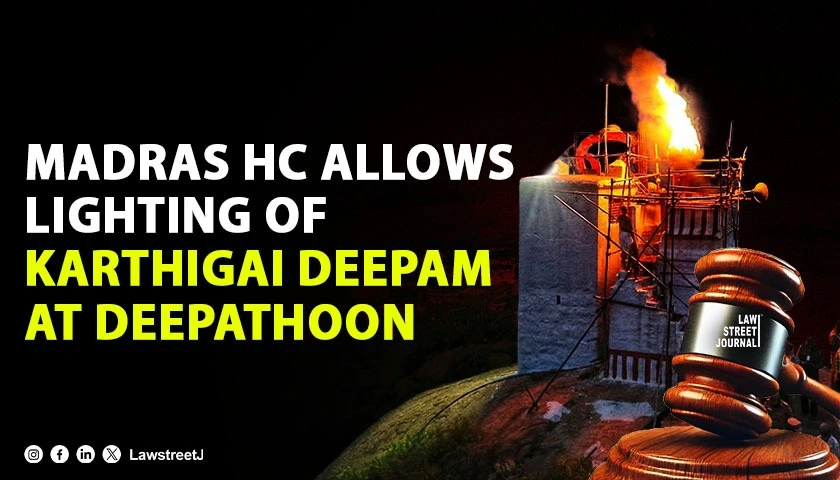
Chennai: The Madras High Court has ruled that the Arulmigu Subramania Swamy Temple at Thiruparankundram must light the Karthigai Deepam festival lamp at a stone pillar located on the hill, and that the temple cannot avoid this religious practice by citing proximity to a dargah or public order concerns.
A Division Bench comprising Justice Dr. G. Jayachandran and Justice K.K. Ramakrishnan delivered the decision on January 6, 2026, while dismissing 20 connected writ appeals challenging the order passed by a Single Judge.
The appeals were filed by the District Collector, the Commissioner of Police, officials of the HR & CE Department, representatives of the Hazarath Sultan Sikkandar Badhusha Avuliya Dargah, the Tamil Nadu Waqf Board, and other parties.
The State government and temple authorities argued that there was no established custom of lighting the lamp at the hilltop stone pillar, claiming that the structure was merely a British-era survey marker. They further contended that the practice could disturb public peace and asserted that previous court orders had already settled the issue. It was also argued that the petitioners ought to have approached the authorities under the HR & CE Act instead of invoking writ jurisdiction.
Rejecting these submissions, the Court found no merit in the objections. It noted that the temple had avoided taking a decision on the issue for several decades, despite a 1996 court order that had specifically left open the possibility of lighting the deepam at alternative locations on the hill. The Court further held that the State’s prolonged inaction and vague claims of public order concerns could not override the fundamental rights of worshippers under Articles 25, 19(1)(a), and 29(1) of the Constitution.
In a detailed examination of religious customs and property rights, the Court underscored that the disputed stone pillar is situated within temple property, as established by a 1920 civil court decree that was affirmed by the Privy Council in 1931. Upon examining historical records from the Great Trigonometrical Survey of India, the Court concluded that the structure was not a survey marker but a traditional lamp pillar (Deepathoon), featuring carved designs and a bowl-shaped cavity intended for holding oil and cotton wicks.
The Court also rejected the contention that lighting the lamp at the hilltop violated Agama Shastra. It clarified that both the statutory framework and religious texts permit lighting deepams at elevated and visible locations, and not merely directly above the sanctum sanctorum. The Court noted that such practices are followed at several prominent temples across Tamil Nadu.
Addressing concerns regarding public order, the Court observed that the State’s apprehensions were “an imaginary ghost created by them for their convenience.” It held that permitting a small devasthanam team to light the lamp on a single day each year, while keeping devotees at the foothill, was entirely manageable and did not justify fears of communal tension.
The Court further rejected the plea of res judicata, holding that earlier proceedings related to different issues and locations. It also ruled that approaching the Joint Commissioner under Section 63(e) of the HR & CE Act was not an efficacious alternative remedy, particularly since the government and the HR & CE Department had already taken a definitive stand against the petitioners and had avoided a decision for over a decade.
In a significant observation, the Court criticized the State administration for widening mistrust between communities through ineffective peace meetings instead of fostering harmony. It emphasized that lighting the Karthigai Deepam at elevated locations is an ancient Tamil cultural practice that deserves constitutional and cultural protection.
Finding no infirmity in the Single Judge’s order, the High Court upheld the direction to light the Karthigai Deepam at the Deepathoon and dismissed all 20 appeals. The Court directed that the devasthanam shall light the lamp through a small team in consultation with the Archaeological Survey of India and the police, with the District Collector coordinating the event.
Case Title: The Executive Officer, Arulmigu Subramania Swamy Temple v. Rama Ravikumar & Connected Cases


![Madras High Court Directs Tamil Nadu Government to Ensure Quota for Transgenders in Local Body Elections [Read Order]](/secure/uploads/2023/08/lj_2507_7a03d113-08b1-4670-b6fb-9058aee481d0.jpg)