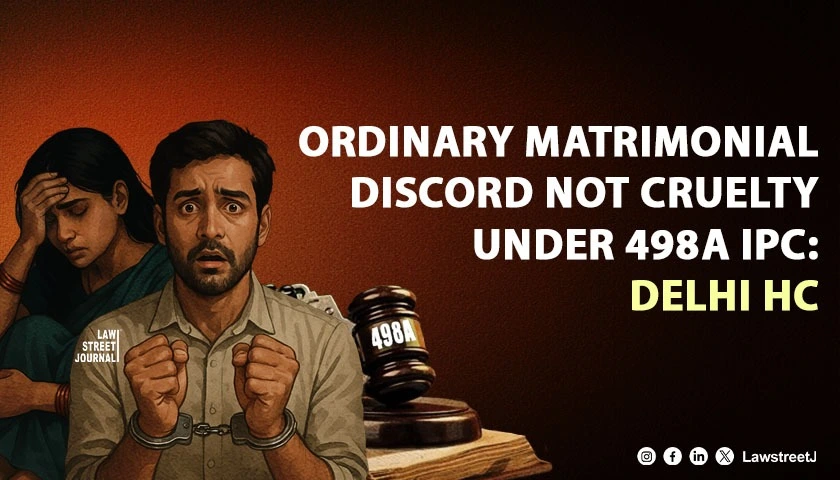
New Delhi: The Delhi High Court has quashed an FIR registered under Sections 498A, 406, and 34 of the Indian Penal Code, 1860, as well as a complaint filed under the Protection of Women from Domestic Violence Act, 2005, holding that the allegations were vague and omnibus, and that the proceedings amounted to an abuse of the process of law.
Justice Neena Bansal Krishna, pronouncing the judgment on March 10, 2026, in two connected petitions filed under Section 482 of the Code of Criminal Procedure, 1973, read with Article 227 of the Constitution of India, allowed both petitions and quashed FIR No. 252/2013 dated June 25, 2013, registered at P.S. KN Katju Marg under Sections 498A/406/34 IPC, as well as Complaint Case No. 494/2016 filed under Sections 18, 19, 20, 21, and 22 of the DV Act, along with all proceedings arising therefrom.
Petitioner No. 1, Sandeep Pathak, and the respondent, Lalita Tiwari, were married on January 25, 2005, at Haldwani, District Nainital, Uttarakhand, as per Hindu rites and customs. According to the petitioners, the parties lived together only for a brief period after the marriage and were thereafter separated. The petitioner filed Divorce Petition No. 54/2011 under Section 13(1)(i-a) of the Hindu Marriage Act, 1955 before the Senior Civil Judge, Almora, Uttarakhand, on July 30, 2011. The respondent did not appear and was proceeded against ex parte. An ex parte decree of divorce was granted on September 5, 2012.
The respondent subsequently filed a divorce petition bearing HMA No. 558502/2012 before the Family Court, Rohini, on September 12, 2012, without disclosing the earlier decree. Upon being apprised of the divorce decree, she withdrew that petition on March 4, 2013. She thereafter filed a complaint under the DV Act on March 5, 2013, and FIR No. 252/2013 was registered on June 25, 2013, under Sections 498A/406/34 IPC against the petitioners.
The Court examined the allegations in the complaint and found that they were generic and lacked specificity as to dates, periods, or the individual conduct of each accused. The respondent had alleged that all eight members of the petitioner’s family tortured, humiliated, taunted, and used abusive language against her. She further alleged that while she was sleeping at the matrimonial home in Ranikhet in June 2009, someone attempted to press her neck through a window during the night, but did not identify any suspect.
The Court held that such allegations were not targeted towards any of the petitioners and were therefore not relevant. Examining the remaining allegations regarding pressure to transfer property, conduct of family members, and instances of alleged misbehaviour, the Court found that they reflected ordinary matrimonial discord and lack of adjustment, but not criminal cruelty of the nature contemplated under Section 498A IPC.
The Court referred to the Supreme Court’s decision in Jayedeepsinh Pravinsinh Chavda and Others v. State of Gujarat, 2024 SCC OnLine SC 3679, noting that cruelty simpliciter is not sufficient to constitute an offence under Section 498A IPC and that where misuse of the provision is found, courts must be vigilant and quash proceedings under Section 482 Cr.P.C. The Court concluded that the essential ingredients of Section 498A IPC were not made out from the complaint.
On the charge of criminal breach of trust, the Court noted that the respondent had made only a single assertion in the complaint that the petitioners had illegally and forcefully retained her gold jewellery and stridhan. The Court found that no description, valuation, or itemization of the jewellery alleged to have been retained was provided. There was no detail regarding what items were given by whom at the time of marriage, their nature, quantity, or quality, and no specific averment was made against the individual petitioners. The Court held that no prima facie case of entrustment had been made out and accordingly found that no offence under Section 406 IPC was disclosed.
The Court placed reliance on the Supreme Court’s decision in Sanjay D. Jain and Others v. State of Maharashtra, Crl. Appeal arising out of SLP (Crl.) No. 12584/2024, decided on September 26, 2025 (2025 INSC 1168), which reiterated that where allegations in an FIR or complaint are vague and general without specific instances or particulars essential to constitute an offence, such FIRs do not disclose a prima facie case and are liable to be quashed. The Court also referred to the principles in State of Haryana v. Bhajan Lal, 1992 Supp (1) SCC 335.
On the DV Act complaint, the Court held that the allegations were substantially the same as those in the FIR and were similarly vague, omnibus, and devoid of specific instances of domestic violence attributable to the petitioners. The Court further held that the decree of divorce dated September 5, 2012 had attained finality and had not been challenged. Once the marriage stood dissolved, the domestic relationship between the parties came to an end. The Court referred to Section 2(f) of the DV Act, which defines “domestic relationship,” and held that in the absence of a subsisting domestic relationship, the foundational requirement for invoking the provisions of the DV Act did not exist.
The Court placed reliance on Kuldeep Kaur v. Swaran Kaur, 2025 SCC OnLine Del 5593, decided on August 21, 2025, a Division Bench decision of the Delhi High Court, which held that once a marriage stands dissolved by a valid decree of divorce, the domestic relationship comes to an end and the substratum upon which the right of residence is founded no longer survives. The Court also relied on Amit Agarwal and Others v. Sanjay Aggarwal and Others, Crl. Misc. No. M-36736 of 2014, decided by the Punjab and Haryana High Court, and Bhushan and Others v. Sau. Nilesha Bhushan Deshmukh, Crl. Appl. 164/2017, decided on August 9, 2021 by the High Court of Judicature at Bombay (Nagpur Bench).
The Court held that the chronology of events indicated that the criminal and DV proceedings were initiated after the marital relationship had already been dissolved and constituted a subsequent attempt to revive matrimonial disputes through criminal proceedings, amounting to an abuse of the process of law. Both petitions were accordingly allowed.
- Case Titles: CRL.M.C. 297/2021, CRL.M.A. 1531/2021 & CRL.M.A. 6072/2021 - Sh. Sandeep Pathak & Ors. v. Lalita Tiwari; CRL.M.C. 485/2021 - Sh. Sandeep Pathak & Ors. v. State (NCT of Delhi) & Ors.
- Court: High Court of Delhi
- Bench: Hon’ble Ms. Justice Neena Bansal Krishna
- Date of Pronouncement: March 10, 2026
- Date of Reservation: December 9, 2025
- Nature of Proceedings: Petitions under Section 482 Cr.P.C. read with Article 227 of the Constitution of India seeking quashing of FIR and DV Act complaint
- FIR Details: FIR No. 252/2013 dated June 25, 2013, P.S. KN Katju Marg, under Sections 498A/406/34 IPC
- DV Complaint Details: Complaint Case No. 494/2016 under Sections 18, 19, 20, 21, and 22 of the Protection of Women from Domestic Violence Act, 2005, before Ld. MM (Mahila Court), North District, Rohini Court, Delhi
- Relief Granted: Both petitions allowed; FIR and DV complaint, along with all proceedings arising therefrom, quashed
- Advocates for Petitioners: Ms. Jyoti Dutt Sharma, Mr. Chinmaya K. Bhatt, and Ms. Amrita Pandey
- For the State: Mr. Ajay Vikram Singh, Additional Public Prosecutor
- Respondent: Ms. Lalita Tiwari, appearing in person

![Delhi High Court Sets Aside Arbitral Tribunal's Award Against NHAI in Highway Project Delay Case [Read Judgment]](/secure/uploads/2023/07/lj_9605_23374c2e-392c-4491-a2fe-f2f12fc5272f.jpg)
![Delhi Court Rejects Stay Request in Defamation Case Against Rajasthan CM Ashok Gehlot [Read Order]](/secure/uploads/2023/08/lj_5208_80de1ddc-d76a-4f7f-b180-408e3ae14fb4.jpg)