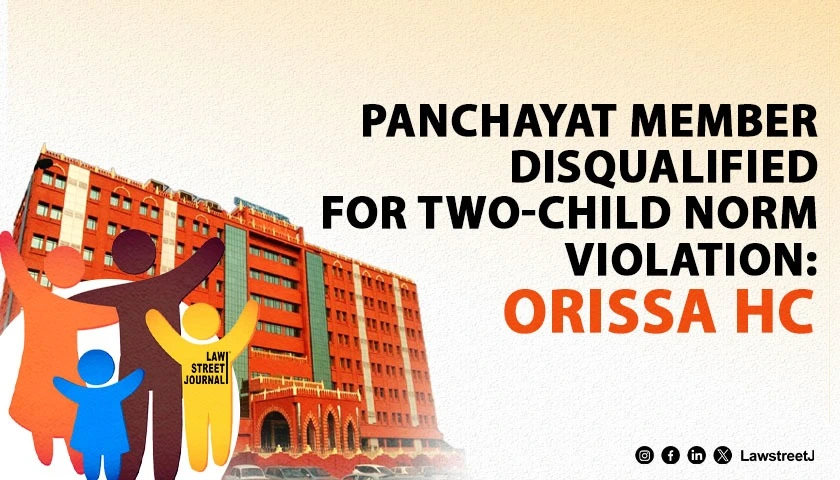
Orissa: The Orissa High Court upheld the disqualification of a Gram Panchayat member for having more than two children, while issuing stark warnings about India’s rapidly growing population and calling for urgent policy measures to address what it termed an “imminent population explosion.”
A Division Bench of Justices Dixit Krishna Shripad and Chittaranjan Dash delivered the judgment on January 15, 2026, dismissing the appeal of Maheswar Jena, whose membership in the Gram Panchayat was terminated under Section 25(1)(v) of the Odisha Grama Panchayats Act, 1964, which disqualifies persons with more than two children from holding such positions.
Jena argued that he was entitled to protection under the proviso to Section 25(1)(v), which exempts persons who had more than two children on the date of commencement of the Orissa Grama Panchayats (Amendment) Act, 1994, or within one year of such commencement, unless they beget an additional child after that one-year period.
However, the Court found that Jena’s case was a “textbook” example of disqualification. He had his third child on March 11, 1993, and his fourth on November 6, 1994. The Amendment Act came into effect on April 18, 1994. The Panchayat elections were held in 2022, by which time the proviso had been in force for 18 years. The Court held that the protective proviso remained “miles away” from Jena’s situation.
The Court noted that the Constitution (Forty-Second Amendment) Act, 1976 introduced Entry 20A on “Population Control & Family Planning” to the Concurrent List in the Seventh Schedule with effect from January 3, 1977, enabling both the Centre and States to devise population control policies.
The judgment went far beyond the immediate case to deliver extensive observations on India’s population crisis. The Court cited data showing India’s population at 1.43 billion as of 2023, projected to reach 1.7 billion by 2050, a growth rate of 17 percent.
The Court invoked economist Thomas Robert Malthus’s 1798 warning that unchecked population doubles every 25 years in geometric progression, and quoted philosopher Bertrand Russell’s statement that “population explosion is more dangerous than a hydrogen bomb.”
The Court further referenced Sir Winston Churchill’s pre-Partition comment that “India is not a nation, but a mere population,” when India’s population was around 30 crores, and speculated what caustic comment Churchill would make today with the population exceeding 140 crores.
The Court cited the United Nations Population Fund (UNFPA) India Policy for 2023–2027, which lists Bihar, Madhya Pradesh, Rajasthan, and Odisha as priority provinces for addressing population growth. The Court noted that Odisha’s population constitutes 3.32 percent of the nation’s population.
The Bench highlighted warnings from 11,000 world scientists about profoundly troubling signs, including sustained increases in human population, livestock populations, per capita meat production, fossil fuel consumption, and carbon dioxide emissions.
The Court quoted former UN Secretary-General Javier Pérez de Cuéllar’s warning that “if rapid population growth in the developing nations is left unchecked, it will evidently undermine all efforts for economic and social development and could easily lead to widespread depletion of each nation’s resources.”
The Court also observed that the gigantic population is hindering implementation of socio-welfare schemes and that individual value and dignity protected by the Constitution would diminish as population increases. The Court recalled difficulties during the COVID-19 pandemic when people were asked to maintain safe distance due to space constraints.
The judgment emphasized that Section 25(1)(v) embodies a state policy to diminish exponential population growth, citing the Punjab and Haryana High Court’s observation in Fazru v. State of Haryana that elected representatives are expected to set good examples by maintaining the two-child norm.
The Court stated that human overpopulation is a major driver of biodiversity loss and a key obstacle to fairly sharing habitat and essential resources with other species. It warned that unchecked population growth places immense strain on environmental, societal, and economic systems, causing environmental degradation, resource scarcity, and intensified societal challenges.
Quoting Lord Byron’s poem Childe Harold’s Pilgrimage, the judgment warned: “A thousand years scarce serve to form a State; an hour may lay it in the dust.”
The Court expressed “deep concern” about the imminent population explosion and stressed the “dire need for devising appropriate policies on a war footing to halt the same.” While appreciating that Parliament introduced the constitutional amendment enabling population control legislation, the Bench observed that “measures hitherto taken to retard population growth rate are far from satisfactory.”
The judgment concluded with a strong call to action: “It is high time that the Constitutional Institutions and the Civil Society do something in the matter.”
The Court directed the Registry to send a copy of the judgment to the Chairman of the Law Commission of India, New Delhi, signalling the need for legislative attention to population control measures.
Case Title: Maheswar Jena v. Madhusudan Dalai & Others


![Orissa HC awards Rs 10 lakh to father who lost child to stray dog attack [Read Judgment]](/secure/uploads/2023/12/lj_3371_Stray_dog_menace.jpg)
![Orissa HC rules in favour of BJDs Lok Sabha MP Anubhav Mohanty in divorce plea [Read Judgment]](/secure/uploads/2024/01/lj_2524_Anubhav_Mohanty.jpg)
![Indian Courts this Week: Law Street Journal's Weekly Round-Up of SC & HCs [Jan 1 - Jan 6]](/secure/uploads/2024/01/lj_9050_WhatsApp_Image_2024-01-06_at_12.07.10_PM.jpeg)