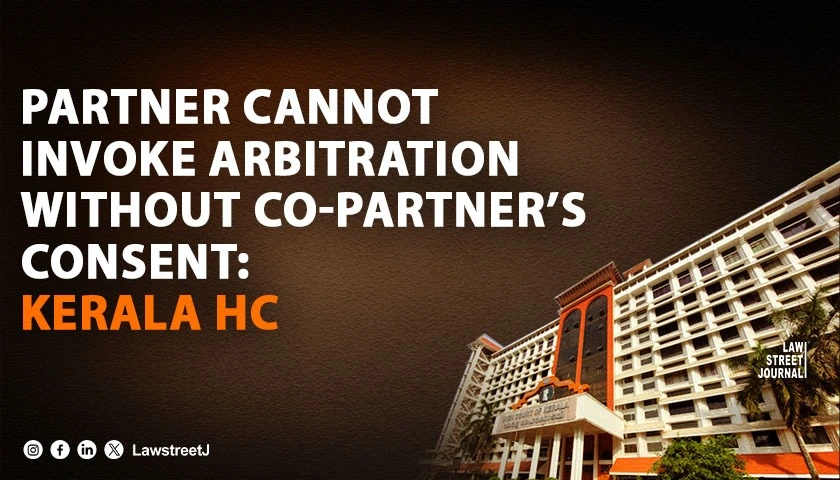
Kerala: The Kerala High Court has delivered an important ruling holding that one partner of a partnership firm cannot, without explicit authorisation from the remaining partners, invoke an arbitration clause or seek appointment of an arbitrator under Section 11 of the Arbitration and Conciliation Act, 1996. The Court emphasised the statutory bar under Section 19(2)(a) of the Indian Partnership Act, 1932.
Justice S. Manu examined the maintainability of AR No. 96 of 2025, an arbitration request filed by one partner in the name of the firm seeking appointment of an arbitrator. The Court noted, “This arbitration request is filed by a partner of the firm in its name,” and proceeded to consider whether such a request could be sustained without the express consent of the co-partner.
The Court recorded that the respondent opposed the request on the ground that Section 19(2)(a) of the Partnership Act expressly denies a partner any implied authority “to submit a dispute relating to the business of the firm to arbitration.” It was argued that the arbitration request was barred for want of express authorisation. The Court observed, “Respondent states that no express authority was given by the other partner… therefore, the arbitration request is liable to be rejected as not maintainable.”
Addressing the legal issue, the Court rejected the petitioner’s argument that objections under Section 19(2)(a) should be left to the arbitrator, holding instead that maintainability of a Section 11 request must be examined by the Court at the threshold. The Court stated, “Scrutiny of the maintainability of an application under Section 11(6)… is well within the authority of the Court,” emphasising that a defective invocation cannot be cured by reference to an arbitrator.
Critically, the Court underscored the effect of the statutory bar, observing that “Implied authority under Section 19(1) is not sufficient for invoking the remedy under Section 11… and express authority is indispensable.” It further held that approaching the Court under Section 11 amounts to submitting a dispute to arbitration and therefore attracts the prohibition under Section 19(2)(a).
The Court also rejected the petitioner’s reliance on a general management clause in the partnership deed, noting that such clauses cannot override Section 19(2)(a). It held that “the above clause is obviously general in nature,” and does not confer express authority to initiate arbitration proceedings on behalf of the firm.
Ultimately, the Court concluded that the arbitration request was filed by one partner “without the explicit authority of the other partner,” and therefore did not meet the statutory requirement of express consent. The request was held to be not maintainable and was accordingly dismissed.
Mr. Reji George appeared for the petitioner, while Mr. E.K. Nandakumar, Senior Counsel, represented the respondent.
Case Title: M/s P.K. Chandrasekharan Nair & Co. vs. Hindustan Petroleum Corporation Ltd.



![Kerala HC Quashes 498A Dowry Harassment Case Against Live-In Partner, Citing Lack of Relative Status [Read Order]](/secure/uploads/2023/08/lj_5693_1057c042-1e57-4e27-8c9e-25af0ec38ec4.jpg)
![Watching porn on mobile: Kerala HC highlights importance of mother cooked meals, outdoor sports [Read Order]](/secure/uploads/2023/09/lj_9155_Parental_supervision_of_mobile_phone_usage.jpg)
![Lakshadweep MP Mohammed Faizal Disqualified from Lok Sabha After Conviction Suspension Plea Rejected by Kerala High Court [Read Notice]](/secure/uploads/2023/10/lj_9640_87b5fd97-0e05-4ff8-9a99-3be1e4446192.jpg)