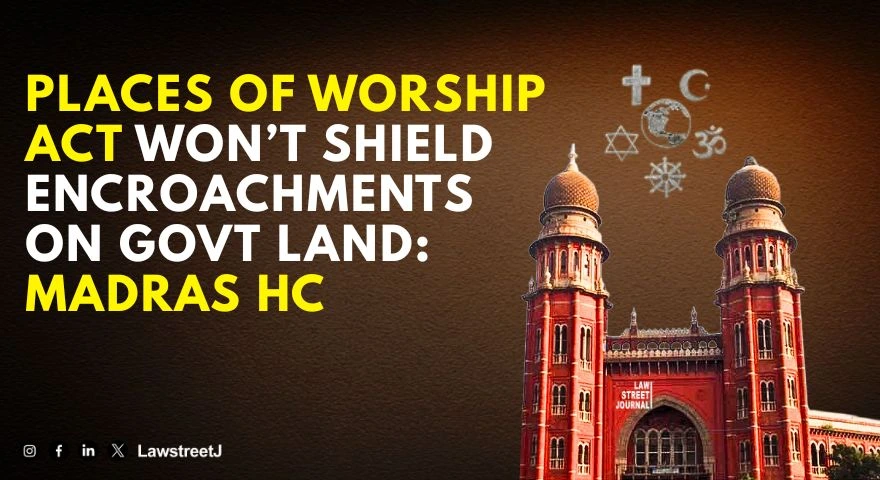
Chennai: The Madurai Bench of the Madras High Court has dismissed a writ petition filed by the Managing Trustee of Sri Arulmighu Raajakaliamman Temple in Ramanathapuram District, who sought to quash an eviction notice issued under Section 128 of the Tamil Nadu Local Bodies Act, 1998.
The two-judge Bench comprising Justice G. Jayachandran and Justice K.K. Ramakrishnan held that the Places of Worship (Special Provisions) Act, 1991 does not provide protection to structures erected on government land through encroachment, and that electricity connections or tax assessments do not confer any legal rights over illegally occupied public property.
The petitioner, N. Kumar, claimed to be the Managing Trustee of the temple situated on land classified in revenue records as “Orruni Poramboke Road”, the bund of a water body used as a public pathway. The Commissioner of Ramanathapuram Municipality had issued a notice dated November 29, 2025, under Section 128 of the Act, directing removal of the alleged encroachment within seven days.
The petitioner challenged this notice before the High Court in W.P.(MD) No. 35551 of 2025, but the petition was dismissed on December 11, 2025, with the Court observing that the petitioner had failed to make any representation to the authorities despite having seven days to do so, and that the notice was issued after the authorities were satisfied about the encroachment on public land.
Following the dismissal of his first writ petition, the petitioner issued a legal notice through his advocate on December 11, 2025, citing the disposal of the writ petition and requesting the authorities to refrain from taking coercive action during the appeal period. On December 15, 2025, he submitted a representation to the Tahsildar, Ramanathapuram, seeking patta for the encroached land by relying on G.O.(Ms) No. 205 issued by the Revenue and Disaster Management Department on April 26, 2025. He also made a representation to the Commissioner requesting that no removal action be taken while his patta application was pending consideration.
The Commissioner rejected this representation on the ground that the petitioner had failed to furnish documents of title and building permission for the structure. A second notice under Section 128 of the Act was issued on December 30, 2025. A legal notice was subsequently issued on behalf of residents of Rajamalayettu Street on January 23, 2026, requesting the authorities not to take action pending disposal of the patta request. Despite these interventions, a third and final eviction notice was issued on January 27, 2026, which became the subject of the present writ petition.
The petitioner advanced several contentions before the High Court. He claimed that the temple had existed from time immemorial and had been under public worship for several decades without hindrance or disturbance. He asserted that he was administering the temple by conducting daily poojas and festivals, and that the temple building was assessed to tax and provided with electricity service. He argued that the eviction notice was issued without following the principles of natural justice and violated Articles 14, 25, 26, and 300-A of the Constitution of India. He contended that his representation for grant of patta under G.O.(Ms) No. 205 dated April 26, 2025, was still pending consideration. Most significantly, he claimed that the disputed structure was protected under the Places of Worship (Special Provisions) Act, 1991, and therefore the authorities could not proceed with the eviction.
The Additional Government Pleader appearing for the respondents countered these submissions by pointing out that the temple structure was constructed on the bund of a water body used as a public pathway, without any permission. He argued that service connections and tax assessments do not confer any right on an encroacher to seek patta for a water body bund used as a public pathway. He explained that G.O.(Ms) No. 205 dated April 26, 2025, related to the issuance of free house site patta by regularizing residential encroachments on unobjectionable government poramboke lands under a special one-time regularisation scheme. Therefore, a temple structure on objectionable government land would not be covered by this Government Order.
He further submitted that the Places of Worship Act, 1991, had no relevance to the case, as the temple structure was put up by encroaching upon the bund of a water body, causing obstruction to a pathway. He characterised the petitioner’s reliance on the Government Order meant exclusively for residential encroachments and the Act meant for places of worship as proof of self-contradictory pleas made to obstruct the eviction process.
After hearing counsel on both sides and examining the record, the High Court was fully satisfied that the petitioner had encroached upon government land and constructed the temple without permission. The Court noted the petitioner’s contradictory claims that the temple existed from time immemorial while simultaneously admitting that he built the structure in 1991.
The Court held that being a non-residential structure on government land, G.O.(Ms) No. 205 dated April 26, 2025, was not applicable. It emphasised that no patta could be granted for land on a water body bund obstructing a public pathway, and therefore any representation made for grant of patta was liable to be ignored.
Regarding the Places of Worship (Special Provisions) Act, 1991, the Court observed that the legislation was enacted to prohibit conversion of any place of worship and to provide for maintenance of the religious character of places of worship as they existed on August 15, 1947.
The Court categorically held that neither the intention of the legislation nor any provision in the Act provides protection to a structure erected on government land by way of encroachment.
The Court therefore concluded that reliance on the Government Order and the Places of Worship Act was merely to mislead and carried no merit whatsoever. Accordingly, the writ petition was dismissed without costs.
Appearance:
Petitioner: Mr. Niranjan S. Kumar, Advocate
Respondents: Mr. S.R.A. Ramachandran, Additional Government Pleader (R1, R3, R4 & R5); Mr. K. Saravanan (R2); Mr. G. Gnanasekaran, Government Advocate (R6)
Case Title:
N. Kumar v. The District Collector & Ors., W.P.(MD) No. 2646 of 2026



![TN Medical Council declares change of gender identity of LGBTQIA+ as misconduct [Read Notification]](/secure/uploads/2022/12/lj_5268_5cebb05a-97fb-40fb-8045-25cdf8f4207a.jpg)
![Madras High Court Directs Tamil Nadu Government to Ensure Quota for Transgenders in Local Body Elections [Read Order]](/secure/uploads/2023/08/lj_2507_7a03d113-08b1-4670-b6fb-9058aee481d0.jpg)
![Anti Corruption sleuths acted like "puppets in The Muppet Show", HC notice to ex TN CM in disproportionate assets case [Read Order]](/secure/uploads/2023/09/lj_8675_7b37fc02-1b2d-4f4a-9816-3df20545b37e.jpg)