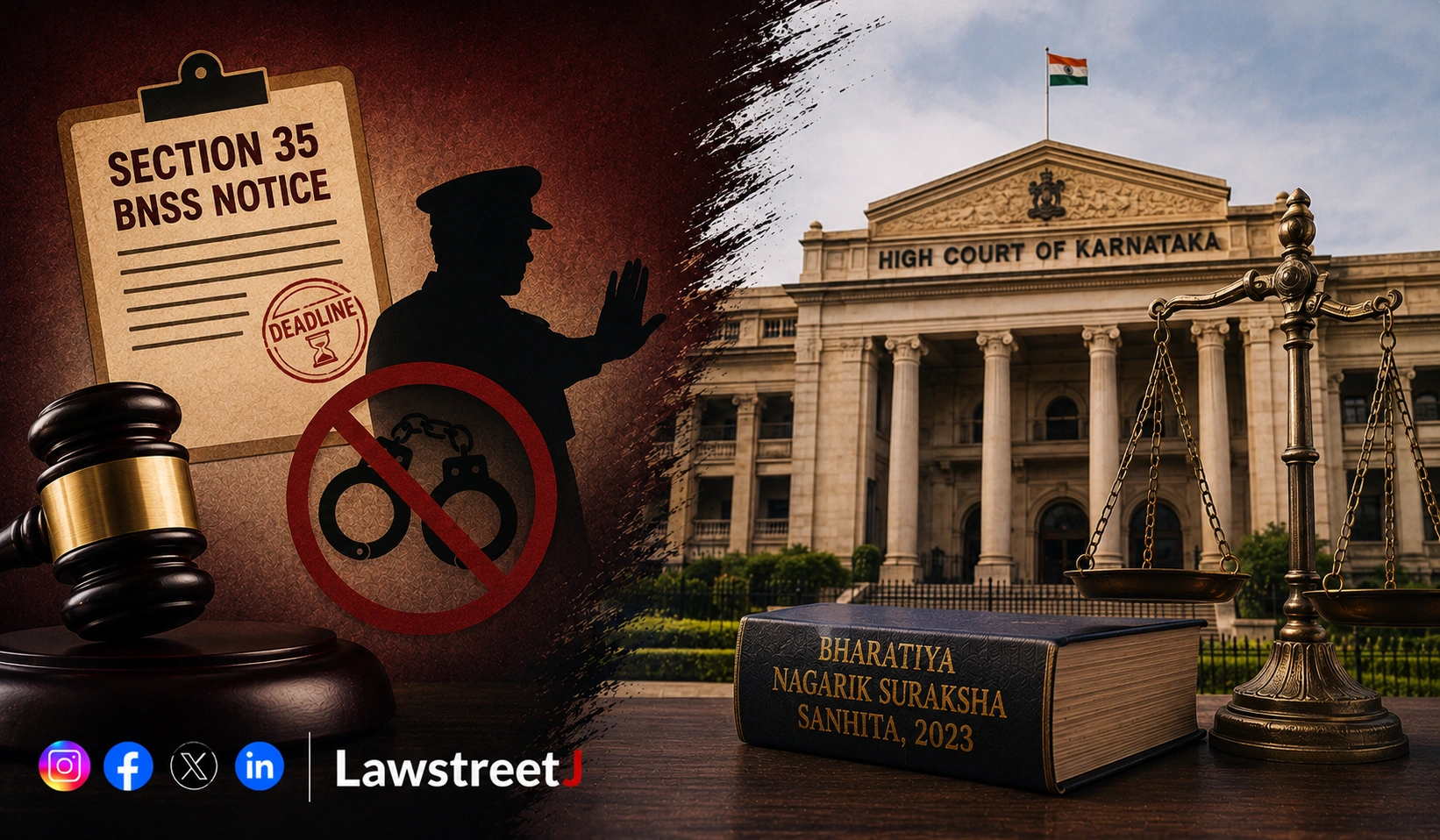
Bengaluru: The Karnataka High Court has declared the arrest of a Will-attesting witness illegal after police took him into custody nearly 48 hours before the very date on which their own Section 35(3) BNSS notice had called upon him to appear, and directed the Investigating Officer and his supervisory officers to personally pay Rs.3,00,000 in exemplary costs, with the amount barred from being drawn from the State exchequer.
Justice M. Nagaprasanna was hearing plea, filed under Section 482 Cr.PC/528 BNSS by the petitioner challenging the registration of Crime No.586/2026 for offences under Sections 61, 338 and 340(2) of the Bharatiya Nyaya Sanhita, after the Whitefield Police took him arrayed as accused No.2 and a mere attesting witness to a Will pending adjudication before the civil court into custody.
The record showed that the jurisdictional police had issued a notice under Section 35(3) of the Bharatiya Nagarik Suraksha Sanhita, 2023 on 25 August 2026, directing the petitioner to appear before the Investigating Officer at 11.00 a.m. on 27 August 2026. Yet, before that hour could even arrive, the police arrested him on the morning of 25 August 2026 itself and produced him before the Magistrate. On the matter being urgently brought before the High Court the same day, the court had directed the petitioner's forthwith release, recording that the case formed a classical illustration of a citizen arrested without rhyme or reason, and called upon the Investigating Officer to explain why exemplary costs should not be imposed on him.
Examining the sequence in the final order, the court observed that the statutory safeguard under Section 35(3) of the BNSS had been rendered a mere piece of paper by the very authority that issued it, holding:
“A statutory safeguard cannot become a trap laid by the State—inviting a citizen to appear tomorrow while arresting him today.”
Relying on the Supreme Court's decisions in Satender Kumar Antil v. Central Bureau of Investigation, 2025 SCC OnLine SC 1578 and 2026 SCC OnLine SC 162, and on Joginder Kumar v. State of UP, (1994) 4 SCC 260, the court reiterated that Section 35 of the BNSS, through the use of the word “may,” makes arrest discretionary rather than mandatory, that investigation can proceed without arrest, and that even non-compliance with a Section 35(3) notice does not automatically justify arrest but requires the police officer to record specific reasons why arrest, as a last resort, has become necessary.
Applying these principles, the court found that since the hour fixed for the petitioner's appearance had not even arrived, there was no occasion for the Investigating Officer to have formed any opinion that the petitioner had failed to cooperate. When queried in court, the Investigating Officer could offer no explanation for what compelling circumstance warranted the arrest, or whether there was any apprehension of abscondence, evidence tampering, or witness intimidation. The court held:
“An arrest is not an innocuous administrative act. It takes away liberty; it wounds reputation; it places the might of the State against an individual; and, even if the incarceration lasts only for a few hours, those hours cannot be restored to the citizen. Liberty is incapable of restitution in kind. Once lost, time in custody cannot be returned.”
The court further held that responsibility could not be confined to the officer who effected the arrest alone, and that the supervisory hierarchy the Assistant Commissioner of Police and Deputy Commissioner of Police concerned bore the solemn responsibility of ensuring coercive power was exercised within the four corners of law. Declaring the arrest illegal, the court quantified exemplary costs of Rs.3,00,000 to be paid personally by the Investigating Officer along with the Assistant Commissioner of Police and the Deputy Commissioner of Police, expressly directing that the amount not be drawn from the State exchequer, reasoning that doing so would produce the curious result of the citizen compensating the citizen for an illegality committed by an errant public servant.
The court additionally noted that the underlying dispute bore the unmistakable complexion of a civil contest over the validity of a Will pending before the civil court, and that the petitioner, being neither its propounder nor beneficiary but only an attesting witness, could not be made to inherit every allegation levelled against the maker or beneficiary of the instrument merely by virtue of having signed it.
The protective order was clarified to enure only to the petitioner-accused No.2 and not to accused No.1, with the matter listed next on 3 September 2026.
Appearances:
For the Petitioner: Mr. Angad Kamath, Advocate.
For Respondent No.1/State: Mr. B.N. Jagadeesha, State Public Prosecutor-1.
Case Title: Mr. K.N. Mohan Reddy vs. State of Karnataka and Another, CRL.P No. 13117/2026



![Karnataka High Court: Cabinet Rank Status Not Equivalent to Ministerial Position [Read Order]](/secure/uploads/2023/09/lj_2318_fc1b99b7-aeed-472b-836e-33750bedb394.jpg)


![Woman living in adultery cannot claim maintenance: Karnataka High Court [Read Order]](/secure/uploads/2023/10/lj_3083_Women_living.jpg)