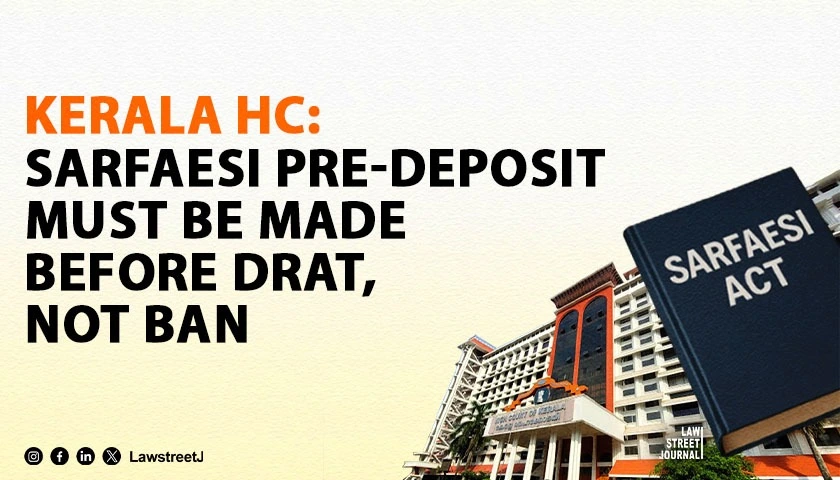
Kerala: The Kerala High Court has held that the mandatory pre-deposit required under Section 18 of the Securitisation and Reconstruction of Financial Assets and Enforcement of Security Interest Act, 2002 (SARFAESI Act) must be deposited before the Debt Recovery Appellate Tribunal (DRAT), and not before the lending bank. The Court further held that writ petitions under Article 226 of the Constitution are not maintainable when an efficacious statutory remedy is available.
A Division Bench comprising Justice Anil K. Narendran and Justice Muralee Krishna S. allowed the writ appeal filed by Kerala Gramin Bank, setting aside the Single Judge’s order which had directed the borrower to deposit ₹15 lakhs with the bank as part of the statutory pre-deposit requirement for filing an appeal before the DRAT.
The case arose from an overdraft facility of ₹70 lakhs availed on June 29, 2017, by M/s Prajith Builders & Developers Private Limited through its Managing Director, Prajith C.M., from Kerala Gramin Bank. Upon default, the bank issued a demand notice dated August 31, 2021, under Section 13(2) of the SARFAESI Act, demanding ₹88,59,605.33.
After the borrowers challenged the notice, it was withdrawn due to defects, and a fresh demand notice dated June 27, 2022, was issued. The borrowers then filed Securitisation Application No. 530 of 2022 before the Debt Recovery Tribunal-I, Ernakulam (DRT), which was dismissed by order dated June 14, 2024.
Instead of directly filing an appeal before the DRAT with the mandatory pre-deposit, the borrowers filed W.P.(C) No. 21833 of 2024 before the High Court under Article 226. By judgment dated August 14, 2024, the Single Judge disposed of the writ petition, directing the borrowers to deposit ₹15 lakhs with the bank within two weeks, noting that they had already remitted ₹10 lakhs pursuant to an interim order dated June 19, 2024. The Court held that ₹10 lakhs fell short of the minimum 25% statutory deposit and directed payment of an additional ₹15 lakhs to make up the shortfall.
Subsequently, the borrowers filed R.P. No. 1265 of 2024 seeking review. By order dated November 29, 2024, the Single Judge clarified that the deposit of ₹15 lakhs “should be treated as a direction for statutory pre-deposit” and directed that no coercive measures be taken until the appeal before the DRAT was decided.
The bank filed the present writ appeal, albeit with a delay of 357 days, which was condoned. The bank contended that as of September 17, 2025, the borrowers were liable to pay ₹1,12,87,071.97 and, therefore, were required to deposit 25% of this amount—₹28,21,766—while presenting the appeal before the DRAT. It was argued that when a statutory appellate remedy exists, a writ petition under Article 226 is not maintainable.
Crucially, the bank argued that the pre-deposit contemplated under Section 18 of the SARFAESI Act is an amount to be deposited before the DRAT, which, upon conclusion of the appeal, would be returned to the depositor, and not paid to the bank. Therefore, the Single Judge’s direction to treat amounts deposited with the bank as the mandatory pre-deposit before the DRAT was illegal.
The bank relied upon Supreme Court decisions including Union Bank of India v. Rajat Infrastructure Private Limited [(2020) 3 SCC 770], Kotak Mahindra Bank Private Limited v. Ambuj A. Kasliwal [(2021) 3 SCC 549], Sidha Neelkanth Paper Industries Private Limited v. Prudent ARC Limited [2023 SCC OnLine SC 12], and the Kerala High Court decision in Union Bank of India v. M/s Suwique Traders [2025 (4) KHC SN 30].
The borrowers contended that after filing the writ petition, they had preferred an appeal under Section 18 before the DRAT, Chennai. They argued that the bank had not disputed in the review petition that the deposits would cover the mandatory 25% pre-deposit. They also disputed the outstanding amount claimed by the bank, contending that although three accounts were clubbed, the subject matter involved only one account. They further argued that once payment of 25% was admitted, the bank ought not to have filed an appeal with delay condonation.
The Division Bench undertook a detailed analysis of Section 18 of the SARFAESI Act. The second proviso provides that no appeal shall be entertained unless the borrower has deposited with the Appellate Tribunal fifty per cent of the amount of debt due, as claimed by the secured creditor or determined by the DRT, whichever is less. The third proviso empowers the Appellate Tribunal to reduce the deposit to not less than twenty-five per cent for reasons to be recorded in writing.
Relying on Rajat Infrastructure, the Court reiterated that there is an absolute bar to the entertainment of an appeal unless the condition precedent of pre-deposit is fulfilled. In Kotak Mahindra Bank, the Supreme Court held that discretion to reduce the pre-deposit can only operate between 50% and 25%, and not below that threshold. In Sidha Neelkanth Paper Industries, it was held that the borrower must deposit the required amount and cannot seek adjustment while simultaneously challenging the auction sale.
The Kerala High Court in M/s Suwique Traders held that a complete waiver of pre-deposit is beyond the scope of Section 18(1), and that the DRAT cannot entertain an appeal unless 25% of the debt is deposited before it.
On the issue of where the pre-deposit must be made, the Court held that there is no provision under the SARFAESI Act permitting the statutory pre-deposit to be made before the bank instead of the DRAT. It noted that the practice of the DRAT is to return the deposited amount upon conclusion of the appeal, particularly since even third parties can appeal before the DRAT.
Accordingly, the Court held that there was no legal basis for the Single Judge’s direction to treat amounts deposited with the bank as the statutory pre-deposit required to be made before the DRAT.
On maintainability of writ petitions, the Court relied on Authorized Officer, State Bank of Travancore v. Mathew K.C. [2018 (1) KHC 786], wherein the Supreme Court held that writ jurisdiction under Article 226 may be invoked only in exceptional circumstances. Further reliance was placed on South Indian Bank Ltd. v. Naveen Mathew Philip [2023 (4) KLT 29] and Sreedhar K. v. M/s Raus Constructions Pvt. Ltd. [2023 KLT OnLine 1007 (SC)].
Analyzing the facts, the Division Bench held that since an efficacious statutory remedy was available before the DRAT, the writ petition was not maintainable. The Court rejected the borrowers’ apprehension that the DRAT would not consider their appeal in time, noting that there was no material to support such a claim.
The writ appeal was accordingly allowed, the Single Judge’s judgment dated August 14, 2024, was set aside, and the writ petition was dismissed.
Case Title: The Authorized Officer and Chief Manager, Kerala Gramin Bank v. M/s Prajith Builders & Developers Private Limited & Ors.



![Kerala HC Quashes 498A Dowry Harassment Case Against Live-In Partner, Citing Lack of Relative Status [Read Order]](/secure/uploads/2023/08/lj_5693_1057c042-1e57-4e27-8c9e-25af0ec38ec4.jpg)
![Watching porn on mobile: Kerala HC highlights importance of mother cooked meals, outdoor sports [Read Order]](/secure/uploads/2023/09/lj_9155_Parental_supervision_of_mobile_phone_usage.jpg)
![Lakshadweep MP Mohammed Faizal Disqualified from Lok Sabha After Conviction Suspension Plea Rejected by Kerala High Court [Read Notice]](/secure/uploads/2023/10/lj_9640_87b5fd97-0e05-4ff8-9a99-3be1e4446192.jpg)