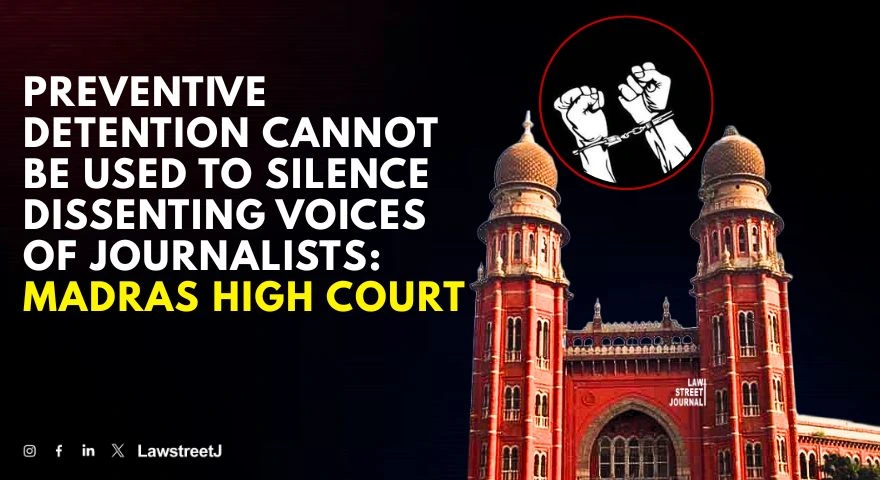
Chennai: The Madras High Court has ruled that preventive detention laws cannot be weaponized to settle political scores or silence dissenting voices, particularly those of investigative journalists and YouTubers who critique government activities.
A Division Bench comprising Justice S.M. Subramaniam and Justice P. Dhanabal delivered this significant judgment while granting interim bail to a YouTube journalist detained under the Tamil Nadu Prevention of Dangerous Activities Act, 1982 (Act 14 of 1982), as a “sexual offender,” based on what the Court found to be a landlord–tenant dispute.
The petitioner’s husband, an investigative journalist running a YouTube channel, was detained under Act 14 of 1982 following a criminal case registered by his landlord. The prosecution alleged that he had used abusive language when asked to vacate the premises—a dispute which, the Court observed, should ordinarily have been resolved before the Rent Control Court rather than through criminal proceedings.
The Court noted several serious irregularities in the detention. First, the grounds of arrest were not communicated in writing to the accused by the investigating officer at the time of arrest, in violation of the constitutional mandate laid down by the Supreme Court in Mihir Rajesh Shah v. State of Maharashtra. Second, the detenu’s representation to the Principal Secretary reached the government on December 16, 2025, but was rejected merely because it had not been received within 12 days as required under the Act, despite postal tracking showing that the prison authorities had forwarded it only on December 15, 2025.
The Court strongly criticized this casual and callous handling by jail authorities, citing the Supreme Court’s ruling in Jaseela Shajiv v. Union of India, which held that transmitting authorities have a duty to send representations promptly—especially in the modern era of technological advancement, where email and speed post are readily available.
Significantly, the Court referred to observations made by a Single Judge of the same High Court in February 2025 while transferring related cases to the CBCID. The Judge had noted that the cases appeared to have been “foisted” against the journalist with mala fide intention to keep him detained even after he was granted bail, with all cases having been registered within a short span by the same police officer.
The Court examined the legal requirements for preventive detention under Act 14 of 1982 and found them not satisfied. Relying on Supreme Court precedents including Vaddi Lakshmi v. State of Telangana and Mallada D. Sri Ram v. State of Telangana, the Court emphasized that mere involvement in a sexual offence is insufficient to invoke preventive detention; the offence must be integrally connected with acting in a manner prejudicial to the maintenance of public order.
Drawing on the landmark judgment in Ram Manohar Lohia v. State of Bihar, the Court distinguished between “law and order,” “public order,” and “security of the State” using the metaphor of three concentric circles. A landlord–tenant dispute involving abusive language, the Court held, affects law and order at best and does not rise to the level of disturbing public order required for preventive detention.
In powerful observations on constitutional principles, the Court stated that liberty under India’s constitutional scheme is “not a gift of the State but its first obligation,” citing the recent Supreme Court judgment in Magesh Kumar Agarwal v. Union of India. The Court emphasized that Constitutional Courts must never stifle Article 19(1)(a), which guarantees freedom of speech and expression.
The Court observed that filing criminal case after criminal case and clamping journalists or YouTubers under preventive detention laws cannot be permitted by Constitutional Courts “under any circumstances,” as it directly infringes fundamental rights. While acknowledging that social media activities must be regulated in accordance with law, the Court held that the State cannot hunt down every dissenting view or opinion.
Taking note of systemic issues, the Court strongly criticized the practice of preventive detention in Tamil Nadu. It observed that hundreds of detention orders are issued by executive authorities, numerous habeas corpus petitions remain pending, and the State repeatedly seeks adjournments for filing counter affidavits. This results in most petitions being heard only at the fag end of detention periods, thereby frustrating the very institution of habeas corpus relief.
The Court held that detaining authorities have begun to exploit these delays, knowing that disposal takes several months. It described this as an unacceptable thought process that cannot be appreciated by courts.
On the issue of maintainability raised by the State, the Court firmly rejected the argument that eight weeks should be granted for filing a counter affidavit. It held that when personal liberty is infringed, Constitutional Courts are not expected to wait for lengthy periods. An illegal detention can never be allowed to continue, as the right to personal liberty is a vital fundamental right.
The Court emphasized that preventive detention laws are draconian and antithetical to fundamental rights under Part III of the Constitution. Such powers must be exercised sparingly, with extreme caution and in good faith. Any callousness, improper motive, extraneous consideration, or attempt to settle political scores or silence dissenting voices should result in disciplinary proceedings against the concerned detaining authorities under the relevant Service Rules.
The Court further observed that the Government must not approve detention orders in a routine manner and that due application of mind and scrutiny of relevant factors are paramount to protecting citizens’ fundamental rights. Personal liberty, the Court reiterated, is not a concession granted by the State but a constitutional duty imposed upon it.
Finding no sufficient grounds to detain the journalist under Act 14 of 1982, the Court granted interim bail for twelve weeks, subject to conditions including execution of a personal bond of ₹1 lakh, prohibition on leaving the country, non-interference with witnesses, and cooperation with the investigation.
The Court directed the Registry to communicate the order by email immediately and ensure the detenu’s release from prison forthwith, with the certified copy of the order to be issued on the same day.
Case Title: Neelima v. The Additional Chief Secretary and Others



![TN Medical Council declares change of gender identity of LGBTQIA+ as misconduct [Read Notification]](/secure/uploads/2022/12/lj_5268_5cebb05a-97fb-40fb-8045-25cdf8f4207a.jpg)
![Madras High Court Directs Tamil Nadu Government to Ensure Quota for Transgenders in Local Body Elections [Read Order]](/secure/uploads/2023/08/lj_2507_7a03d113-08b1-4670-b6fb-9058aee481d0.jpg)
![Anti Corruption sleuths acted like "puppets in The Muppet Show", HC notice to ex TN CM in disproportionate assets case [Read Order]](/secure/uploads/2023/09/lj_8675_7b37fc02-1b2d-4f4a-9816-3df20545b37e.jpg)