

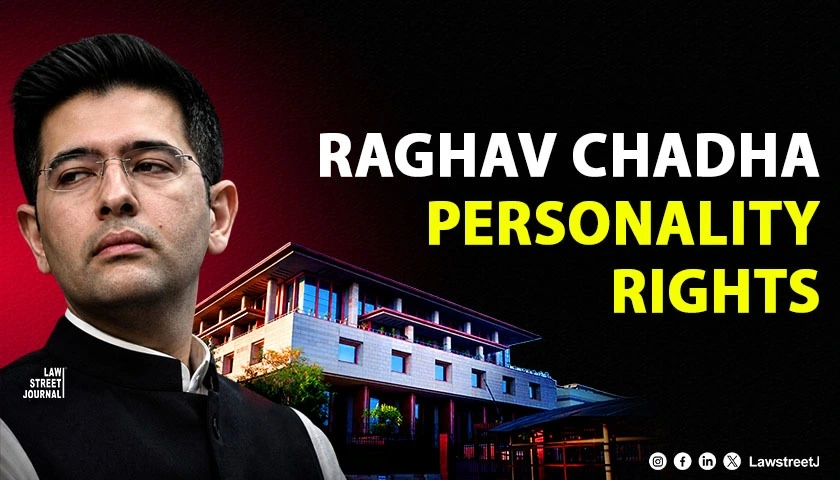
New Delhi: The Delhi High Court on May 21, 2026 reserved its order on an application for interim relief filed by BJP Member of Parliament Raghav Chadha, who has filed a suit seeking the takedown of allegedly defamatory content portraying him as having sold himself for money after joining the BJP, in the matter of Raghav Chadha v. Ashok Kumar John Doe & Ors., before Justice Subramonium Prasad. The Court expressed a prima facie view that the impugned posts amounted to criticism of a political decision rather than a violation of personality rights, noted that the line between defamation and criticism is quite thin, and appointed an amicus curiae to assist the Court, indicating that this may not be a fit case for the grant of an interim injunction, unlike other personality rights matters.
Background
Raghav Chadha, a BJP Member of Parliament, has filed the suit seeking a John Doe order against unknown entities, as well as various named defendants, restraining them from exploiting his personality traits, including his photographs, without his consent. The suit is filed through Advocates Satyam Anand and Nikhil Aradhe. Senior Advocate Rajiv Nayar appeared for Chadha at the hearing.
The core grievance is the circulation of content allegedly showing that Chadha traded his political allegiance for money, a narrative that Chadha’s counsel characterised as profane and defamatory. The defendants include Meta, among other known and unknown parties.
Court’s Observations
At the outset, the Court told Senior Advocate Nayar that its prima facie impression was that no personality right is involved in the case. The Court distinguished the present suit from the typical personality rights proceedings before the Court, observing that the content complained of related to criticism of a political decision and not to the unauthorised commercial exploitation of Chadha’s image or likeness:
“Unlike other judgments, here it’s just criticism taken on decisions taken by you in political arena… It is a comment by a person criticising a political decision.”
Referring specifically to the photographs to which Chadha had objected, the Court remarked that the posts were an attack or critique of a political figure, and that as a political leader, Chadha must be expected to endure a degree of commentary that might not apply to others. The Court observed:
“It is not a defamation suit. It is a suit on the basis of personality rights.”
Nayar’s Submissions and Court’s Response
Senior Advocate Nayar clarified that he was pressing the application for interim relief only in respect of the defamatory posts, and not the broader personality rights claims. He submitted that the story being circulated is that Chadha traded his position for money, which went beyond political criticism and was profane. He argued:
“The story being circulated is that I traded for money. That can’t be criticism.”
The Court acknowledged the submission but remained unconvinced that interim relief was warranted at this stage, responding that the line between defamation and criticism is quite thin and that the question of which side of the line the impugned content falls on would be a matter of debate. The Court indicated:
“That would be a matter of debate… Let me appoint an amicus. Let amicus come.”
As Nayar continued to press for interim relief, the Court further elaborated on the distinction it was drawing, observing that there is a difference between commercialising personality rights and criticism. Pointing to the leading Delhi High Court precedent in the matter involving Congress leader Shashi Tharoor, the Court noted that the Shashi Tharoor judgment protected the manner in which he speaks and his demeanour, a distinctly different category from criticism of a political decision. The Court also directed that the plaint be registered as a suit.
Meta’s Submissions
Counsel for Meta submitted that the plaintiff had placed 32 screenshots on record as a schedule, of which many belonged to newspapers or consisted of content supporting the plaintiff, and many did not even contain his photographs. It was further argued that publicity rights flow out of copyright, and that the material on record did not establish the kind of unauthorised commercial exploitation that attracts a restraint order in personality rights matters.
Delhi High Court’s Personality Rights Jurisprudence
The Delhi High Court has developed a substantial body of jurisprudence on personality rights, having previously granted protection to political figures including Congress leader Shashi Tharoor and Andhra Pradesh Deputy Chief Minister Pawan Kalyan. The Court has similarly protected entrepreneur Aman Gupta, actors Allu Arjun, Mohanlal, Kajol Devgan, R. Madhavan, NTR Junior, Nagarjuna, Aishwarya Rai Bachchan and Abhishek Bachchan, singer Jubin Nautiyal, former cricketer Sunil Gavaskar, spiritual preacher Aniruddhacharya, and film producer Karan Johar. A similar suit has also been filed by actor Salman Khan.
The Court has additionally passed orders protecting journalist Sudhir Chaudhary in connection with the circulation of allegedly misleading and AI-generated videos against him on social media, and podcaster Raj Shamani, whom the Court described as a known face in India, particularly in the field of content creation. Coordinate benches have also passed orders protecting the personality rights of Sri Sri Ravi Shankar of The Art of Living Foundation.
The Court’s prima facie observations in the present case, drawing a distinction between political criticism and personality rights infringement, mark a potentially significant qualification of this growing line of authority, and the order reserved on interim relief is likely to be closely watched for its implications on the scope of personality rights protection available to political figures.
Case Details:
Raghav Chadha v. Ashok Kumar John Doe & Ors., Delhi High Court. Before Justice Subramonium Prasad. Heard on May 21, 2026. Senior Advocate Rajiv Nayar appeared for the plaintiff; Advocates Satyam Anand and Nikhil Aradhe are on record for the plaintiff. Order on interim relief reserved; amicus curiae appointed

![Delhi High Court Sets Aside Arbitral Tribunal's Award Against NHAI in Highway Project Delay Case [Read Judgment]](/secure/uploads/2023/07/lj_9605_23374c2e-392c-4491-a2fe-f2f12fc5272f.jpg)
![Delhi Court Rejects Stay Request in Defamation Case Against Rajasthan CM Ashok Gehlot [Read Order]](/secure/uploads/2023/08/lj_5208_80de1ddc-d76a-4f7f-b180-408e3ae14fb4.jpg)