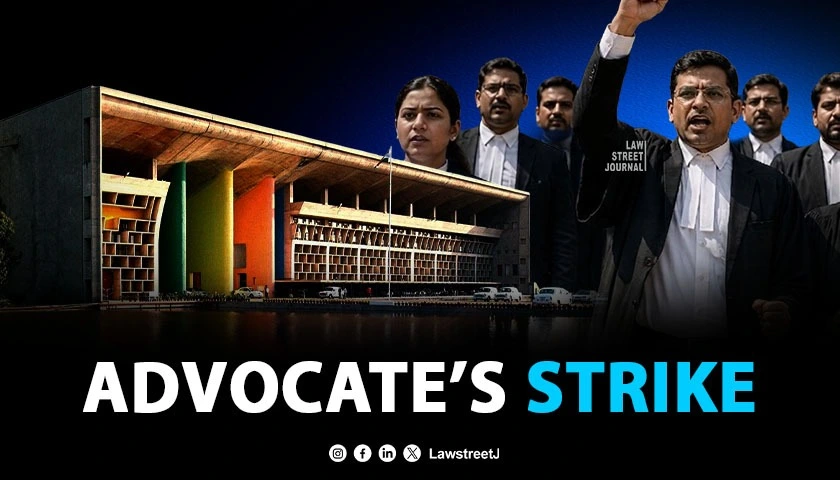
Punjab: Taking up the matter suo motu, a Division Bench of Chief Justice Sheel Nagu and Justice Sanjiv Berry questioned whether striking advocates were fulfilling their duty to litigants, while also directing steps to augment security at the High Court complex and calling for a fresh investigation report into the alleged firing incident of May 19, 2026.
The Punjab and Haryana High Court this week took up suo motu proceedings in connection with an alleged firing incident involving Advocate Gagandeep Jammu, former Secretary of the Punjab and Haryana High Court Bar Association, and simultaneously censured the Bar Association’s decision to abstain from work during the post-lunch session of May 21, 2026, as a mark of solidarity. A Division Bench of Chief Justice Sheel Nagu and Justice Sanjiv Berry questioned whether the abstention served any purpose for litigants and made pointed remarks about the duty of advocates to their clients, telling the Bar that there were ‘other ways’ to express solidarity without ceasing to discharge professional responsibilities.
The proceedings arose out of an alleged attempt on the life of Advocate Gagandeep Jammu on or around May 19, 2026, in respect of which an FIR was registered on the same date. The Bar Association, in a communication issued on the morning of May 21, stated that the High Court had already directed authorities to ensure the life and liberty of Jammu and that a permanent PCR vehicle had been stationed outside his residence. The association also stated that it would pursue a fair and expeditious investigation into the FIR.
On May 22, the court called for a fresh report on the status of the investigation into the attack. The court also indicated that it would take steps to augment security measures at the High Court complex. The Bar Association, in a separate communication, also referred to an alleged incident involving Advocate Adarshdeep Singh Brar, claiming that unidentified persons had attempted to abduct him from within the High Court premises itself, and sought a comprehensive security audit of the complex.
On May 21, after the Bar Association announced post-lunch abstention as a symbolic gesture of solidarity with Jammu, Chief Justice Nagu took strong exception to the decision during the hearing. He raised concerns about the plight of litigants who travel long distances to attend court, only to find that their matters cannot proceed because their advocates have chosen not to appear.
“Do you imagine the plight of that litigant who must have come from 100 kilometres or 200 kilometres just with the hope that his case will be decided today?”
~ Chief Justice Sheel Nagu, Punjab & Haryana High Court (21.05.2026)
The Chief Justice also questioned the practical utility of the abstention in addressing the security threat to advocates, asking the Bar President directly: “If you abstain from work, will the gangsters stop functioning?” He informed the Bar Association that he would not sign the order the Bench had prepared, which had been taken up out of turn specifically to address the Jammu matter, unless the strike was withdrawn. He noted that the Bench had done its duty by taking the case up urgently and questioned whether the Bar was doing its duty towards its clients.
“You are disrespecting your profession by going on strike. What attracts you towards just not working? It is your duty as an advocate to represent the client.”
~ Chief Justice Sheel Nagu, Punjab & Haryana High Court (21.05.2026)
Bar Association President Rohit Sud submitted that the abstention was symbolic and reflected the sentiments of Bar members, and that the association was seeking stronger institutional safeguards to deter attacks on advocates, including day-to-day investigation and trial in such matters. Sud submitted before the Bench: “It should send a message to the larger public also that you can’t touch lawyers like this.” Sud also referred to discussions regarding the framing of a standard operating procedure and the appointment of a dedicated police officer to handle issues concerning advocates exclusively.
In a notable development during the proceedings, Advocate Jammu himself addressed the Bench and clarified that he had neither called for the abstention nor initially supported it. When asked directly by the Chief Justice whether he supported the strike, Jammu maintained a careful position, stating that the final decision rested with the Bar Association and its members.
“I was the first one to say that I do not want a strike. I said so. I said, I want results. I don’t want a strike.”
~ Advocate Gagandeep Jammu before the Punjab & Haryana High Court (21.05.2026)
Jammu acknowledged that Bar members had subsequently felt that stronger collective action was warranted due to a perceived lack of sufficient progress in the matter. He said: “If there is nothing happening, there is no remedy left, then we should be the ones standing in solidarity.” However, he was explicit that it was not he who had called the strike and that he would not interfere in the Bar’s internal decisions. He also expressed some discomfort at the manner in which the issue was being ventilated before the court.
On May 22, the court went beyond the immediate circumstances of the Jammu case and addressed the broader question of security at the High Court complex. The Bench indicated that it would take proactive steps to augment security measures at the Punjab and Haryana High Court. The court also asked advocates to cooperate with security frisking procedures at the complex, signalling an intent to tighten access controls. A fresh report on the investigation into the firing incident was called for, indicating that the court intended to closely monitor the pace and quality of the investigation.
The Punjab and Haryana High Court’s suo motu intervention in the Gagandeep Jammu matter comes in the broader national context of rising concerns about the safety of advocates, a theme simultaneously being addressed by the Bombay High Court’s Kolhapur Bench in PIL (ST.) No. 1956/2026, where a Division Bench is considering framing 21-point interim guidelines for the protection of advocates from violence pending enactment of appropriate legislation. The Punjab and Haryana High Court’s approach — calling for expeditious investigation, enhanced physical security, and the constitution of a dedicated police mechanism — mirrors several of the proposed guidelines under consideration at Kolhapur, reflecting a convergence of judicial thinking across High Courts on the inadequacy of existing arrangements for advocate protection.
Chief Justice Nagu’s pointed remarks on Bar strikes also touch upon a long-standing tension in Indian court practice. The Supreme Court, as well as multiple High Courts, have repeatedly deprecated the practice of lawyers abstaining from court work as a form of protest, holding that such abstentions constitute a disservice to litigants and undermine the administration of justice. The Chief Justice’s refusal to sign the suo motu order until the abstention was addressed was a direct application of this principle.
CASE REFERENCE
Matter: Suo Motu – Attack on Advocate Gagandeep Jammu
Court: Punjab & Haryana High Court
Bench: Chief Justice Sheel Nagu & Justice Sanjiv Berry
FIR registered: May 19, 2026 (Chandigarh)
Bar Association President: Rohit Sud
Hearing dates: May 21 & 22, 2026
Parallel matter: PIL (ST.) 1956/2026 – Bombay HC Kolhapur Bench (advocate protection guidelines)

![Police protection to fund manager alleging threat from Kirron Kher & aide: Punjab & Haryana HC [Read Order]](/secure/uploads/2023/12/lj_9007_Police_Kirron_Kher.jpg)
![Most interested witness being the father of deceased, SC upholds acquittal of 6 accused for murder [Read Judgment]](/secure/uploads/2023/12/lj_9904_df2c02a2-d8c5-4dd6-8b58-a59e17b8635b.jpg)
![Supreme Court Collegium approves new Chief Justices for five key High Courts in India [Read Recommendations]](/secure/uploads/2023/12/lj_8000_380d1135-6f3a-4988-a00a-4d5cd5901815.jpg)