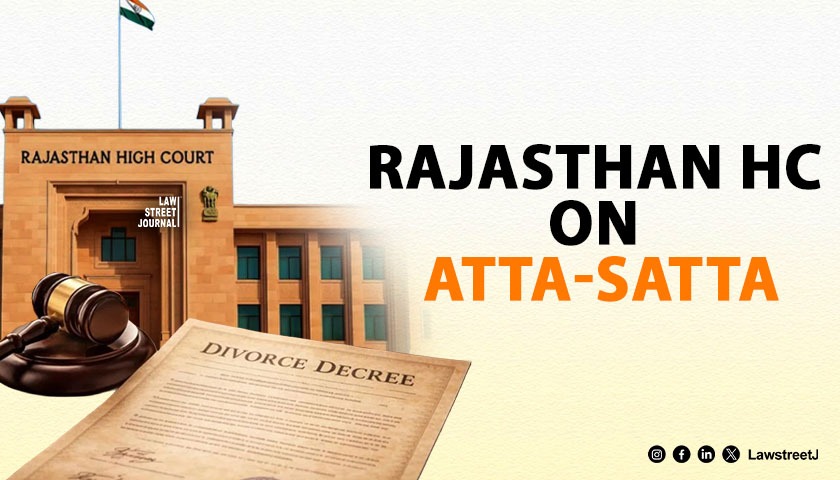
Rajasthan: The Rajasthan High Court at Jodhpur allowed an appeal filed by a wife against the dismissal of her divorce petition, holding that the Family Court had gravely erred in treating her departure from the matrimonial home as voluntary desertion, while also strongly indicting the ‘atta-satta’ system of reciprocal marriage involving minors, in Kiran Bishnoi v. Sunil Kumar, D.B. Civil Miscellaneous Appeal No. 3506/2025. The judgment was delivered on April 10, 2026, by a Division Bench of Justices Arun Monga and Sunil Beniwal.
Background
The marriage between the parties was solemnized on March 31, 2016, in Bikaner under Hindu rites. On the same day, under the atta-satta custom — a reciprocal marriage arrangement in which one family gives a daughter in marriage to another and, in return, takes a daughter from the same family — the respondent-husband’s minor sister, Suman, was also married to the appellant-wife’s brother, Ravindra Bishnoi.
The appellant alleged that from the inception of the marriage, the respondent and his family subjected her to continuous harassment, physical assault, and unlawful demands for additional dowry, including a motorcycle and gold articles. She further alleged denial of her stridhan, sexual assault by her brother-in-law and father-in-law, and that on March 19, 2020, she was forcibly ousted from the matrimonial home along with her minor daughter, whose custody was subsequently restored to her through police intervention. An FIR was registered at Mahila Thana, Bikaner, and a charge-sheet was filed against the respondent and his father under Sections 498-A, 406, 323, and 34 of the IPC.
The respondent denied all allegations of cruelty and dowry demand and attributed the marital discord entirely to the atta-satta arrangement, specifically the refusal of his sister Suman, upon attaining majority, to perform ‘muklawa’ (the ceremony by which a bride formally goes to reside with her husband) and continue the marriage with Ravindra Bishnoi. He alleged that the appellant’s family had exerted pressure on Suman and that the appellant voluntarily left the matrimonial home under family influence.
The Family Court, Bikaner, dismissed the divorce petition by judgment dated September 24, 2025, holding that the primary cause of the appellant’s departure was not cruelty arising from dowry demands but the dispute stemming from the atta-satta arrangement, and that the appellant had voluntarily deserted the respondent.
High Court’s Analysis
The Division Bench held that the Family Court committed a fundamental error by conflating two separate spheres: the dispute arising from the atta-satta custom and the independent statutory standard for determining matrimonial cruelty and desertion. The Court found that the Family Court had improperly assumed, in absolute terms, that an external family disagreement over Suman’s muklawa was the unilateral cause of the marital dispute between the appellant and the respondent.
On the question of desertion, the Bench held that labelling the appellant’s departure as “voluntary” ignored the profound duress that had rendered cohabitation impossible. The Court observed that a woman cannot be expected to maintain marital normalcy after enduring years of sustained emotional isolation and psychological pressure, and that mere shared physical residence does not equate to harmonious cohabitation. The Court further held that many women remain in difficult marriages due to economic dependence, social pressure, children, lack of shelter, fear of stigma, or absence of parental support, and that endurance is often mistaken for consent or condonation.
The Bench also disapproved of the Family Court’s characterisation of the appellant’s legal proceedings, including the petition under Section 125 CrPC and the criminal complaint, as mere attempts to exert “undue pressure.” The Court held that such proceedings were necessary defensive measures to secure basic rights that were otherwise being denied and were symptoms of an abusive environment necessitating legal intervention, not proof of wilful marital misconduct.
On the standard of proof, the Bench held that the Family Court misdirected itself by failing to recognise that matrimonial cruelty is assessed on a preponderance of probabilities and not proof beyond reasonable doubt. The Court further observed that the parties had attempted mediation before the Family Court at Bikaner, which proved futile, and that given the long and continuous separation of over five years, without any genuine effort by the respondent to seek restitution of conjugal rights, the marital bond stood fractured to such an extent that insisting on its continuance would itself amount to perpetuating cruelty.
The Court accordingly set aside the Family Court’s judgment and decree, reversed its findings, and dissolved the marriage under Section 13 of the Hindu Marriage Act, 1955. The appellant, through her counsel, stated during the hearing that she would relinquish all claims to alimony and past, present, and future maintenance. The Court clarified that its observations would not bear upon the pending criminal or custody proceedings between the parties.
Court’s Condemnation of Atta-Satta
Before concluding, the Division Bench delivered extensive observations on the atta-satta custom. The Court held that matrimonial law, built on the principles of consent, adulthood, free will, and dignity, cannot be overridden by custom, and that communities cannot invoke tradition to legitimise what the law prohibits. The Court observed that an atta-satta arrangement involving minors is, in substance, an exchange transaction in human lives, in which children, particularly girls, are used as matrimonial barter and treated as transferable obligations rather than rights-bearing individuals.
The Bench further observed that the atta-satta structure, by tying the fate of one marriage to the compliance of another, is fundamentally unjust, denying individuality and turning marriage into mutual hostage-taking between families. It characterised the system as “gender coercion, child-rights violation, and familial extortion disguised as custom,” and stated that in a constitutional democracy governed by the rule of law, such practices deserve unequivocal social and legal repudiation. The Court also noted that consent given upon attaining majority after coercive childhood conditioning cannot be regarded as free consent.
Case Details: Kiran Bishnoi v. Sunil Kumar, High Court of Judicature for Rajasthan at Jodhpur, D.B. Civil Miscellaneous Appeal No. 3506/2025 [2026:RJ-JD:16834-DB]. Before Justices Arun Monga and Sunil Beniwal. Judgment dated April 10, 2026. Mr. D.K. Gaur appeared for the Appellant. Mr. Nitesh Mathur appeared for the Respondent.



![Supreme Court Collegium approves new Chief Justices for five key High Courts in India [Read Recommendations]](/secure/uploads/2023/12/lj_8000_380d1135-6f3a-4988-a00a-4d5cd5901815.jpg)
!["Consolidate bail pleas in identical FIR cases to ensure consistent judicial decisions": Supreme Court to High Courts [Read Order]](/secure/uploads/2023/12/lj_4845_8d23b142-dc06-4f22-955f-04342d1d5bd2.jpg)