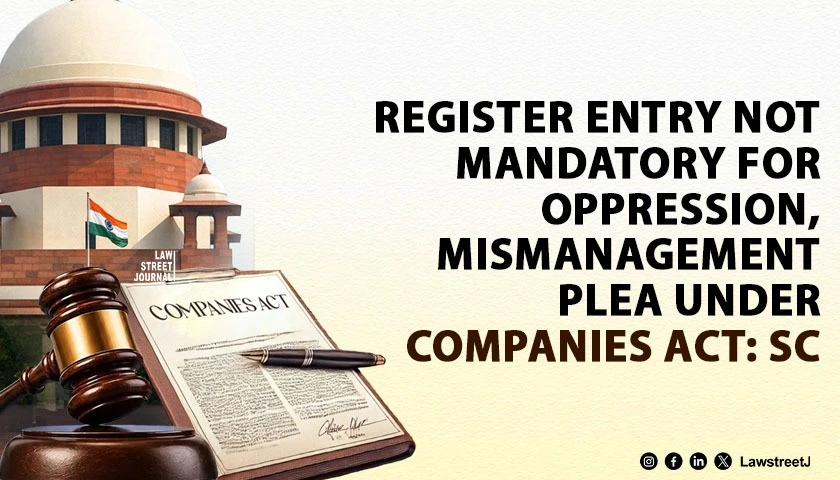
New Delhi: The Supreme Court of India has held that a person can be regarded as a “member” of a company for the purpose of maintaining a petition under Sections 397 and 398 of the Companies Act, 1956, even in the absence of a formal entry of their name in the register of members, if the company’s conduct demonstrates consistent recognition of their proprietary interest.
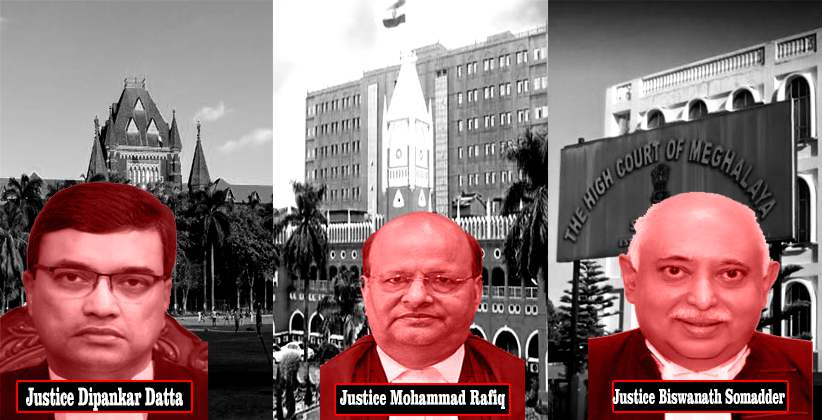
A bench comprising Justice Pamidighantam Sri Narasimha and Justice Alok Aradhe delivered the judgment on 04.05.2026, dismissing two civil appeals filed by Dr. Bais Surgical and Medical Institute Pvt. Ltd. and others against orders of the Company Law Board that had been affirmed by the High Court.
Appellant No. 1, Dr. Bais Surgical and Medical Institute Pvt. Ltd., was incorporated on 14.11.1994. The company operated a hospital which, after encountering financial constraints, was approached by the respondent, Dhananjay Pande, who proposed to infuse funds subject to his appointment as Managing Director and conversion of the hospital into a specialised cardiac facility. Acting on the proposal, Pande was appointed as Managing Director with effect from 01.01.1998 for a period of five years, and the hospital was thereafter converted into a heart institute and rebranded as Ekvira Heart Institute, reflecting the name of Pande’s trading concern.
Pande claimed that at a Board of Directors meeting held on 15.07.1999, 14,75,998 shares were allotted to him against share application money paid by him. This was disputed by the appellants. Disputes subsequently arose between the parties, leading to Pande’s suspension. Conciliation proceedings were held between 27.05.2000 and 29.05.2000, following which the suspension order was withdrawn and Pande withdrew from the day-to-day affairs of the company.
In January 2001, Pande filed a petition under Sections 397 and 398 of the Companies Act, 1956, before the Company Law Board, alleging oppression and mismanagement, with the principal grievance being the failure of the appellants to issue share certificates despite receipt of share application money. The appellants raised a preliminary objection to Pande’s locus standi, contending that he did not qualify as a “member” under Section 399 of the Act. By order dated 02.12.2004, the Company Law Board allowed the petition, treating Pande as a member, and directed the company to either allot shares corresponding to his investment or refund the invested amount with interest.
A second set of proceedings arose from a Board meeting held on 25.12.2004, wherein 14,75,998 shares were allotted to Pande and 60,00,000 shares were allotted to Appellant No. 2 as consideration for transfer of the land and building in which the hospital operated, as a precondition for execution of a Management Agreement with Wockhardt Hospitals Ltd. Pande challenged this allotment on the ground that it was intended to dilute his shareholding from 49 per cent to 15 per cent. By order dated 14.03.2008, the Company Law Board held that the allotment of shares to Appellant No. 2 against transfer of property was oppressive and that the manner in which the Management Agreement with Wockhardt was entered into was improper. The Board directed the appellants or Wockhardt to purchase Pande’s shares, along with interest at 6 per cent per annum from the date of investment.
Both orders of the Company Law Board were affirmed by the High Court. The Supreme Court, by order dated 02.08.2010, directed the appellants to deposit ₹2,59,18,525, inclusive of interest, and admitted both appeals for final hearing.
The principal question before the Supreme Court was whether, in the absence of a formal entry of Pande’s name in the register of members, he could nonetheless be regarded as a “member” so as to invoke the jurisdiction of the Company Law Board under Sections 397 and 398 of the Companies Act, 1956.
Senior Advocate Shyam Mehta, appearing for the appellants, confined his submissions to the question of law relating to the scope of the expression “member” under Sections 397 and 398. He argued that Pande was never a member within the meaning of Section 41 of the Act, as his name was never entered in the register of members, and that the existence of membership constitutes a jurisdictional fact for invoking the provisions relating to oppression and mismanagement. He further argued that Pande had himself instituted civil suits seeking recovery of his investment as a debt, demonstrating that he did not treat the amount as share capital. Reliance was placed on Balkrishan Gupta v. Swadeshi Polytex Ltd., Nanalal Zaver v. Bombay Life Assurance Co. Ltd., and Severn Trent Water Purification Inc. v. Chloro Controls (India) Pvt. Ltd.
Senior Counsel Shailesh Mandiyal and Senior Counsel Haripriya Gopal Shankar, appearing for Pande, submitted that entry in the register of members is a statutory obligation cast upon the company, which the appellants had failed to discharge despite receiving substantial investment and repeated requests. They contended that the appellants could not be permitted to take advantage of their own failure to comply with statutory requirements by invoking a hyper-technical interpretation of the expression “member”, and that the company’s own conduct demonstrated recognition of Pande’s proprietary stake. Reliance was placed on Shri Balaji Textile Mills Pvt. Ltd. v. Ashok Kavle, M/s World Wide Agencies Pvt. Ltd. v. Margarat T. Desor, and Umesh Kumar Baveja v. IL and FS Transportation Network Ltd.
The Court examined the interplay between Section 2(27) and Section 41 of the Companies Act, 1956. It held that Section 2(27) employs language of wide amplitude, subject only to the limited exclusion of a bearer of a share-warrant issued under Section 114, while Section 41 operates in a different sphere and prescribes the recognised modes by which membership may arise. The Court held that the requirement of agreement “in writing” introduced by the Amendment Act of 1960 was intended to ensure reliable proof of consent and to prevent fraudulent inclusion of names in the register, and not to impose entry in the register as the sole or exclusive mode of acquiring membership.
The Court observed that the jurisdiction conferred under Sections 397 and 398 is equitable in character, and that the expression “member” in the context of these provisions must be construed with reference to the wider definitional framework in Section 2(27), and not confined to the technical formulation in Section 41(2). It held that construing the expression in an unduly restrictive or technical manner would frustrate the remedial purpose underlying the legislative scheme for protection of minority shareholders.
Placing reliance on Shri Balaji Textile Mills, World Wide Agencies, and the Delhi High Court’s decision in Umesh Kumar Baveja, the Court affirmed that where substantial funds invested towards acquisition of equity are accepted and reflected in the financial records of the company as share application money, and are utilised for the company’s business, such conduct constitutes strong evidence of recognition of the investor’s proprietary stake.
Applying these principles to the facts, the Court found that the cumulative chain of factual circumstances, including the letter dated 13.02.1998 describing Pande as “co-owner”, the conciliation proceedings acknowledging his entitlement to shareholding, his appointment as Managing Director, the rebranding of the hospital in the name of his trading concern, and the utilisation of his investment for the company’s expansion, demonstrated that Pande was consistently treated as a stakeholder with a proprietary interest in the company.
Finding no reason to take a view different from that adopted by the High Court and the Company Law Board, the Court dismissed both appeals and directed that the amount deposited before it, along with accrued interest, be released in favour of Dhananjay Pande. No order as to costs was made.
Case Details:
- Case Title: Dr. Bais Surgical and Medical Institute Pvt. Ltd. & Ors. v. Dhananjay Pande
- Case Numbers: Civil Appeal No. 8973 of 2010 and Civil Appeal No. 9456 of 2010
- Citation: 2026 INSC 447
- Court: Supreme Court of India
- Bench: Justice Pamidighantam Sri Narasimha and Justice Alok Aradhe
- Date of Judgment: 04.05.2026
Appearances:
- For the Appellants: Senior Advocate Shyam Mehta
- For the Respondent: Senior Counsel Shailesh Mandiyal and Senior Counsel Haripriya Gopal Shankar