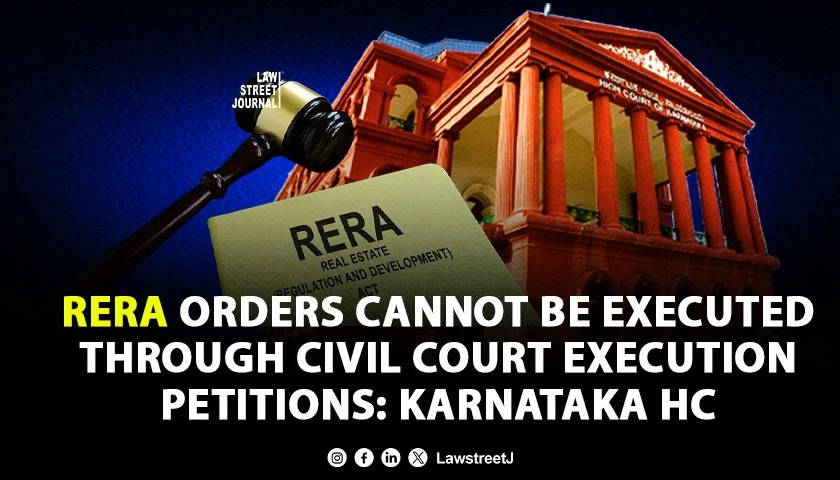
Karnataka: The Karnataka High Court has ruled that orders passed by the Real Estate Regulatory Authority (RERA) or its Appellate Tribunal cannot be executed through execution petitions filed before civil courts, as such orders do not constitute “decrees” within the meaning of the Code of Civil Procedure (CPC).
The court of Justice M. Nagaprasanna delivered the decision while allowing three connected writ petitions filed by Mantri Developer Pvt. Ltd., challenging orders that rejected their applications seeking termination of execution proceedings on the ground of lack of jurisdiction.
The case arose from orders passed by RERA in favour of homebuyers on various dates in 2023. To enforce these orders, the homebuyers approached civil courts by filing execution petitions. The developer then filed applications under Section 47 of the CPC seeking termination of the proceedings, arguing that civil courts lacked jurisdiction to execute RERA orders. When these applications were rejected by the Executing Court, the developer approached the High Court.
The developer argued that the RERA Act is a self-contained code with its own enforcement mechanism. It contended that Section 79 of the RERA Act bars civil courts from entertaining any petition concerning RERA matters, and that Rule 26 of the Karnataka RERA Rules prescribes the manner of implementing orders, thereby making civil court execution proceedings impermissible.
The homebuyers countered that execution petitions were maintainable because RERA orders are “decrees” that can be executed by competent civil courts.
The Court examined the statutory framework of the RERA Act in detail. It noted that Section 40(1) provides that any interest, penalty, or compensation imposed by RERA shall be recoverable “in such manner as may be prescribed as arrears of land revenue.” Section 79 bars civil courts from entertaining any suit or proceeding in respect of matters which RERA is empowered to determine. Rule 26 of the RERA Rules specifies that orders shall be enforced by RERA “in the same manner as if it were a decree,” and only when RERA is unable to execute the order can it be forwarded to the principal civil court.
The Court held that an order passed by RERA cannot, by any stretch of legal interpretation, be equated with a decree so as to invite execution under Order XXI of the CPC. The Act itself prescribes a distinct and self-contained mode of enforcement—recovery as arrears of land revenue from the defaulting promoter or allottee. The Court emphasized that recovery of land revenue cannot be pursued through an execution petition before a civil court; it lies within the province of the jurisdictional Revenue Authority, ordinarily the Tahsildar.
The Court clarified that it is only when there is complete failure, after all efforts to execute the order before the Tahsildar as arrears of land revenue, that the aggrieved party may approach executing courts—and even then, only in exceptional circumstances.
In reaching its conclusion, the Court examined the definition of “decree” under Section 2(2) of the CPC, which requires three essential conditions:
- the adjudication must arise from a suit,
- the suit must start with a plaint and end in a decree, and
- the adjudication must be formal and final by a court.
Proceedings before RERA are initiated on complaints, not plaints, and therefore cannot be termed suits. Consequently, orders passed by RERA or the Appellate Tribunal do not constitute decrees within the meaning of the CPC.
The Court relied on judgments from various High Courts. It cited the Allahabad High Court’s decision in Supertech Limited v. Subrat Sen, which held that RERA orders do not meet the statutory requirements of a decree. The Madhya Pradesh High Court in Khilla Colonizers v. Subhash Jain similarly held that although Section 57 of the RERA Act makes orders executable as decrees, this legal fiction is limited to the specific purpose for which it was created, and does not transform such orders into decrees for appeal or execution proceedings.
The Court also referred to the Supreme Court’s decision in Newtech Promoters and Developers Private Limited v. State of Uttar Pradesh, which recognised that the RERA Act provides an in-built mechanism for enforcement and that amounts determined as refundable are recoverable within the ambit of Section 40(1).
Reviewing judgments from the High Courts of Rajasthan and Calcutta, the Court noted that they uniformly held that orders of the Adjudicating Officer, the Authority, or the Appellate Tribunal under the RERA Act are not decrees within the meaning of Section 2(2) of the CPC.
Setting aside the impugned orders, the Court held that the developer’s applications under Section 47 of the CPC challenging the civil court’s jurisdiction were legally sound. The orders rejecting those applications and holding that civil courts have jurisdiction to entertain execution petitions were contrary to law and warranted interference.
The Court clarified that the respondents would be at liberty to avail such remedies as are available in law—implicitly referring to the enforcement mechanism through revenue authorities as prescribed under the RERA Act.
Case Title: Mantri Developer Pvt. Ltd. v. Snil Pathiyam Veetil and connected cases
[Writ Petition Nos. 17821, 18348 & 19184 of 2025]


![Karnataka High Court: Cabinet Rank Status Not Equivalent to Ministerial Position [Read Order]](/secure/uploads/2023/09/lj_2318_fc1b99b7-aeed-472b-836e-33750bedb394.jpg)


![Woman living in adultery cannot claim maintenance: Karnataka High Court [Read Order]](/secure/uploads/2023/10/lj_3083_Women_living.jpg)