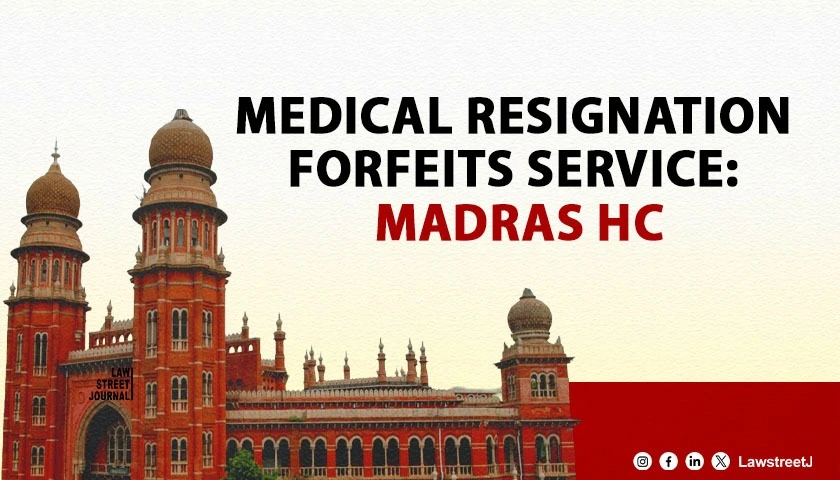
Chennai: A Full Bench of the Madras High Court has settled a legal conundrum by holding that resignation from service, even if tendered on medical or health grounds, entails forfeiture of past service under Rule 23 of the Tamil Nadu Pension Rules, 1978, and cannot be treated as voluntary retirement for pension purposes.
The three-judge Bench comprising Justice S.M. Subramaniam, Justice D. Bharatha Chakravarthy, and Justice C. Kumarappan was constituted to resolve conflicting views expressed by two Division Benches on whether resignation on medical grounds would attract forfeiture of service under Rule 23 of the Tamil Nadu Pension Rules, 1978.
In D. Vijayarangan v. Secretary, Sales Tax Appellate Tribunal and Others [(2009) 3 MLJ 100], a Division Bench had held that resignation on medical grounds should not entail forfeiture of service. However, another Division Bench in A.I. Angel Illangovan v. The Government of Tamil Nadu and Others [2016 (3) CTC 87] took a contrary view without referring to the earlier judgment.
The Full Bench observed that Rule 23 of the Tamil Nadu Pension Rules, 1978, which deals with forfeiture of service on resignation, provides only one exemption—where resignation is with proper permission to take up another temporary or permanent appointment under the Government where service qualifies. The Court noted that the Rule is conspicuously silent on resignation due to ill health.
Applying the literal rule of interpretation, the Court held that when the language of a statute is clear and unambiguous, no new words or legislative meaning can be added to it. The Court invoked the Latin maxim “Absoluta sententia expositore non indiget”—an absolute judgment or sentence needs no expositor—emphasising that when the language of law is clear, no interpretation is required.
The Court observed that the Tamil Nadu Pension Rules contain specific provisions for medical grounds, particularly Rule 36, which deals with invalid pension granted to a government servant who is permanently incapacitated for public service by physical or mental infirmity. The Court held that when there is a specific provision designed to deal with a particular instance, there is no compelling need to forcefully read it into another provision contemplating a different situation.
Relying on the recent Supreme Court judgment in Independent Sugar Corporation Ltd. v. Girish Sriram Juneja [2025 INSC 124], the Full Bench reiterated that the intent of the legislature must be gathered from the words used in the statute, and courts should avoid assuming that the legislature committed a mistake in using or omitting certain words.
The Court further relied on the Supreme Court judgment in Kanchana Rai v. Geeta Sharma [2026 INSC 54], which emphasised that where a provision is clear and unambiguous, it must be interpreted literally unless such interpretation conflicts with the purpose of the Act or leads to impractical results.
The Full Bench also examined Section 49 of the Tamil Nadu Government Servants (Conditions of Service) Act, 2016, and Rule 41 of the erstwhile Tamil Nadu State and Subordinate Service Rules, both of which clearly stipulate that resignation entails forfeiture not only of service in the particular post but of all previous service under the Government.
Emphasising the distinction between resignation and voluntary retirement, the Court cited the three-judge Bench decision of the Supreme Court in Senior Divisional Manager, LIC & Ors. v. Shree Lal Meena [(2019) 4 SCC 479], which held that in service jurisprudence, the expressions “superannuation”, “voluntary retirement”, “compulsory retirement”, and “resignation” convey different connotations and operate differently. The Court noted that voluntary retirement is a concept created by statutory provisions, whereas resignation is the unilateral determination of the employer–employee relationship.
The Court held that an employee, on entering service, is fully aware of the consequences of resignation as provided under the Act and Rules. After resignation, such an employee cannot turn around and claim pensionary benefits on medical grounds, as it would amount to approbation and reprobation, which is impermissible in law.
The Full Bench answered the reference as follows:
- Resignation from service or post under Rule 23 of the Tamil Nadu Pension Rules, 1978, entails forfeiture of past service. Therefore, resignation from service even on medical or health grounds entails forfeiture of past service.
- The grounds on which resignation is sought are immaterial, and resignation shall only mean forfeiture of past service.
- There is a valid distinction between “resignation” and “voluntary retirement” as held by the Supreme Court. Therefore, resignation from service cannot be treated as voluntary retirement.
The Full Bench declared that the principle laid down in D. Vijayarangan v. Secretary, Sales Tax Appellate Tribunal and Others (supra) is bad in law and upheld the view taken in A.I. Angel Illangovan v. The Government of Tamil Nadu (supra).
Appearances:
For Petitioner (WP No. 39583/2015): Mrs. S. Nagashyla
For Respondents (WP No. 39583/2015): Mr. K.H. Ravikumar, Government Advocate for R1–R3; no appearance for R4
For Petitioner (WP No. 26986/2011): Mr. Krishna Ravindran
For Respondents (WP No. 26986/2011): Mr. R. Sivakumar for Mr. S. Manikandan, Standing Counsel for R1 & R2; Mr. V. Vijay Shankar, Standing Counsel for R3
Case Title:
D. Kaliyamoorthy v. State of Tamil Nadu & Ors. and
Dr. G. Krishnamohan v. The Registrar, Tamil Nadu Agricultural University & Ors.



![TN Medical Council declares change of gender identity of LGBTQIA+ as misconduct [Read Notification]](/secure/uploads/2022/12/lj_5268_5cebb05a-97fb-40fb-8045-25cdf8f4207a.jpg)
![Madras High Court Directs Tamil Nadu Government to Ensure Quota for Transgenders in Local Body Elections [Read Order]](/secure/uploads/2023/08/lj_2507_7a03d113-08b1-4670-b6fb-9058aee481d0.jpg)
![Anti Corruption sleuths acted like "puppets in The Muppet Show", HC notice to ex TN CM in disproportionate assets case [Read Order]](/secure/uploads/2023/09/lj_8675_7b37fc02-1b2d-4f4a-9816-3df20545b37e.jpg)