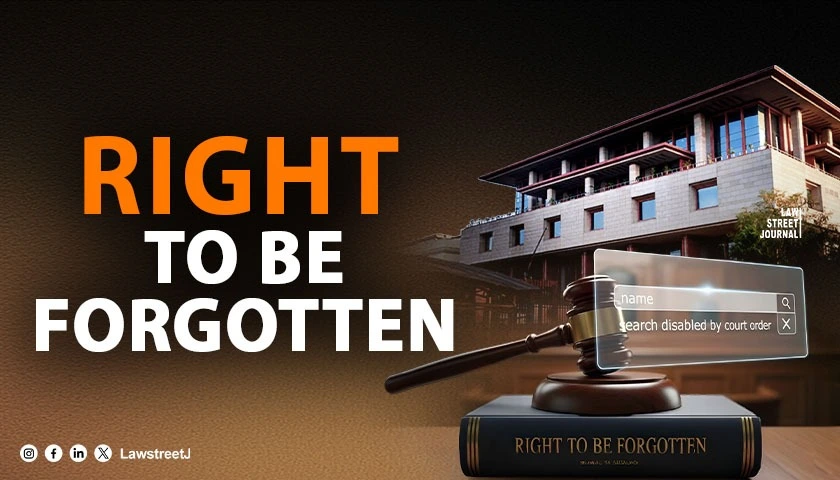
New Delhi: The Delhi High Court has recognised the right to be forgotten as an integral facet of the fundamental right to privacy under Article 21 of the Constitution, holding that individuals may seek the removal or masking of personal information from online judicial records where continued accessibility causes disproportionate harm to their privacy, dignity, and reputation.
Justice Sachin Datta, while deciding a batch of petitions seeking de-indexing, de-linking, or removal of content from the internet, laid down a detailed framework governing requests for the masking or removal of personal information from online judicial records.
“The right to be forgotten thus reflects the evolution of privacy in response to the permanence of online information. In a society where digital records are virtually indelible, the ability to seek erasure ensures that informational self-determination remains effective. It protects individuals from perpetual exposure to past events that may no longer bear relevance, while preserving their dignity and autonomy in society,” the Court observed.
Background:
The Court examined petitions filed by a diverse group of individuals, including persons acquitted of criminal charges, parties to matrimonial disputes, and individuals whose names appeared incidentally in court proceedings. Many petitioners argued that online search results linking their names to past legal disputes continued to adversely affect their professional and personal lives despite the proceedings having concluded in their favour.
Relief was sought not only against news publications but also against legal databases such as Indian Kanoon, which publishes court orders. The petitioners sought directions requiring such platforms to mask the names of parties so that they would not appear in search results.
Framework Laid Down by the Court:
The Court held that masking should protect privacy without compromising the integrity of judicial records. Under the framework, only names and personal identifiers would be concealed, while the judgment’s reasoning, findings, and legal conclusions would remain publicly accessible.
Unredacted versions of judgments would continue to be preserved in court records and remain available to courts, parties, and authorities for legitimate legal purposes. Masking orders would apply to both existing and future digital versions of judgments.
Once a court issues a masking order, search engines and legal databases must de-index the judgment from name-based searches. Judicial forums may also review or revoke such orders if circumstances change. Applications must be decided promptly, given the continuing harm caused by the online disclosure of personal information.
Case Details
- Court: High Court of Delhi
- Judge: Justice Sachin Datta
- Date of Judgment: June 1, 2026

![Delhi High Court Sets Aside Arbitral Tribunal's Award Against NHAI in Highway Project Delay Case [Read Judgment]](/secure/uploads/2023/07/lj_9605_23374c2e-392c-4491-a2fe-f2f12fc5272f.jpg)
![Delhi Court Rejects Stay Request in Defamation Case Against Rajasthan CM Ashok Gehlot [Read Order]](/secure/uploads/2023/08/lj_5208_80de1ddc-d76a-4f7f-b180-408e3ae14fb4.jpg)