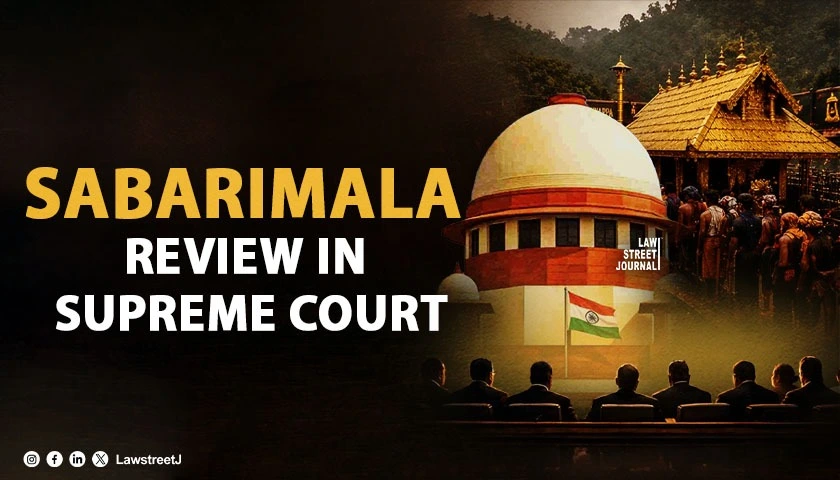
New Delhi: A nine-judge Constitution Bench of the Supreme Court of India commenced hearings in the Sabarimala review reference, revisiting foundational constitutional questions on religious freedom, denominational rights, and the scope of judicial review under Articles 25 and 26 of the Constitution.
The Bench, led by Chief Justice Surya Kant and comprising Justices B.V. Nagarathna, M.M. Sundresh, Ahsanuddin Amanullah, Aravind Kumar, A.G. Masih, P.B. Varale, R. Mahadevan, and Joymalya Bagchi, is examining issues arising from the 2018 decision permitting entry of women of all ages into the Sabarimala temple.
Union Challenges Essential Religious Practices Doctrine
Appearing for the Union government, Solicitor General Tushar Mehta urged the Court to reconsider the Essential Religious Practices (ERP) doctrine. He relied on the decision in Commissioner, Hindu Religious Endowments, Madras v. Sri Lakshmindra Thirtha Swamiar of Sri Shirur Mutt (1954) to argue that the determination of what constitutes religion must be left to the religion itself.
He submitted that subsequent jurisprudence, particularly Durgah Committee v. Syed Hussain Ali (1961), marked a departure by allowing courts to assess whether a practice is “essential,” thereby drawing the judiciary into questions of faith.
Mehta contended that courts cannot determine essentiality unless they reach a level of “spiritual supremacy,” though he clarified that courts may still examine the existence of a practice.
Interplay of Articles 25 and 26
The Bench is considering multiple constitutional questions, including the scope of judicial review over religious practices, the meaning of “morality” under Articles 25 and 26, and the relationship between individual religious freedom and denominational rights.
Mehta argued that Article 26 protects not only religious denominations but also “any section thereof,” extending constitutional safeguards to sub-groups within religions. He further submitted that denominational character does not depend on exclusivity of access, asserting that participation by persons of different faiths does not dilute the identity of a religious institution.
Relying on Sri Venkataramana Devaru v. State of Mysore (1957), he argued that Article 25(2)(b), which enables social reform, permits limited intervention—such as opening temples to all classes of Hindus—but does not subordinate denominational rights entirely.
Constituent Assembly Debates and Scope of Reform
Referring to Constituent Assembly Debates, Mehta argued that Article 25(2)(b) was intended to address caste-based exclusion and cannot be extended to gender-based claims. He submitted that the phrase “all persons are equally entitled” emerged in the context of communal tensions rather than gender equality.
He further objected to the application of Article 17 (abolition of untouchability) to gender-based exclusion, arguing that the provision is historically rooted in caste discrimination.
Justice B.V. Nagarathna observed that untouchability has a distinct social context and cannot be extended to temporary or biological conditions.
Constitutional Morality Under Scrutiny
On the second day of hearings, Mehta argued that “constitutional morality” is not a ground for judicial review in matters of religion. He submitted that courts cannot determine whether a religious practice is “superstitious,” asserting that such determinations fall within the legislative domain.
The Bench, however, raised concerns. Justice Ahsanuddin Amanullah observed that courts retain jurisdiction to examine whether a practice is superstitious, while Chief Justice Surya Kant noted that practices that “shock the conscience” may still be tested against public order, morality, and health.
Justice Joymalya Bagchi also questioned whether harmful practices could escape scrutiny if shielded as essential religious practices.
Critique of Judicial Trends
Mehta also criticised the reliance on doctrines such as “transformative constitutionalism” in prior judgments, including Navtej Singh Johar v. Union of India (2018) and Joseph Shine v. Union of India (2018), arguing that constitutional morality had been expanded beyond its original context.
He questioned the use of foreign academic material in judicial reasoning, contending that such sources cannot constitute binding law under Article 141.
The Bench clarified that such materials represent viewpoints rather than binding precedent.
Maintainability of Petitions
The Bench also examined the maintainability of the original Sabarimala petitions. Justice B.V. Nagarathna questioned whether non-devotees could challenge religious practices, noting that the original petitioner was the Indian Young Lawyers Association.
Mehta supported this concern, describing the case as one involving a “silent majority” and a “vocal minority.” However, Chief Justice Surya Kant noted that safeguards in public interest litigation jurisdiction have evolved, with courts scrutinising the bona fides of petitions before issuing notice.
Day 3: “Sampradaya,” Denominational Rights, and Judicial Limits
On the third day, Additional Solicitor General K.M. Nataraj continued the Union’s submissions, focusing on the structure of religious rights under Articles 25 and 26.
He described these provisions as a “three-tier mechanism” comprising individual rights, regulatory power, and denominational rights. He argued that denominational rights are rooted in collective belief and must be understood in the Indian context as “sampradaya.”
The Bench emphasised that courts may still adjudicate disputes where the existence or content of a practice is contested.
Public Morality vs Constitutional Morality
Nataraj reiterated that “public morality,” rather than constitutional morality, is the relevant standard under Articles 25 and 26. Supporting this position, Additional Solicitor General Vikramjit Banerjee argued that the term “morality” corresponds to “sadachar” in the Hindi text of the Constitution.
Denominational Autonomy and Limits of Reform
Senior Advocate C.S. Vaidyanathan, appearing for the Nair Service Society, argued that Article 26(b) is a substantive right that cannot be controlled by Article 25(2)(b). He submitted that the latter is an enabling provision intended for specific social reforms, particularly caste-based exclusion.
He further argued that the Essential Religious Practices doctrine has been expanded beyond its original scope, leading courts into impermissible evaluation of religious practices.
The Bench, however, indicated that conflicts between individual rights and denominational practices may still require judicial resolution.
Proceedings to Continue
The Constitution Bench is scheduled to continue hearing the matter, with arguments focusing on the balance between religious autonomy, individual rights, and the scope of judicial intervention in matters of faith.
Case Details
- Case: Sabarimala Review Reference
- Court: Supreme Court of India
- Bench: CJI Surya Kant; Justices B.V. Nagarathna, M.M. Sundresh, Ahsanuddin Amanullah, Aravind Kumar, A.G. Masih, P.B. Varale, R. Mahadevan, Joymalya Bagchi
- Key Issues: Scope of Articles 25 & 26; Essential Religious Practices doctrine; Constitutional morality; Denominational rights
- Union Representation: Solicitor General Tushar Mehta; ASG K.M. Nataraj; ASG Vikramjit Banerjee
- Other Appearance: Senior Advocate C.S. Vaidyanathan (for Nair Service Society)
- Status: Hearing ongoing