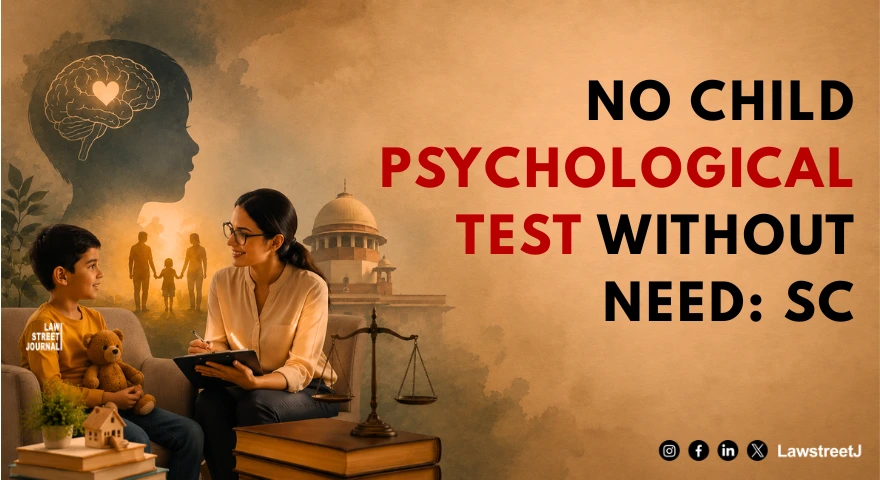
The Supreme Court has held that children caught in parental custody disputes cannot be subjected to psychological evaluation unless it is absolutely necessary, and has issued detailed guidelines directing family courts to first assess the psychological condition of the parents before considering any evaluation of the child.
A bench comprising Justice Sanjay Karol and Justice N. Kotiswar Singh pronounced the ruling on June 11, 2026, in an appeal challenging orders passed by the Bombay High Court directing the psychological evaluation of a minor in a custody dispute. The top court modified the High Court’s orders dated April 27, 2023 and December 7, 2023, and remitted the matter to the family court for fresh consideration in light of the guidelines now laid down.
Background
The case arose from a custody dispute in which the Bombay High Court had directed the psychological evaluation of a minor child and constitution of a panel of experts to evaluate both the child and the parents, with the stated objective of facilitating restoration of contact between the father and the minor. The matter was carried to the Supreme Court by way of a special leave petition challenging these directions.
The Supreme Court, exercising its jurisdiction as parens patriae, took note of the complex psychological challenges faced by children caught in parental disputes, drawing on expert material including a report by the National Institute of Mental Health and Neurosciences (NIMHANS) and the Department of Child and Adolescent Psychiatry. The reports highlighted that such children commonly experience strained parent-child relationships, parental conflict, mental health concerns, maladjustment, school-related difficulties, and instances of malicious conduct by parents.
“Such studies reflect both the mental health of children involved in parental disputes and the psychological condition of the disputing parents, providing an important backdrop for judicial decision-making.”
Guidelines Issued By The Court
The bench stressed that psychological evaluation of children in custody proceedings must be used sparingly and only when strictly necessary. The Court laid down the following guidelines:
Parents to be assessed first. Family Courts must first appoint a psychologist to assess the psychological condition of both parents, particularly the parent having present custody of the child, before deciding whether any psychological assessment of the child is required at all. The Court was unequivocal:
“Family Courts must first appoint a psychologist to assess the psychological condition of both parents, particularly the parent having present custody of the child, before deciding whether any psychological assessment of the child is required.”
Child’s evaluation only if necessary. If the family court, based on the psychologist’s report on the parents, finds that assessment of the child is unnecessary or undesirable, no such evaluation shall be conducted. The Court directed:
“No psychological assessment of the child should be conducted if the Family Court, based on the psychologist’s report, finds such assessment unnecessary or undesirable.”
Independent child psychologist. Where evaluation of the child is found necessary, it must be conducted by an independent child psychologist. Such evaluation must be carried out in consultation with any psychologist already treating the child, and must involve minimal interaction so as not to disturb the child’s mental condition.
Evolving psychological needs of the child. Courts must remain mindful that a child’s psychological needs change with age and may require periodic review and reassessment. The Court directed:
“Family Courts must remain conscious that a child’s psychological needs change with age and may require periodic review and assessment.”
Parental alienation and false memory. Family courts must examine concerns such as parental alienation and the risk of false memory creation, and must ensure that the child is not exposed to influences that may foster such tendencies.
POCSO proceedings to be disclosed. Parties must apprise the family court of the status of any proceedings pending under the Protection of Children from Sexual Offences Act (POCSO Act) against either party, as those proceedings may significantly affect decisions concerning visitation and custody rights. The Court directed:
“Parties must apprise the family court of the status of proceedings pending under the POCSO Act against the respondent, as those proceedings may significantly affect decisions concerning visitation and custody rights.”
Court’s Reasoning
Emphasising its role as parens patriae, the Court observed that custody and visitation disputes involving children are inherently dynamic in nature and constitute a continuing cause of action. It clarified that parents retain the liberty to seek modification of custody or visitation arrangements at any time as circumstances change, reinforcing the principle that the welfare of the child is the paramount consideration in all such proceedings.
The Court underscored that psychological evaluation of a child is an intrusive process that carries the potential to cause harm if not warranted by the circumstances, and that family courts must exercise caution before directing such an exercise. The requirement of assessing the parents first is intended to serve as a necessary filter, ensuring that the child is put through the process only as a last resort.
Directions
The Supreme Court modified the Bombay High Court’s orders of April 27, 2023 and December 7, 2023, and remitted the case to the family court for a fresh consideration in accordance with the guidelines now laid down. The detailed judgment is awaited.
Case Details
Court: Supreme Court of India
Bench: Justice Sanjay Karol and Justice N. Kotiswar Singh
Date of Judgment: June 11, 2026
High Court Orders Modified: Bombay High Court orders dated April 27, 2023 and December 7, 2023